Summary
Understanding the Distinction Helps managers stay focused on what matters, making training more relevant and engaging.
1) Process Orientation — “How we do the work.”
Definition
A process-oriented approach focuses on the methods, steps, standards, and consistency used to produce an outcome. Success is measured by adherence to the process, quality of execution, and continuous improvement.
What it emphasizes
- Standard operating procedures (SOPs). That’s the way we’ve always done it.”
- Checklists, controls, compliance
- Repeatability and reliability
- Risk reduction and defect prevention
- Learning and incremental improvement
Typical metrics
- Cycle time/throughput time
- Defect rate/error rate/rework
- Process compliance rate
- On-time completion of steps
- Variation reduction (stability)
- Pleasing the boss
Strengths
✅ Predictable, scalable performance
✅ Better quality control and risk management
✅ Easier onboarding and training
✅ Prevents “hero culture” and chaos
Weaknesses (when overdone)
⚠️ Can become bureaucratic
⚠️ Can reward “checking boxes” instead of Impact
⚠️ Slower adaptation if processes become rigid
Example
A mortgage operations team tracks whether every file follows a documented checklist (documents collected, disclosures sent on time, underwriting conditions cleared in sequence). Even if one file closes, the priority is consistent file quality and fewer “fire drills.”
2) Results Orientation — “What we achieve.”
Definition
A results-oriented approach centers on outcomes and measurable Impact, motivating your team and energizing them through their achievements.
What it emphasizes
- Key Performance Indicators (KPIs), quotas, Objectives, and Key Results (OKRs), targets
- Output and Impact
- Accountability for outcomes
- Speed, initiative, ownership
- Autonomy (choose the best path)
Typical metrics
- Revenue/profit/margin
- Units shipped / projects delivered
- Customer acquisition/retention
- Market share/growth rate
- OKR attainment, deadline completion
Strengths
✅ Drives performance and urgency
✅ Encourages innovation and initiative
✅ Reduces “busy work” and perfection paralysis
✅ Good for competitive, dynamic environments
Weaknesses (when overdone)
⚠️ Can incentivize corner-cutting
⚠️ Can raise compliance/quality risk
⚠️ Can cause burnout (“whatever it takes”)
⚠️ Can hide fragility (results look good until something breaks)
Example
A sales team is rewarded primarily for closed volume. They might find creative ways to hit targets—but if unchecked, they could create downstream problems (bad fits, churn, compliance misses).
3) The cleanest way to remember it
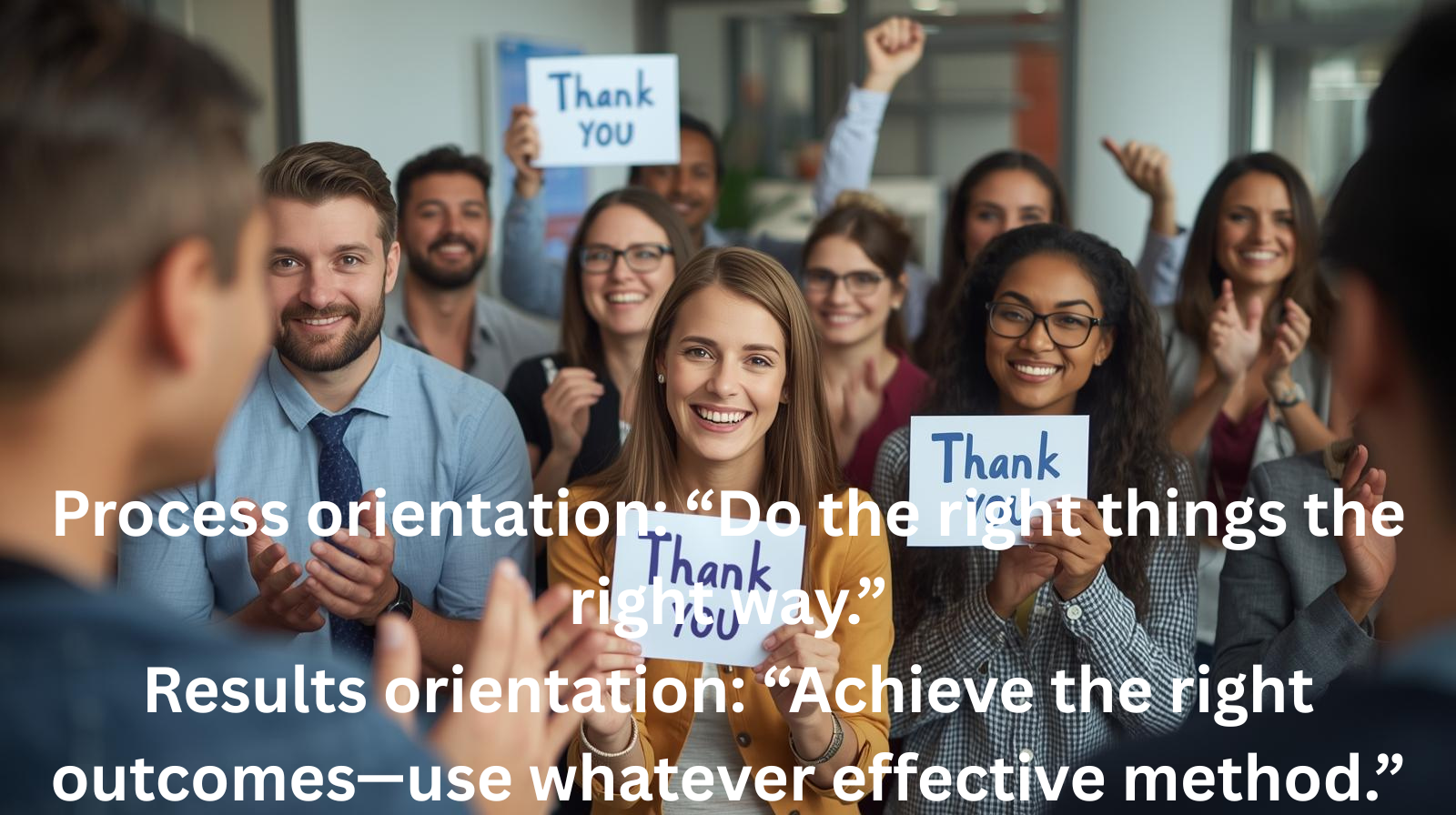
- Process orientation: “Do the right things the right way.”
- Results orientation: “Achieve the right outcomes—use whatever effective method.”
4) When each is most appropriate
Choose more process orientation when:
- Safety, compliance, or legal exposure is high (healthcare, finance, aviation)
- Quality and consistency matter more than speed
- Work must be repeatable and scalable
- You’re training new staff or standardizing performance
Choose a more results-oriented approach when:
- Goals are clear and measurable
- Environment changes quickly (startups, competitive sales)
- Innovation and speed matter
- Teams are experienced and can self-manage
5) The best teams use both (the “guardrails + freedom” model)
In business, guardrails are boundaries, rules, or metrics that guide decisions and actions, keeping an organization aligned with its core goals while preventing it from going off track into risky or unintended territory
A high-performing culture often sets:
- Non-negotiable processes (guardrails): compliance, safety, ethics, minimum quality standards
- Results ownership (freedom): teams choose tactics to hit goals within guardrails
Example hybrid rule:
“You can do it your way—as long as you meet compliance, maintain quality thresholds, and hit the deadline.”
6) Common failure modes
Process-heavy failure:
- People follow steps perfectly… but the customer outcome suffers.
- “We complied with the procedure” becomes an excuse.
Results-heavy failure:
- People hit numbers… but quality, reputation, or risk exposure worsens.
- Success becomes unsustainable.
Quick self-check question
If someone on your team is praised, is it more often because they:
- “Followed the process correctly and improved it” (process orientation), or
- “Hit the target / delivered the outcome” (results orientation)?
Helpful follow-up
Shifting from process orientation (“did we follow the steps?”) to results orientation (“did we achieve the outcome?”) is mainly a management system change—not a motivational speech. If you don’t redesign goals, measures, incentives, decision rights, and feedback loops, people will keep optimizing for compliance and activity.
Below is a practical playbook that works in most organizations (especially operations-heavy environments like finance, compliance, healthcare, and regulated services).
1) Start with the outcome (not the tasks)
Define outcomes in plain language
Replace “complete X steps” with “deliver Y outcome for Z customer.”
Examples
- Process: “Make 50 calls/day.”
- Results: “Book 8 qualified appointments/week that meet criteria A/B/C.”
- Process: “Submit the underwriting checklist fully.”
- Results: “Close 20 loans/month with ≤1 post-close defect per file.”
Use “So that…” translation.
Take each process KPI and translate:
“We do [process] so that we achieve [result].”
If you can’t name the “so that,” the process is probably legacy or busywork.
2) Pick 3–5 “North Star” metrics (and stop measuring everything)
Results orientation fails when you drown people in metrics. Choose a small set that reflects business health.
Common “North Stars”
- Revenue / gross margin
- On-time delivery/cycle time (end-to-end)
- Customer retention / NPS / complaint rate
- Quality (defects, rework, post-close findings)
- Risk/compliance thresholds (guardrails)
Rule of thumb
- 3–5 lagging outcome metrics (what you ultimately want)
- 5–10 leading indicators (predict outcomes)
- A few non-negotiable guardrails (compliance/safety)
3) Keep the best processes—but demote them to guardrails or leading indicators
Going “results-only” can incentivize corner-cutting. Instead:
Reclassify processes into three buckets
· Non-negotiables (guardrails): legal, safety, ethics, core compliance
· Best practices: recommended default approach
· Optional/retire: low value, redundant, legacy controls
Then communicate clearly:
“You have freedom in how you get results—as long as guardrails are met.”
4) Replace activity targets with “definition of done” + quality criteria
A results culture still needs clarity. Define what counts as success:
Use a simple “Outcome Spec.”
- Outcome: What must be true at the end?
- Quality: What standards must it meet?
- Time: When is it due?
- Customer: Who approves/benefits?
- Constraints: Budget/compliance rules
Example
Outcome: Deliver weekly pipeline report that guides staffing decisions.
Quality: Includes pull-through rate, cycle time, fallout reasons, and the top 3 blockers with owners.
Time: Every Monday at 9:00 a.m.
Customer: VP Ops + Sales Leader.
Constraints: Data must reconcile to LOS totals; no Borrower PII in shared version.
5) Change incentives and performance reviews (or nothing changes)
If people are rewarded for process compliance, they’ll keep optimizing for it.
Adjust evaluation weights (typical transition)
- Before: 70% process, 30% outcomes
- Transition: 50% outcomes, 30% leading indicators, 20% guardrails
- Mature: 70% outcomes, 20% leading indicators, 10% guardrails (industry-dependent)
Important: guardrails should be binary where possible: pass/fail, not a “nice-to-have.”
6) Give decision rights (autonomy) alongside accountability
Results orientation requires people to make choices. If every decision escalates, you’ll get paralysis.
Use a “decision rights” map (quick version)
- D: Decide
- I: Input
- A: Approve
- E: Execute
Assign these for recurring decisions (pricing exceptions, priority shifts, vendor selection, rework approvals).
7) Shorten feedback loops: weekly outcomes > monthly post-mortems
Process cultures often “audit later.” Results cultures learn fast.
Implement a weekly cadence.
- Scoreboard: 10 minutes (North Stars + leading indicators)
- Blockers: 15 minutes (top 3 constraints)
- Commitments: 10 minutes (who will do what by when)
- Learning: 5 minutes (one improvement to test)
This is how you keep results focused without chaos.
8) Run “freedom experiments” (pilot autonomy in controlled areas)
Don’t flip the whole org at once. Pilot with one team or one workflow.
A safe pilot approach
- Pick a process-heavy area with clear outcomes (e.g., “reduce cycle time”)
- Keep guardrails (compliance/quality thresholds)
- Allowthe team to modify steps for 30 days
- Track outcomes vs baseline
- Keep what works; standardize the new best practice
This builds trust and proves the shift is real.
9) Teach managers to coach outcomes, not police steps
Managers in process cultures often function as compliance enforcers. You need them to become outcome coaches.
Replace “Did you do X?” with:
- “What outcome are you driving this week?”
- “What’s the constraint?”
- “What would you try if approval wasn’t required?”
- “What’s the smallest test we can run by Friday?”
10) Watch for predictable failure modes (and fix them fast)
Failure Mode A: “Results at any cost.”
Fix: make guardrails explicit, audit risk indicators, and protect quality metrics.
Failure Mode B: “Confusing outcomes with vanity metrics.”
Fix: tie metrics to business value (profit, retention, risk, customer Impact).
Failure Mode C: “Too many KPIs.”
Fix: cut 50%. If it’s not used to make a decision, it’s noise.
Failure Mode D: “No authority but full accountability.”
Fix: align decision rights, or you’ll get cynicism and burnout.
A practical 30–60–90-day transition plan
Days 0–30: Define results + scoreboard
- Choose North Star outcomes
- Define guardrails
- Build a simple weekly scoreboard
- Stop tracking at least 20–30% of low-value activity metrics
Days 31–60: Align incentives + decision rights
- Update performance expectations and review templates
- Map decision rights for key recurring decisions
- Launch 1–2 autonomy pilots
Days 61–90: Standardize what works
- Convert winning pilot practices into “best practices.”
- Train managers on outcome coaching
- Tighten feedback loops (weekly reviews, fast experiments)
Defining guardrails clearly is the difference between “freedom with accountability” and “chaos (or bureaucracy).” The goal is to make boundaries so explicit that a frontline person can make quick decisions without guessing—and still protect compliance, quality, brand, and margin.
Below is a practical, field-tested approach to defining guardrails that are unambiguous, measurable, enforceable, and coachable.
What “guardrails” are (in one sentence)
Guardrails are non-negotiable constraints that define what must never be violated in pursuit of results.
They are minimum standards + hard limits—not “best practices.”
The 6 qualities of a good guardrail (use this checklist)
A guardrail is “clear” when it is:
· Binary or thresholded
· “Must / must not” or “≤ / ≥” (not vague like “be careful”)
· Measurable + auditable
· Someone can prove compliance with data or evidence
· Owned
· A specific role is accountable for defining and updating it
· Actionable
· Tells people what to do if they hit the boundary (escalate, pause, log exception)
· Risk-based
· Exists because the downside is material (legal, financial, safety, reputational)
· Few enough to remember
· Typically 5–12 per team/workstream (otherwise it becomes a process manual)
A simple “Guardrail Spec” (copy/paste template)
Use this format so every guardrail reads the same:
GUARDRAIL NAME:
Intent (why it exists):
Rule (plain language):
Threshold (numbers or pass/fail):
Measurement (how we check):
Frequency (real-time/daily/weekly / per transaction):
Owner (role):
Escalation path (who/when):
Exception policy (allowed? who approves? how recorded?):
Consequence (what happens if violated):
ExaOKles (2 OKOK 2 NOT OK):
Show more lines
This eliminates 90% of ambiguity.
The 5 core categories of guardrails (most orgs need all)
1) Legal / Compliance
- Regulations, licensing, recordkeeping, disclosures, and advertising rules
- Usually, “hard stop” guardrails
2) Risk / Safety / Security (incl. Privacy)
- Data handling, access control, safety protocols
- Often, a real-time monitoring + incident response
3) Quality / Customer Harm
- Defect caps, service level floors, complaint thresholds
- Prevents “hit numbers by breaking the product.”
4) Financial / Margin
- Pricing floors, approval required for discounts, and spend caps
- Protects unit economics
5) Brand / Ethics
- Claims you will not make, channels you will not use, and conduct rules
- Keeps trust intact
How to write guardrails so they can’t be misunderstood
Step 1: Replace adjectives with numbers
Vague → Clear
- “Respond quickly” → “Respond within 4 business hours for Tier 1 issues.”
- “Maintain quality” → “Post-close defect rate ≤ 1.0% month.l..y.”
- “Don’t spam” → “No more than 1 promotional message/day per contact; unsubscribe honored immediately.”
Step 2: Use “Stop / Slow / Go” language
- STOP: prohibited; system should block if possible
- SLOW: allowed only with approval (exception workflow)
- GO: safe zone—team can act autonomously
Example:
- STOP: Send SMS without documented consent
- SLOW: Send >2 messages/week to the same user segment without marketing approval
- GO: Send transactional alerts (opted-in) within template library
Step 3: Define the “edge case”
Every guardrail should answer:
“What happens when we’re right at the line?”
Good guardrails include:
- an escalation path
- an exception policy
- a logging requirement
Make guardrails enforceable (not just words)
Best practice hierarchy:
· Automate enforcement (system blocks prohibited actions)
· Real-time alerts (flag risk as it happens)
· Sampling audits (post hoc detection)
· Training + attestation (last line of defense)
If a guardrail is essential and frequently violated, it’s usually because it’s not automated or not measurable.
Examples (tailored to your likely worlds)
A) Mortgage/lending operations guardrails (illustrative)
Guardrail: Compliance completeness
- Rule: “No file may be submitted to underwriting without required disclosures sent and acknowledged where applicable.”
- Threshold: Pass/fail checklist items A, B, C
- Measurement: LOS audit trail
- Escalation: Ops Manager approves the exception with a documented reason
- Consequence: Submission blocked or flagged; retraining if repeated
Guardrail: Quality floor
- Threshold: “Post-close defects ≤ 1 per 20 files per month.”
- If exceeded: root-cause review within 5 business days; corrective action
Guardrail: Turn time
- Customer harm guardrail: “Borrower updates at least every 7 days when conditions are outstanding.”
- Measurement: CRM/LOS note timestamp
B) Mass texting/mass email platform guardrails (illustrative)
Guardrail: Consent
- STOP: “No SMS marketing messages without a verifiable opt-in record.”
- Measurement: consent object stored (timestamp, source, wording)
- Automated: block sends if consent is missing
Guardrail: Unsubscribe
- STOP: “Opt-out must be processed immediately; no further marketing sends.”
- Measurement: suppression list enforcement; audit logs
Guardrail: Deliverability/reputation protection
- Threshold: “Hard bounce rate ≤ 2% per campaign; complaint rate ≤ 0.1%”
- Escalation: if exceeded, pause sending + list hygiene required before next campaign
Guardrail: Data privacy
- STOP: “No PII in message body beyond last 4 digits; no SSNs; no medical details.”
- Automated: content scanning + policy warnings
The “Guardrails Workshop” (60 minutes, highly effective)
If you’re converting a team from process to results, do this once per quarter:
· List the top 10 failure modes (ways outcomes are achieved badly)
· Rank by Impact × likelihood
· For the top 5, write guardrails using the Guardrail Spec
· Add “Stop / Slow / Go.”
· Decide enforcement method (block/alert/audit)
· Train with 5 real scenarios + edge cases
Quick tests to see if your guardrails are clear enough
Ask any team Member:
· “Can you state the rule in one sentence?”
· “What number triggers escalation?”
· “Who do you call when you hit it?”
· “What’s an exOKe of okaOK not okay?”
If they can’t answer in 30 seconds, the guardrail is not yet clear.
Common mistakes (and how to fix them)
Mistake: Guardrails = “Best practices”
Fix: Best practices are optional; guardrails are non-negotiable.
Mistake: Too many guardrails
Fix: Keep 5–12. Fold the rest into SOPs or playbooks.
Mistake: No exception policy
Fix: Decide up front: never allowed, rare but allowed with approval, or allowed with logging.
Mistake: No measurement
Fix: If you can’t measure it, rewrite it until you can.
If you tell me your context, I’ll draft your guardrails
What are you defining guardrails for?
- Sales, Ops, customer support, product/dev, mortgage workflow, or your mass texting/email platform?
And what’s the “result orientation” goal you’re pushing toward (e.g., faster cycle time, more closes, higher retention, fewer defects, higher margin)?
Give me that, and I’ll produce a clean 8–10 guardrail set in the Guardrail Spec format, including Stop/Slow/Go and enforcement recommendations.
Closing:
The point isn’t to abandon process—it’s to stop confusing process with performance. We will define a small set of outcome metrics, establish a handful of enforceable guardrails, and give teams the autonomy to choose the best path to results. If guardrails are met, people should move with speed; if a boundary is hit, escalation and exceptions will be clear and fast. This approach replaces box‑checking with ownership—and creates accountability for outcomes, not activity.
Results are what our customers feel, what our partners remember, and what ultimately funds growth. By setting clear guardrails, we protect what matters most while giving our people room to think, adapt, and win. The expectation in the future is simple: own the outcome, learn quickly, and operate within the boundaries that keep us safe and credible. When we do that consistently, performance becomes repeatable—and excellence becomes the standard.