Summary
How a cowboy idiom became a ruthless filter for business claims—and how to use it without sounding like a cliché.
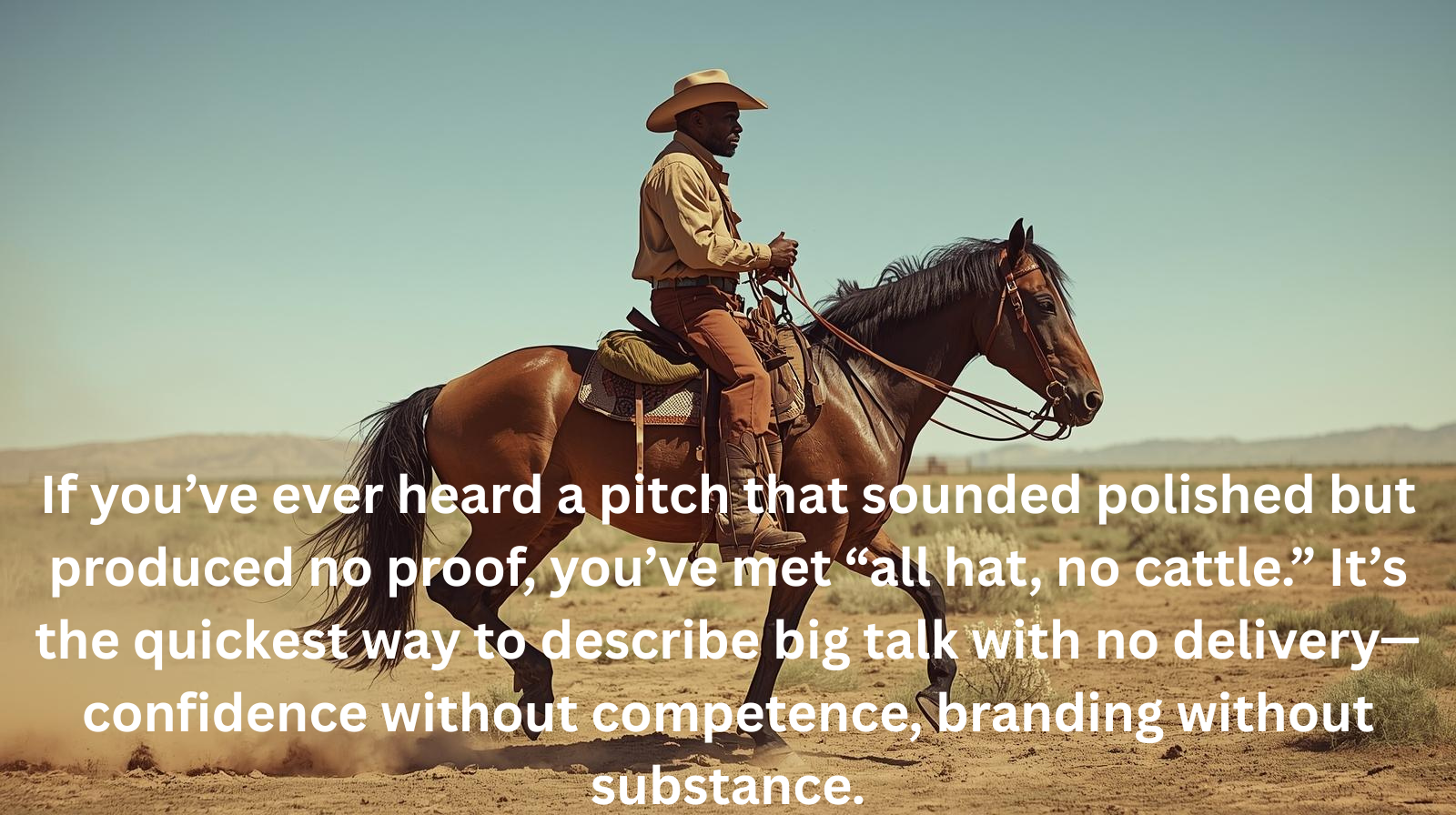
If you’ve ever heard a pitch that sounded polished but produced no proof, you’ve met “all hat, no cattle.” It’s the quickest way to describe big talk with no delivery—confidence without competence, branding without substance.
In marketing and business writing, this phrase is a built-in lie detector: it spots the gap between what someone says with genuine confidence and what they can actually prove.
What “All Hat, No Cattle” Means
Definition: Someone who looks at the part and talks big—but doesn’t have the results, experience, or substance to back it up.
- “Hat” = image, style, status signaling, swagger, performative expertise
- “Cattle” = tangible assets, honest work, tangible outcomes, real proof
Branding without backing!
“‘All hat, no cattle’ means the costume is real—but the credentials aren’t.”
Why It Hits So Hard in Business
Business rewards outcomes. But marketing—done poorly—can reward theatrics. That’s why this phrase persists: it captures a standard failure mode across industries:
- The company that says “enterprise-ready” but can’t onboard a mid-size team
- The lender who promises “fast closings” but can’t explain turn times
- The consultant who sells “strategy” but avoids specifics, metrics, or accountability
The phrase isn’t anti-marketing. It’s anti-unearned certainty.
“Real operators can show receipts. ‘All hat’ operators sell vibes.”
The “All Hat” Pattern: How to Spot It in Copy
If you’re editing an article, landing page, or sales email, “all hat, no cattle” usually shows up as:
1) Claims without a mechanism
“We help you scale.”
…but how? Process, system, framework, steps—missing.
2) Benefits without evidence
“Proven results.”
…but where are the numbers, examples, case studies, constraints?
3) Differentiation without specificity
“White-glove service.”
…but what do you do that others don’t?
4) Confidence without constraints
“We can do any deal.”
…but what are the edge cases, exclusions, or tradeoffs?
A simple editor’s test:
If a competitor could paste your paragraph onto their website unchanged, it’s probably all hat.
“Generic copy is the language of ‘all hat, no cattle.’”
Apply the Blog-Specific Tests (Using “All Hat, No Cattle” as the Standard)
Below is how to use your three tests as an editorial checklist—specifically to eliminate all-hat writing.
✅ Hook Test (2–3 sentences)
Goal: Grab attention fast and promise a specific payoff.
Pass criteria: In 2–3 sentences, the reader knows:
- Who this is for
- What problem are you solving
- What they’ll get
- Why it matters now
All-hat hook (fails):
“In today’s changing market, credibility is important.”
Cattle hook (passes):
“If your content sounds impressive but doesn’t convert, it’s probably ‘all hat, no cattle.’ Here are three ways to replace vague claims with proof—so your marketing earns trust instead of asking for it.”
Upgrade move: Replace “importance” with deliverables (steps, templates, examples, metrics).
✅ Skim Test (Subheads + bold should carry the message)
Goal: A reader should “get it” in 10 seconds by scanning.
Pass criteria:
- Subheads state conclusions (not teasers)
- Bold text marks decision points
- Lists replace long paragraphs
All-hat structure (fails):
- Clever subheads like “The Secret Sauce.”
- Dense blocks of text
- Bold is used for emotion, not meaning
Cattle structure (passes):
- Subheads like: “Claims need mechanisms.”
- Bolded takeaways like: “Add one proof point per claim.”
Rule: Every ~200 words, add a subhead or a list—or lose readers.
✅ Shareability Test (Would someone quote this?)
Goal: Make at least one line per section worth sharing.
All-hat paragraphs (fail):
- Safe truths
- Corporate fog
- Soft adjectives (“innovative,” “world-class,” “best-in-class”)
Cattle paragraphs (pass):
- Crisp rules
- Contrasts
- Memorable metaphors
Quotes for Business Writing:
- “If your promise isn’t measurable, it won’t be believable.”
- “Marketing isn’t decoration; it’s decision support.”
- “Don’t tell me you’re fast—tell me your turn times and your bottleneck.”
- “Proof beats polish.”
“The internet is full of hats. Buyers pay for cattle.”
How to Convert “All Hat” Content Into “Cattle” Content (Fast)
Use this Claim → Cattle formula:
Step 1: Identify the claim
Example: “We close fast.”
Step 2: Add one “cattle” element (choose one)
- Mechanism: “We front-load underwriting conditions before the offer.”
- Metric: “Average clear-to-close: X–Y days after docs received.”
- Constraint: “Fastest on W-2, standard property; condos vary by review.”
- Example: “Here’s a timeline from file open to funding.”
- Template: “Here’s the Borrower doc checklist we use.”
Step 3: Cut the fluff you no longer need
Once you add proof/mechanism, most adjectives become redundant.
This editor’s rule:
Every central claim must be expressed as a step, example, number, or constraint.
When to Use the Phrase (And When Not To)
Use it when:
- You’re calling out empty posturing in a light, culturally familiar way
- You’re writing a critique with a straightforward fix (proof, process, metrics)
- You want a memorable framing device for a post about credibility
Avoid it when:
- The tone must be highly formal (regulatory, legal, HR)
- You’re addressing a sensitive audience relationship (unless used gently)
- You’re making a personal attack instead of a professional critique
Professional alternative phrases (less colloquial):
- “High confidence, low evidence.”
- “Brand-forward, proof-light.”
- “Claims exceed capability.”
- “Positioning without performance.”
Conclusion: Use “All Hat, No Cattle” as Your Editing Standard
If you write in marketing or business, your job isn’t to impress; it’s to reduce uncertainty. “All hat, no cattle” is a reminder that credibility is built with specifics: mechanisms, numbers, examples, constraints, and clear next steps.
Cut the hat. Add the cattle. Readers—and Conversions—will tell the difference.