Summary
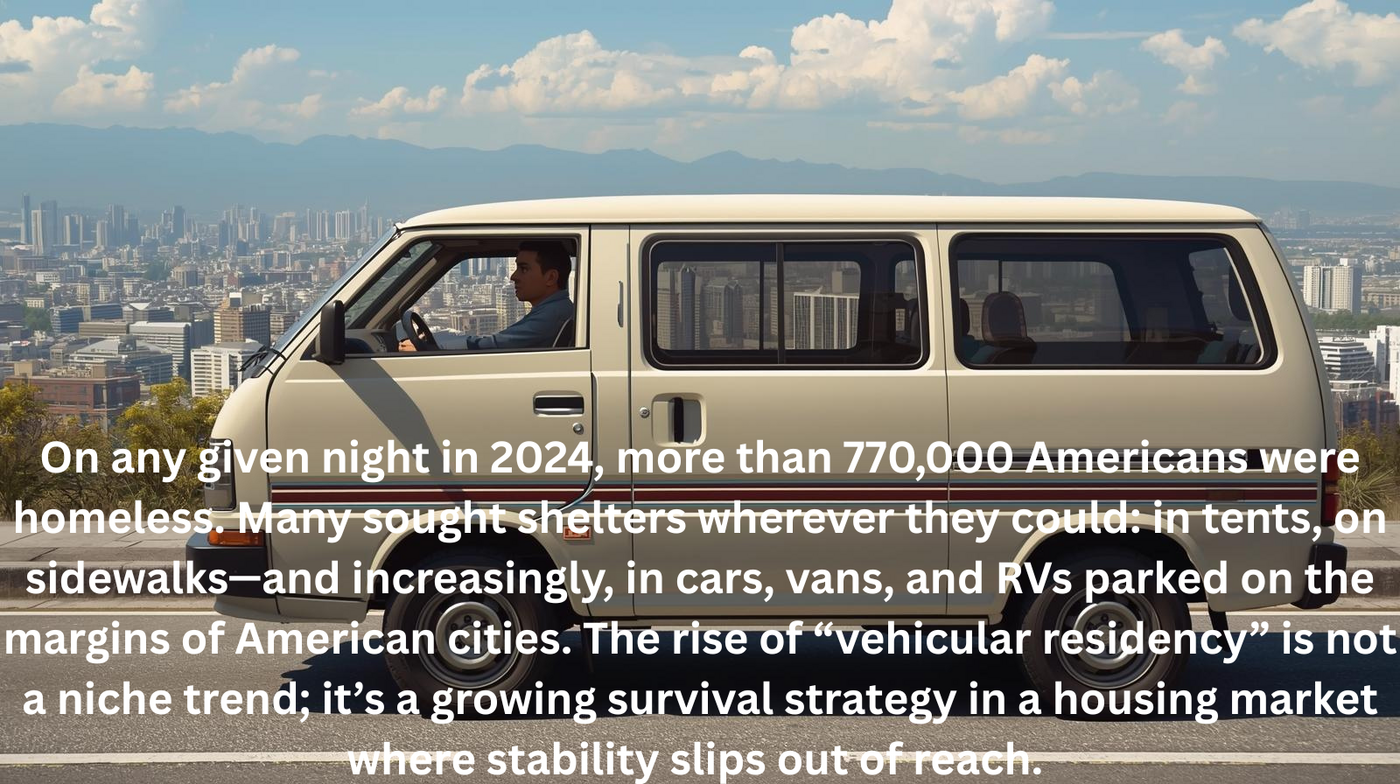
On any given night in 2024, more than 770,000 Americans were homeless. Many sought shelters wherever they could: in tents, on sidewalks—and increasingly, in cars, vans, and RVs parked on the margins of American cities. The rise of “vehicular residency” is not a niche trend; it’s a growing survival strategy in a housing market where stability slips out of reach.
Are people living in their cars, out of economic necessity, treated with compassion, dignity, and respect?
- Policy vs. Practice: Many cities—including Dana Point—frame their approach as “compassionate enforcement,” pairing parking restrictions with outreach programs. For example, Dana Point has a dedicated Community Outreach Worker who connects individuals living in vehicles to housing, health care, and employment resources.
- Challenges: Despite these efforts, enforcement (tickets, towing, overnight bans) can feel punitive when safe parking options are scarce. Advocates stress that dignity entails not only outreach but also the provision of adequate, safe lots, sanitation, and pathways to permanent housing, thereby fostering empathy among policymakers and service providers.
- Best Practices: Programs that succeed in treating people with respect typically include:
- Safe Parking Sites should accommodate a range of vehicle types, including RVs, vans, and converted cars, to ensure inclusivity and safety for all residents.
- Non-criminal enforcement (warnings before citations).
- Direct service navigation to ensure people aren’t displaced.
“Compassion vs. Enforcement: Are We Getting It Right?”,
A truly compassionate program for people living in vehicles goes beyond simply allowing overnight parking. It combines dignity, safety, and pathways out of homelessness.
Here are the core elements:
✅ 1. Safe, Legal Parking
- Clearly designated lots where people can park without fear of tickets or towing.
- Well-lit, secure environments to reduce vulnerability.
✅ 2 Basic Amenities
- Access to restrooms, showers, and trash disposal.
- Wi-Fi and charging stations, when possible—critical for job searches and communication.
✅ 3. Case Management & Services
- On-site outreach workers who connect individuals to housing programs, healthcare, and employment.
- Navigation support for benefits and permanent housing placement.
✅ 4 Non-Punitive Enforcement
- Warnings and education before citations.
- Policies that prioritize relocation to safe parking rather than displacement.
✅ . Community Integration
- Respectful treatment by staff and volunteers.
- Programs designed to reduce stigma and foster trust.
✅ 6. Clear Pathways Out
- The goal isn’t indefinite vehicle living—it’s transition. Programs should track outcomes and support individuals in moving into stable housing.
We must also recognize that some people are content to live in their cars, having withdrawn from society due to the constant pressure of work and the need to make a living. The alternatives are living on $2,000; joining 24-hour fitness for workouts and showers; joining Doheny State Park with an annual pass; RVing with Sanitation Dumps, which offer restrooms and showers; and shopping at the $5 table at Ralph’s for good-quality cooked food.
“What Makes a Program Truly Compassionate?”
The big picture: homelessness at a record high
The U.S. Department of Housing and Urban Development’s 2024 Annual Homelessness Assessment Report (AHAR) found 771,480 people experiencing homelessness on a single night in January 2024, an 18% year‑over‑year increase—the most significant one-year jump in the History of the count. Of those, 274,224 were unsheltered, and 497,256 were in shelters or temporary housing.
Several drivers explain the surge: shortages of affordable housing, expiration of pandemic-era protections, and renewed migration pressures on local systems. Policy analysts note that chronic homelessness and family homelessness both rose sharply, even as veteran homelessness declined.
“Homelessness reached an all-time high in 2024; policy fixes must match the scale of the housing crisis.”
How many people live in vehicles?
There is no official national count of Americans living in vehicles, and estimates vary widely. Industry and media reports suggest hundreds of thousands live full-time in RVs alone—one survey cited by NBC News estimated about 486,000 full-time RV residents. In contrast, broader lifestyle estimates (including vans and conversions) range into the millions, reflecting the rise of “van life.” Interpret these figures with caution—they are not government counts and methods differ.
The federal government recognizes that the lack of comprehensive data on vehicle residents hampers effective policy development, underscoring the need for improved data collection.
West Coast concentration: Los Angeles, San Diego, Seattle
Los Angeles
LA’s overall homelessness declined modestly for the second year in a row, countywide by 4% and in the City by 3.4%, even as the national trend rose. Officials attribute the drop to encampment resolution efforts and record permanent housing placements.
Within that picture, vehicular residency is substantial. LA’s 2025 count recorded ~12,005 vehicles used as shelters (cars, vans, and RVs). Applying USC’s multiplier suggests that approximately 21,000 people—roughly 44% of the county’s 47,450 unsheltered—reside in vehicles. This underscores the importance of regional efforts and encourages policymakers that progress is possible.
“In LA County, roughly two in five unsheltered residents likely live in vehicles—cars, vans, or RVs.” (derived from LAHSA counts + USC methodology)
Policy context: LA restricts vehicle dwelling between 9 p.m. and 6 a.m. on residential streets and near parks and schools, and enforces overnight oversize-vehicle bans (2 a.m.–6 a.m.) in posted zones. Enforcement of vehicles used as dwellings resumed in 2022, under safety and public-health criteria, and remains a priority.
San Diego
San Diego’s 2025 Point‑in‑Time Count showed a 7% regionwide decline, with notable drops in unsheltered families (‑72%) and unsheltered veterans (‑25%)—yet senior homelessness remains a concern: one in three unsheltered San Diegans is 55+, and the share of 55+ who live in vehicles rose three percentage points year over year.
The city’s Vehicle Habitation Ordinance prohibits overnight living in vehicles 9 p.m.–6 a.m. and within 500 feet of homes or schools; enforcement resumed in 2024 under settlement rules that require safe parking alternatives to be available. Police training bulletins detail progressive enforcement guidelines and carve-outs when safe parking lots are full.
As of January 2026, the City lists Safe Parking Program sites with updated hours and capacity (including standard and oversized vehicles), reflecting the effort to pair enforcement with managed overnight options.
Seattle / King County (Pacific Northwest)
King County’s 2024 PIT estimated 16,868 people experiencing homelessness on a single night. Local service pages state that nearly half of the region’s unhoused residents live in vehicles. At the same time, recent academic fieldwork in Seattle found ~13% living in cars—highlighting how methodology and geography can swing estimates.
Seattle emphasizes parking regulations (e.g., the citywide 72-hour limit and overnight restrictions for oversized vehicles outside certain zones) and directs vehicle owners to outreach teams and safe parking programs, primarily for cars (not RVs).
Seniors, workers, and first‑timers
Multiple datasets show that older adults are increasingly represented among unsheltered residents, and vehicular living can become a bridge for seniors on fixed incomes priced out of housing. Media and industry reporting also chronicle working families moving into RVs as rents outpace wages, underscoring that employment does not guarantee housing security in high-cost markets.
“For many seniors and working families, a vehicle isn’t freedom—it’s the last affordable roof.”
Enforcement is tightening—sometimes paired with reforms.
Across California, local vehicle‑dwelling and overnight parking restrictions remain in force (e.g., LA’s LAMC §85.02 and oversize bans, San Diego’s VHO). Meanwhile, state-level changes effective 1 January 2026, permit waiving or reducing parking penalties for people unable to pay—an attempt to curb spirals of tickets, towing, and lien sales that can push vehicle residents deeper into crisis.
The policy tension is evident: cities seek visibility, safety, and access management, while advocates argue enforcement must be matched with capacity—safe parking, shelter beds, and permanent housing placements—to avoid simply displacing people block to block.
What we still don’t know
Despite improved local dashboards, the nation lacks a precise count of vehicle residents. Federal reports note that vehicular homelessness is often invisible, mobile, and subject to varying local definitions—which complicates measurement and policy design. Until the U.S. builds consistent data on vehicle residency, the accurate scale will remain uncertain.
Key facts (for quick scan)
- Seven hundred seventy-one thousand four hundred eighty people were homeless on a single night in Jan 2024, up 18% YoY.
- Unsheltered 274,224; Sheltered 497,256 (Jan 2024).
- LA 2025: ~12,005 vehicles used as shelter; estimated ~44% of unsheltered residing in vehicles (using USC multiplier).
- San Diego 2025: homelessness down 7%; 1 in 3 unsheltered are 55+; vehicle living among 55+ up 3 points.
- King County 2024: 16,868 homeless on a single night; local estimates of vehicle living vary (13% to ~50%).
- Policy: LA and SD restrict vehicle dwelling overnight; CA AB 1299 (2026) enables parking penalty relief for low-income residents. , [sandiego.gov],
What would help—fast?
Scale up Safe Parking and case management. Managed lots reduce citations and create pathways to housing when paired with navigation and benefits access.
Convert emergency funding into durable placements. Regions that reduced street homelessness invested in permanent housing placements and encampment resolution linked to shelter—replicable at scale.
3) Fix data and definitions. A national vehicle residency module—standardized across CoCs—would turn “best guesses” into actionable metrics.
“Measure what matters: without a national vehicle residency count, policy is flying half‑blind.”
Hard Facts:
- “Vehicular residency is the fastest-growing shelter strategy for people priced out of housing—visible, mobile, and largely uncounted.”
- “LA’s 2025 data suggest roughly two in five unsheltered residents live in vehicles.” (derived from LAHSA counts + USC multiplier)
- “San Diego’s seniors are at the center of vehicle living: one in three unsheltered are 55+, and the share living in vehicles is climbing.” [
Dana Point, California: Local Parking Rules & Outreach 🚗
Dana Point’s municipal policies and outreach programs take a balanced approach between enforcement and support:
❌ RV/Vehicle Parking Restrictions
- Under Dana Point Municipal Code §12.05.050, RVs are prohibited from parking on public streets—unless they’re adjacent to the registered owner’s home. The same restriction generally applies to other oversized vehicles. Residents may report violations to the Orange County Sheriff at (949) 770-6011.
🛠 Community Outreach Efforts
- The city’s Community Outreach Worker coordinates daily with Police Services and Public Works, linking unsheltered individuals—including those living in vehicles—to housing, medical and mental health services, transportation, job placement, and substance abuse support.
📊 Local Program Metrics
- As of June 2025, Dana Point had 13 active homeless clients engaged through its outreach program. This figure changes frequently as the outreach worker makes ongoing contacts — notably, the city does not separately track individuals living in cars versus other unsheltered arrangements.
📣 What This Means:
|
Enforcement |
Outreach |
|
Strict parking rules are in place to prevent vehicles from dwelling on public streets. |
Coordinated outreach aims to connect people to services and housing rather than displace them. |
Dana Point addresses vehicular residency through a policy of citations and enforcement, but also supports a compassion-driven approach—pairing those enforcing the Law with case managers who seek connections to shelters and permanent housing.
🟢 Orange County Safe Parking Program (Tustin)
- Unsafe Parking OC
- Location: 1703 Flight Way, Tustin, CA 92782 (near Barranca Parkway & Red Hill Ave) [
- Cost: Free, no registration required [s
- Vehicle types accepted: Cars, vans, trucks (including RVs, semi-trucks, trailers)—call for size restrictions
- Conditions: Park at your own risk; no overnight security or structured supervision
🏥 Nearby Public Lot Tips Shared by Community
According to local experience (Reddit), lots such as hospital parking areas in nearby Irvine or Costa Mesa are sometimes used:
- Camp overnight (11 p.m.–6 a.m.)
- Stay discreet (e.g., park nose-out, use sunshades)
- Generally tolerated if users are respectful and responsibly parked
🏢 County & City Resources for Assistance
- Orange County Homeless Services Hotline
- Call 2‑1‑1 (or 888‑600‑4357 outside OC) to reach referral services for shelter and parking alternatives.
- Or contact the OC Outreach & Engagement team via 800‑364‑2221 or OCOE@ceo.oc.go.v.
- Dana Point Outreach Team
Although the city doesn’t run a formal safe‑parking lot, its Community Outreach Worker helps direct vehicle dwellers to: - Regional safe parking sites (e.g., in Tustin)
- Shelter beds, wrap-around support, and services
📌 Summary Table
|
Program / Resource |
Location |
Cost |
Notes |
|
Un‑Safe Parking OC |
Tustin (1703 Flight Way) |
Free |
Open, no services, park at your own risk |
|
Hospital/public parking lots |
Irvine / Costa Mesa (local) |
Varies |
Commonly County overnights zones |
|
OC Homeless Services (Countywide) |
Countywide |
Free |
Referrals to shelters, safe parking |
|
Dana Point Outreach Worker |
Dana Point |
Free |
Links individuals to the nearest programs |
⚠️ Important reminders: Always verify local restrictions—especially overnight bans and vehicle size limits. Even free lots may enforce rules or have towing policies. Contact providers in advance when possible.
The primary safe parking option I identified near Dana Point—Unsafe Parking OC in Tustin—is free and does not require registration. However, it’s an unmanaged lot, so there’s no security or services provided; you park at your own risk.
Other informal options (like hospital or public lots mentioned in community forums) may also be free. Still, they’re not official programs and could carry towing risk if local rules are enforced.
Would you like me to compile a comprehensive list of official Orange County safe-parking programs, including details on costs, hours, and vehicle-size limits?
Here are the official safe parking program options in Orange County near Dana Point:
🟢 Un‑Safe Parking OC – Tustin (Official Safe Parking Program)
- Location: 1703 Flight Way, Tustin, CA 92782 (near Barranca Parkway & Red Hill Ave)
- Cost: Free — no registration or fee required [
- Vehicle types allowed: Cars, vans, trucks, trailers, RVs, semi-trucks (size restrictions may apply—call to confirm) [
- Amenities: Well-lit public lot with trash cans and Wi‑Fi in parts of the park; managed by Safe Parking OC; no overnight security staff on site
📞 County-Level Support (Referral and Resource Coordination)
While not parking lots themselves, these official county resources can refer you to safe parking sites, help with shelter placement, and offer supportive services:
- 211 Orange County – Dial 2‑1‑1 (or 888‑600‑4357 outside OC) for referrals to safe parking programs, shelters, sanitation, and case management
- OC Outreach & Engagement – Call 800‑364‑2221 or email OCOE@ceo.oc.gov for direct assistance and placement in safe parking or supportive housing
✅ Summary Table
|
Program / Resource |
Location |
Cost |
Notes |
|
Un‑Safe Parking OC |
Tustin (1703 Flight Way) Countywide |
cial Safe Parking OC-managed lot |
|
|
211 OCountywidey |
Countywide hotline |
Free |
RCountywide parking/shelter programs |
|
OC Outreach Countywide |
Countywide |
Free |
Personalized outreach & placement assistance |
ℹ️ Quick Notes:
- Un‑Safe Parking OC is currently the only officially listed Safe Parking lot in Orange County.
- Other cities/towns (e.g., Anaheim, Santa Ana) use nearby Navigation Centers and shelters—not designated vehicle parking programs.
- For additional safe parking resources or waitlist placement, contact 2‑1‑1 or OC Outreach directly.