Summary
Nationally representative assessments show a sustained erosion in U.S. student achievement over the past decade, with pandemic disruptions deepening trends already underway. Across grades and subjects, reading and math scores have fallen, proficiency rates are shrinking, and achievement gaps by race/ethnicity and performance level remain stubborn—or are widening. These signals appear in the Nation’s Report Card (NAEP), its Long-Term Trend (LTT) series, and the SAT Total Group reports, forming one of the most explicit empirical pictures of systemic underperformance in modern U.S. schooling.
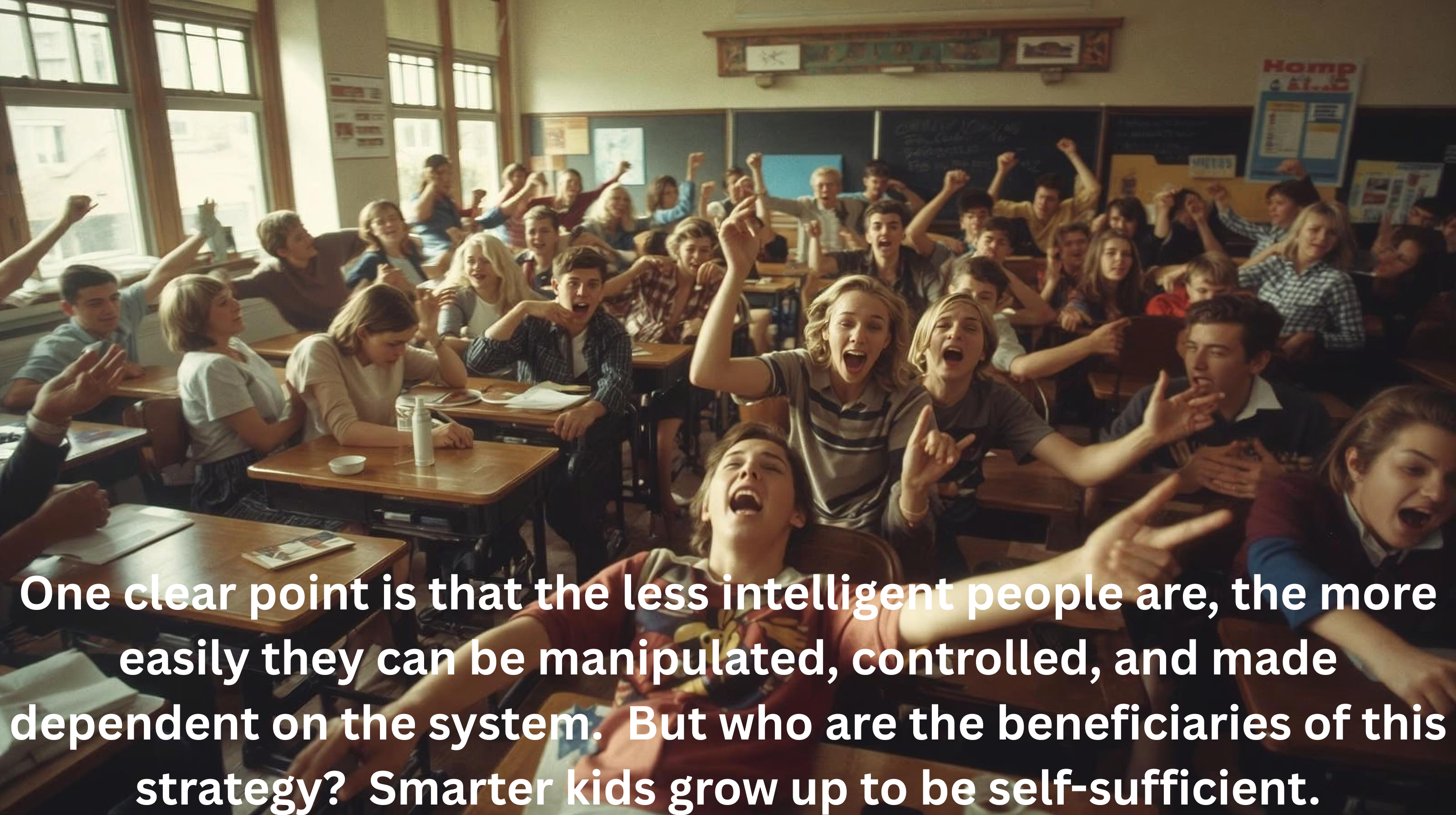
One clear point is that the less intelligent people are, the more easily they can be manipulated, controlled, and made dependent on the system. But who are the beneficiaries of this strategy? Smarter kids grow up to be self-sufficient.
The ‘Big Picture: National Declines’ underscores the widespread and persistent drops in student achievement, emphasizing the urgency for systemic reform.
In 2024, the NAEP reported lower average reading scores at grades 4 and 8 than in 2022, and the lowest 12th-grade reading score ever recorded—a stark indicator of college readiness. Meanwhile, 12th-grade math reached its lowest average in NAEP History. At grade 8, science declined for the first time since the current assessment began in 2009. These declines disproportionately affected lower-performing students, expanding the gap between the 10th–25th percentiles and the top performers (75th–90th percentiles).
Internationally, PISA 2022 found that U.S. math scores fell by 13 points since 2018 (reading scores down 10), although the U.S. decline was smaller than the OECD average, nudging U.S. rankings slightly higher despite absolute decreases.
The SAT mirrors this pattern. The Class of 2024 averaged 1024 (ERW 519; Math 505), continuing a gradual slide from 2021 and 2023. Subgroup breakdowns indicate persistent gaps, and the College Board cautions against simplistic comparisons due to participation changes; however, the direction is unambiguous.
Long-Term Trend: A Half-Century Lens
NAEP’s Long-Term Trend (LTT) series, which tracks basic skills across decades, confirms both post-2012 stagnation/decline and post-2020 setbacks. Among 13-year-olds, 2023 LTT scores dropped 9 points in math and 4 points in reading compared with 2020—the most significant math decline in the LTT’s History. Declines were observed across major racial/ethnic groups, with the steepest among lower-performing students. Reading scores are now near levels last seen in the 1970s.
By race/ethnicity, LTT averages for 13-year-olds in 2023 show White students at 285 in math and 264 in reading; Black at 243 and 237; Hispanic at 257 and 247—translating to White–Black gaps of 42 (math) and 27 (reading) and White–Hispanic gaps of 28 (math) and 17 (reading). These national gaps contextualize the state-level differences below.
State-Level Racial/Ethnic Gaps: What the Snapshots Show
NAEP’s 2024 State Snapshot reports provide consistent, comparable subgroup scores and explicit statements of score gaps. The examples below illustrate the range of gaps by grade and subject:
Mathematics — Grade 4 (2024)
- California:
White 247 | Black 213 | Hispanic 223 → White–Black gap 34 | White–Hispanic gap 24.
Interpretation: Large gaps indicate substantial separation in subgroup scores at the foundational stage. - Florida:
White 252 | Black 228 | Hispanic 241 → White–Black gap 24 | White–Hispanic gap 11.
Note: Florida’s White–Hispanic gap ranked #2 smallest among states in 2024 (grade 4 math).
Mathematics — Grade 8 (2024)
- Texas:
White 284 | Black 254 | Hispanic 261 → White–Black gap 29 | White–Hispanic gap 23.
Interpretation: Mid-adolescence math gaps remain substantial, tracking closely to national LTT patterns for age 13.
Reading — Grade 8 (2024)
- New York:
White 265 | Black 248 | Hispanic 243 → White–Black gap 16 | White–Hispanic gap 22.
Interpretation: The White–Black gap is comparatively smaller; the White–Hispanic gap remains sizable, underscoring subgroup variation by subject.
How to access any state: Use NAEP’s State & District Snapshots portal to select the state, subject, grade, and year; each PDF includes Results for Student Groups and Score Gaps.
Why the Gaps Persist (and Sometimes Widen)
Three recurring dynamics appear across the datasets:
· Performance-Level Divergence
2024 NAEP results show higher-performing students recovered sooner (or continued to gain), while lower-performing students saw flat or further declines—especially in grade 8 math. That divergence widens intra-state and national gaps even when some averages tick up.
· Demographic Composition and Opportunity to Learn
State-level comparisons can be misleading without adjustment for student demographics (e.g., poverty, disability, English learner status). Demographically adjusted analyses show that part—but not all—of observed differences reflect population composition, suggesting policy and practice also matter.
· Post-Pandemic Headwinds
Chronic absenteeism, reduced independent reading, and disrupted math course-taking underpin slower recovery. LTT survey data show fewer 13-year-olds reading for fun and more reporting extended absences—factors correlated with lower achievement.
The Control Question: Is “Dumbing Down” a Strategy—or a Systemic Outcome?
The data does not prove intent.
They do show:
- Information ecosystems that reward brevity, sensationalism, and emotional engagement over sustained literacy and numeracy.
- Complexity creep in policy and assessments can obscure accountability and hinder recovery.
- Incentive structures (district finance, staffing shortages, and curriculum fragmentation) impede long-term skill formation.
Whether deliberate or emergent, the net effect is constrained academic growth, emphasizing the critical need for evidence-based reforms to support students who are most dependent on school quality.
What Would a Serious Recovery Agenda Look Like?
1) Literacy Reset (K–8 and Secondary):
Adopt science-of-reading-aligned curricula; ensure daily, protected reading time; train teachers in structured literacy with real-time progress monitoring. The NAEP literacy declines and the LTT reading patterns argue for urgency.
2) Math Pathways with Acceleration:
Guarantee coherent math sequences (fractions → ratios → algebra) and high-impact tutoring at scale (2–3x/week), targeted to the 25th percentile and below, where declines are most severe.
3) Attendance & Time-on-Task:
State dashboards should weigh chronic absenteeism alongside achievement; fund attendance interventions (transportation, health, counseling) and extend learning time where recovery lags. LTT survey indicators on reading habits and absences flag this as a keystone.
4) Transparent Gap Reporting (with Adjustments):
Publish unadjusted and demographically adjusted state/district results side-by-side to separate composition effects from school effectiveness. Use NAEP’s publicly available State Snapshots and adopt the Urban Institute’s adjustment methodology for policymaking.
5) Evidence-Based Funding and Talent Pipelines:
Target resources to low-performing schools and subgroups, pair investments with instructional coaching, and expand teacher residency programs in literacy and math. Monitor Impact with short-cycle interim assessments aligned to NAEP frameworks.
Sidebar: Quick Facts You Can Quote
- 12th-grade reading (2024): lowest average ever recorded by NAEP. 12th-grade math: lowest average since the assessment began.
- PISA 2022: U.S. math down 13 points since 2018; reading down 10—smaller declines than OECD average, raising ranks despite absolute deterioration.
- SAT (Class of 2024): 1024 average; subgroup disparities persistent; caution on cohort comparability.
- LTT (Age 13, 2023): math down 9 points; reading down four since 2020; most significant math drop on record; declines across racial groups; lower performers fell the most.
State Gap Table (Selected 2024 Snapshots)
|
Grade & Subject |
State |
White |
Black |
Hispanic |
White–Black Gap |
White–Hispanic Gap |
|
Gr 4 Math |
California |
247 |
213 |
223 |
34 |
24 |
|
Gr 4 Math |
Florida |
252 |
228 |
241 |
24 |
11 |
|
Gr 8 Math |
Texas |
284 |
254 |
261 |
29 |
23 |
|
Gr 8 Reading |
New York |
265 |
248 |
243 |
16 |
22 |
Conclusion
The decline is real; the gaps are durable; and the recovery is uneven. Calling it “dumbing down” may oversimplify complex forces. Still, the result is the same: millions of students are leaving school with weaker skills, especially in math, reading, and science—precisely when the economy demands more. The path forward is not mysterious; it is execution-heavy and politically challenging: adhere to evidence, measure what matters (including gaps), invest in proven practices, and stay the course long enough to see cohort-level gains appear in NAEP, PISA, and college-entry benchmarks.
Sources
- NAEP (Nation’s Report Card): 2024 Reading & Mathematics (Grades 4 & 8) national/state results & subgroup trends; State & District Snapshots. [bing.com], [bing.com]
- NAEP LTT (Age 13, 2023): National math/reading declines; subgroup averages & gaps; survey indicators (reading for fun; absenteeism). [deloitte.com], [theeduledger.com]
- NAGB summaries and takeaways: 2024 NAEP national context; widening gaps among lower vs. higher performers. [bing.com], [education.nh.gov]
- PISA 2022 (OECD/NCES): U.S. math/reading declines and comparative rankings. [nationsrep...rtcard.gov], [nces.ed.gov]
- SAT Total Group (College Board): Class of 2024 averages; subgroup data context. [nationsrep...rtcard.gov]
- State Snapshot PDFs (examples):
- California Grade 4 Math: subgroup scores & gaps. [jabberwocking.com]
- Florida Grade 4 Math: subgroup scores, White–Hispanic gap rank. [wvnstv.com]
- Texas Grade 8 Math: subgroup scores & gaps. [wiche.edu]
- New York Grade 8 Reading: subgroup scores & gaps. [dispatch.com]