Summary
Ayn Rand’s view that both systems rest on the same premise-that the individual exists for the state or collective-helps us understand modern debates on government power and individual rights, emphasizing that both threaten personal freedom today.
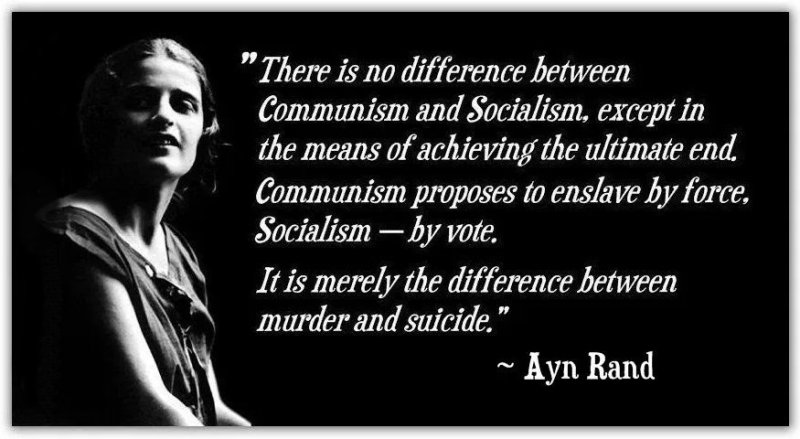
Rand’s argument was not that socialism and communism are identical in packaging.
Rand’s point was that, regardless of whether socialism arrives gradually through bureaucracy or swiftly via revolution, both are rooted in the same moral principle: placing the collective above the individual and making the method secondary to the core threat to freedom.
That is the heart of her critique. In For the New Intellectual, she defined socialism as a doctrine in which a person’s life and labor are treated as belonging to society rather than to the individual. Once that premise is accepted, the rest is just administrative detail. Whether power is seized overnight or layered in gradually through regulation, redistribution, and state control, the destination remains the same: the individual loses sovereignty over his work, property, and choices.
Rand sharpened that point further in “The Monument Builders,” published in The Virtue of Selfishness.
There, she argued that socialism’s essential characteristic is the denial of individual property rights, because property is not a side issue or a luxury item—it is the practical extension of one’s effort, judgment, and independence. Once the state claims the authority to control production and distribution, it is no longer merely managing economics; it is placing itself between the individual and the product of his own life.
Rand dismissed the idea that ‘moderate’ socialism is harmless, warning that partial socialization gradually erodes individual rights, just as total socialization does, thereby shrinking the space for private ownership and personal freedom.
Her hostility to communism was not merely historical or emotional, though her personal experience gave it added force. In the foreword to We the Living, Rand explained that what she regarded as evil was not simply communist brutality as a tactic, but the underlying principle that man exists for the sake of the state. She also warned against the lazy habit of condemning communist methods while excusing or romanticizing communist ideals. In her view, that intellectual dodge had helped communism advance far beyond what its open brutality alone could have achieved.
So Rand’s bottom line was not subtle, and she did not intend it to be. Socialism and communism are not opposites. They are relatives. Close relatives. One comes through the front door, kicking it off the hinges. The other strolls in through the side entrance, carrying a policy memo and asking for just a little more power for the public good. Rand believed both led in the same direction: diminished individual rights, weakened property rights, expanding state control, and the steady conversion of free citizens into managed subjects.
When the state claims moral ownership over the individual’s effort, it’s a slow erosion of liberty-an urgent issue the audience must recognize and oppose.
Closing
Rand’s message was straightforward: communism takes your freedom at gunpoint; socialism invoices you for the surrender and calls it progress.