Short answer
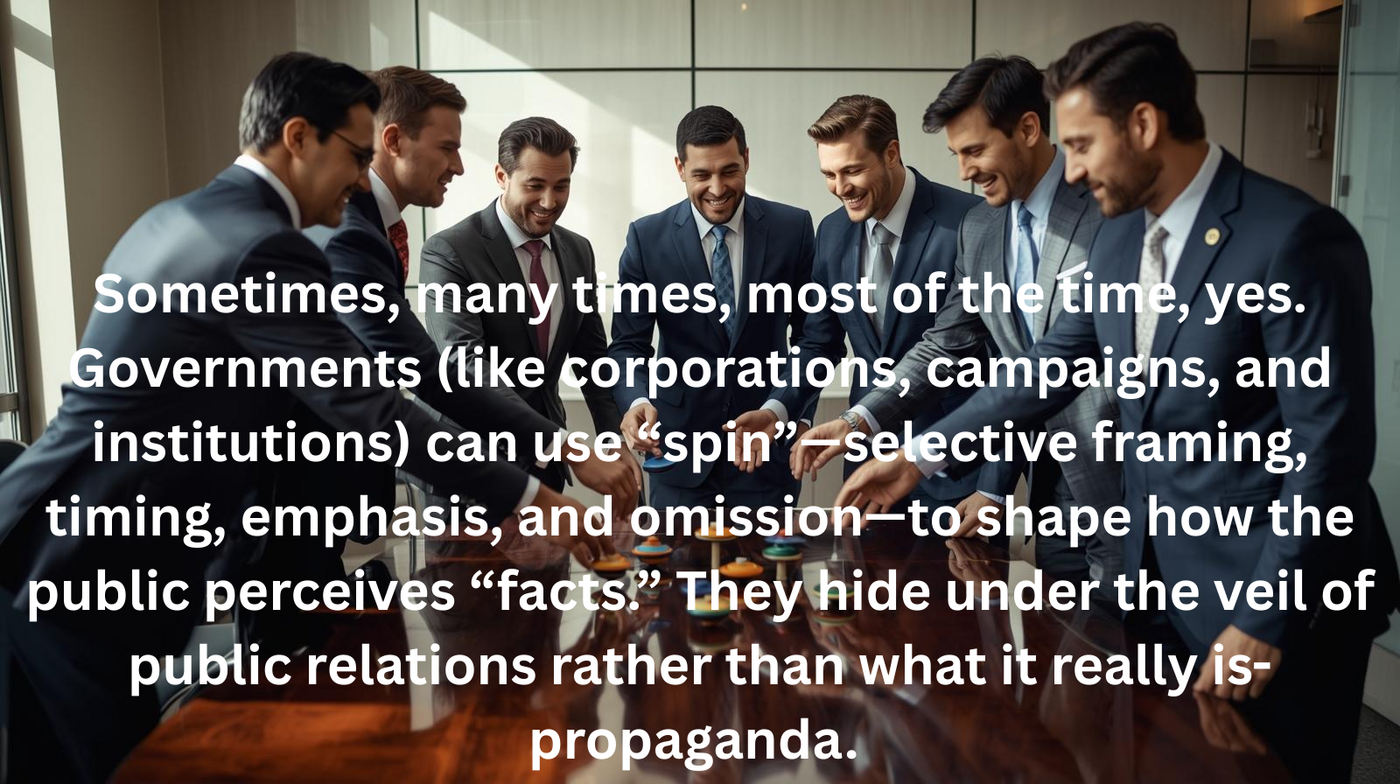
Sometimes, many times, most of the time, yes. Governments (like corporations, campaigns, and institutions) can use “spin”—selective framing, timing, emphasis, and omission—to shape how the public perceives “facts.” They hide under the veil of public relations rather than what it really is- propaganda.
But it’s also true that many government communications are constrained by formal standards for accuracy, objectivity, and correction, which aim to build trust and confidence, and changes in messaging can reflect new data rather than deliberate deception.
Below is a practical way to think about it.
1) What “bait-and-switch” means—then how it maps (imperfectly) to government messaging.
In consumer Law, “bait advertising” is defined as an alluring but insincere offer that the advertiser does not intend to fulfill, designed to redirect the customer to something else that benefits the advertiser.
The FTC’s guide also notes a key idea: even if the “facts” emerge later, the deception can still matter if the initial contact was secured through deception.
Government doesn’t “sell products” the same way, so calling it “bait-and-switch” is usually a metaphor for a similar pattern:
- Bait: a simplified public claim (a headline, “fact,” assurance, or promise)
- Switch: later details, constraints, or revised information that change what the audience reasonably believed.
This is closest to what political communication researchers and reference sources call “spin”—an attempt to control or influence communication, often via selective presentation of facts, careful timing, and strategic wording, sometimes “to the neglect of delivering the full truth.”
2) Yes, governments can “spin” facts (and that can feel like bait-and-switch)
“Spin” in politics is widely described as the biased management of messages—including selective facts, word choice, timing, and framing—to shape public understanding.
Britannica explicitly notes it’s often associated with government press conferences, where officials have a vested interest in producing a desired outcome and may downplay full context.
What this looks like in the business world of government communications
Here are standard “bait → switch” patterns that can occur without naming specific administrations:
· Headline certainty → Footnote uncertainty
· Bait: “The evidence shows X.”
· Switch: Later: “preliminary,” “subject to revision,” small sample, or assumptions not stated up front.
This aligns with classic “spin” behaviors: selective presentation and message management. Britannica+1
· Benefit framing → Cost/constraint revealed later
· Bait: A policy’s upside emphasis in the first announcement.
· Switch: Limits, eligibility, tradeoffs, or implementation hurdles appear later.
Selective emphasis and careful wording are standard tools of spin.
· “Not a big deal” → “Actually, it’s significant.”
· Bait: Reassuring language early to maintain calm.
· Switch: Later briefings disclose higher severity, uncertainty, or risk.
Again, timing and reframing are described as “spin techniques.”
These patterns often stem from incentives, such as avoiding panic or protecting negotiations, which can lead to intentional or strategic spin rather than outright deception, clarifying the complexity of government messaging.
3) No, it’s not supposed to work that way—standards are pushing in the opposite direction
The U.S. federal government has explicit policies aimed at information quality:
- OMB’s government-wide information quality guidelines implement a legal framework (Section 515) that requires agencies to ensure and maximize the quality, objectivity, utility, and integrity of disseminated information, including mechanisms for seeking correction.
- OMB defines “objectivity” as information that is accurate, reliable, unbiased, and presented clearly and thoroughly.
Additionally, GAO’s “Green Book” internal control standards emphasize that management should use and communicate relevant, high-quality information.
While the system is designed to promote quality and provide correction pathways—per OMB’s guidelines and GAO standards-enforcement varies, raising questions about their real-world effectiveness in preventing deceptive practices.
4) How to tell the difference: “new facts” vs. “bait-and-switch.”
Here’s a practical diagnostic you can use.
A) Signs are regularly updated (not bait-and-switch)
- The agency clearly labels information as preliminary and explains uncertainty. (That’s consistent with quality/objectivity principles.)
- They publish methods/data sources, and revisions are documented. (Aligned with “accurate, reliable” dissemination goals.
- They offer a correction mechanism (or correct errors).
B) Signs it’s closer to a bait-and-switch pattern
- The initial message is overconfident; later, it is backfilled with “fine print” that changes its meaning. (Resembles securing initial acceptance before revealing “facts.”)
- Selective data is used—cherry-picked facts without key context. (Classic “spin.”)
- The latter clarification is framed as “nothing changed,” even though the practical meaning clearly did. (Spin-by-reframing.)
“If the headline sells certainty and the appendix admits uncertainty, you weren’t informed—you were managed.”
5) A simple “anti–bait-and-switch” checklist for citizens
When you hear a big government claim, ask:
· What exactly is being asserted: fact, estimate, or prediction? (Look for objectivity cues.)
· What assumptions make the claim true (Missing assumptions = common spin surface area)
· What would they have to disclose to change your decision? (This is the FTC-style “facts” test in spirit.)
· Is there a documented correction path if the info is wrong?
· Are there independent audits/oversight signals? (GAO internal control standards emphasize quality information and communication.)
Bottom line
- Yes, government communications can sometimes function like a bait-and-switch, primarily through spin (selective framing, omission, and reframing).
- However, there are formal standards (OMB information quality rules; GAO control standards) that push agencies toward accuracy, objectivity, and correction, and genuine updates aren’t automatically deceptive.