Summary
Few weapons have escaped the battlefield to become part of everyday language. “Big Bertha” did—and more than a century later, it still thunders through our vocabulary.
When people say they are bringing out the “Big Bertha,” they rarely mean artillery. They mean decisive force, overwhelming scale, or a solution so large it ends debate. The phrase has come to signify power that is not merely effective, but unmistakable.
Its origin, however, lies in a very real machine—one that helped redefine warfare and permanently altered how societies think about force, scale, and inevitability.
The Birth of Big Bertha: Industrial War Made Visible
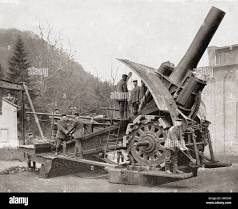
The original Big Bertha was a 42-centimeter siege howitzer designed by Krupp, Germany’s industrial giant, on the eve of World War I. Its purpose was brutally practical: destroy modern concrete fortifications that had rendered older artillery obsolete.
And it worked.
In 1914, Big Bertha reduced Belgian forts thought to be impregnable in a matter of hours. Observers were stunned—not just by the destruction, but by how quickly it happened.
Military historian John Keegan famously argued that World War I marked a turning point where technology overwhelmed traditional defenses:
“The First World War was a war of matériel,” Keegan wrote, “in which mass and firepower triumphed over maneuver and valor.”
Big Bertha embodied that shift. It was not elegant. It was not subtle. It was overwhelming.
Naming the Weapon: Why ‘Bertha’ Mattered
German crews nicknamed the gun Dicke Bertha—“Fat Bertha”—a name widely believed to refer to Bertha Krupp von Bohlen und Halbach, heiress to the Krupp industrial empire.
Whether personal or symbolic, the name humanized the weapon without diminishing its menace.
Cultural historian Paul Fussell, writing in the language of war, observed:
“Modern war depends as much on names and symbols as on tactics. A named weapon acquires personality—and personality lingers in memory.”
Once named, the gun became more than steel. It became a character in the war’s story.
From Weapon to Myth: The Expansion of ‘Big Bertha’
Technically, Big Bertha referred only to the 42‑cm howitzer. In practice, Allied troops used the term loosely to describe any massive German artillery piece, including—incorrectly—the long-range Paris Gun that shelled Paris in 1918.
This linguistic drift mattered. It turned Big Bertha into a mythic presence, a symbol of destruction that could arrive unseen and unchallenged.
Historian Barbara Tuchman captured this psychological dimension in The Guns of August:
“The guns themselves became actors in the drama, shaping morale as much as military outcomes.”
Big Bertha was not just feared for what it destroyed—but for what it represented: distance, inevitability, and helplessness.
Etymology and Endurance: Why the Phrase Survived
The name Bertha derives from the Old High German Berahta, meaning “bright” or “glorious.” Paired with “big,” the phrase suggests something that dominates attention and demands respect.
Language scholars note that metaphors endure when they compress meaning efficiently.
Cognitive linguist George Lakoff has argued:
“A successful metaphor organizes experience.”
Big Bertha organizes ideas of size, power, finality, and excess into two words—making it endlessly reusable.
Historians on Scale and Modern Power
The deeper reason Big Bertha still resonates is that it reflects a permanent feature of modern life: when systems fail, societies reach scale.
Military historian Hew Strachan has written of World War I:
“Industrialized war was not about brilliance—it was about capacity. Victory went to those who could apply force on a scale the enemy could not match.”
Big Bertha was the physical manifestation of that logic.
Similarly, historian Martin van Creveld observed:
“Technology does not merely change how wars are fought; it changes how power itself is understood.”
Once power became measurable in tonnage, range, and output, metaphors like Big Bertha became inevitable.
Big Bertha Enters Popular Culture
The phrase soon escaped military history.
- Golf: Callaway’s Big Bertha driver (1991) deliberately invoked raw power and forgiveness. It reshaped both equipment design and marketing language.
- Engineering: Seattle’s tunnel‑boring machine “Bertha” carried the name with ironic precision—massive, slow, unstoppable.
- Comics: Marvel’s Big Bertha literalized the metaphor, turning mass into strength.
- Music: The Grateful Dead’s “Bertha” demonstrates how names accumulate meaning even without direct intent.
As historian Eric Hobsbawm noted, cultural symbols:
“Once detached from their origin, symbols do not weaken—they multiply.”
Why Big Bertha Still Works
Today, calling something “Big Bertha” signals a deliberate choice: stop optimizing, stop negotiating—apply decisive force.
It is a phrase that carries the memory of industrial war into civilian life.
As Keegan later reflected:
“The legacy of the First World War lies not only in borders and treaties, but in how modern societies think about power.”
Big Bertha survives because that way of thinking has never disappeared.
The Final Shot
Big Bertha began as a gun. It became a myth. It endures as language.