Summary
Bureaucratic drag cripples’ performance—and what leaders can do to stop it.
Definition
Bureaucratic drag hampers organizational focus by diverting attention from customer value to internal rules, leaving leaders uncertain about their influence. Recognizing this Impact helps leaders feel more confident in addressing resource waste.
Bureaucratic policies and procedures shift focus from the “vital few” to the “trivial many, “emphasizing processes over results, which hampers productivity and profits. Bureaucratic policies and procedures that hinder productivity can occur in both small entrepreneurial enterprises and large Corporation. Consider a small company in which the owner is ego-driven and attempts to micromanage all aspects of the organization, leaving employees as yes-men, yes-women, and lapdogs.
Impact on Performance and Profits
Bureaucratic drag negatively affects performance and profits through several mechanisms:
- Wasted Time
Research and executive commentary show that bureaucracy consumes substantial employee time and underutilizes human potential, diverting effort from value creation toward compliance tasks, reporting, and approvals. - Slow Decision-Making
Multiple layers of management and rigid chains of command slow decision-making and blunt responsiveness; flattening structures and expanding spans of control have been shown to accelerate it. - Stifled Innovation and Creativity
Rule-heavy environments suppress autonomy and experimentation; cultures that trust people over process (e.g., Netflix’s “freedom & responsibility”) consistently report faster pivots and better creative output. - Low Morale and Disempowerment
When promotion and advancement hinge on internal politics rather than performance, engagement falls, and turnover rises—especially in multilayered organizations. - Increased Political Behavior
Complex hierarchies foster blame-shifting and resource hoarding; leaders must redesign structures and incentives to reduce political arenas and reinforce accountability. - Resource Duplication and Inefficiency
Siloed operating models duplicate work and slow cross-functional flow; agile “networks of teams” and helix models show superior coordination and throughput.
In essence, bureaucratic drag is organizational friction that impedes a company’s ability to operate with agility and efficiency in today’s fast-paced business environment.
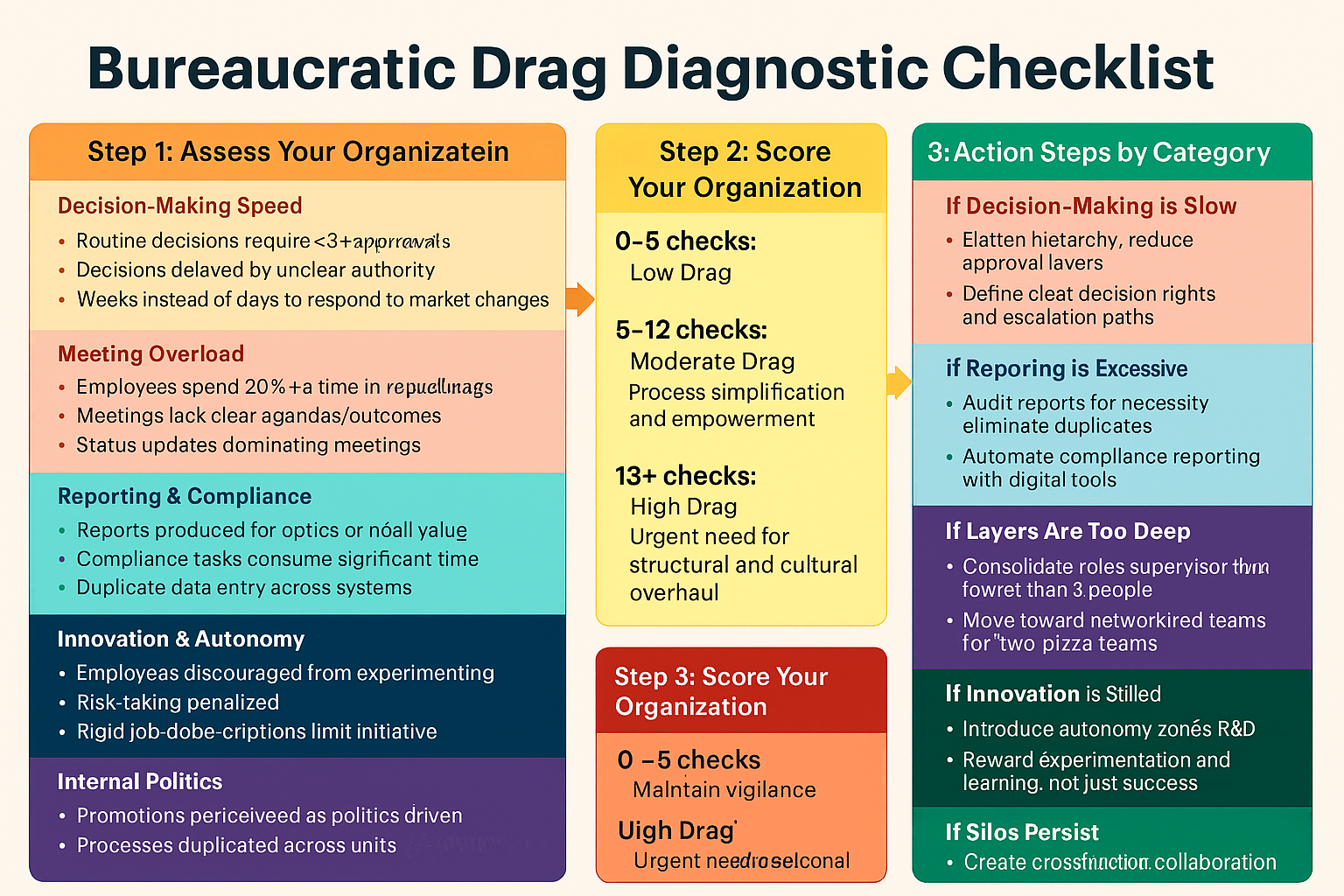
Reducing bureaucratic drag requires deliberate action to streamline processes and empower employees. Practical strategies like process simplification and decentralization help leaders feel capable and in control of change.
Practical strategies:
· Simplify Processes
Eliminate unnecessary approvals and redundant reporting. Use lean practices to prioritize value-added work and cut waste.
· Decentralized Decision-Making
Push authority closer to the front lines. Small, autonomous teams (“two-pizza teams”) are faster, clearer, and more accountable.
· Digitize and Automate
Use workflow automation to eliminate manual bottlenecks and reduce cycle time; digitization programs consistently reduce compliance burdens and accelerate service delivery.
· Clarify Priorities
Shift focus from the “trivial many” to the “vital few” by aligning metrics with outcomes, thereby accelerating progress and reducing unnecessary noise.
· Fostering a culture of trust and accountability by replacing rigid oversight with clear goals and transparency helps leaders feel empowered to lead change effectively.
Replace rigid oversight with clear goals, context over control, and transparency.
· Reward results, not processes and compliance paperwork.
· Continuous Review
Audit policies and procedures regularly to retire low-value rules and refresh governance for agility without sacrificing safeguards.
Break Down Silos
Breaking down silos is the process of eliminating barriers and isolation between departments or teams within an organization to encourage communication, collaboration, and a unified focus on overarching company goals. This approach helps prevent information hoarding and duplication of effort, which can hinder efficiency and innovation.
Move from tall hierarchies to flatter, cross-functional networks of teams to improve speed, flow, and collaboration.
Key Strategies to Break Down Silos
Establish a Unified Vision and Common Goals: A primary cause of silos is misaligned departmental objectives. Leaders should define clear, shared, organization-wide goals that all teams can work toward, helping employees understand how their individual roles contribute to the company’s broader success.
- Encourage Open Communication and Transparency: Create a culture in which information flows freely across teams, not only from the top down. Implement standardized communication practices and tools (such as shared project management software or internal discussion boards) to ensure that everyone has access to the information they need.
- Promote Cross-Functional Collaboration: Actively encourage employees from different departments to work together on projects or initiatives. This can involve creating cross-functional teams, organizing joint training sessions, or implementing job rotation programs to help employees develop empathy for and an understanding of other teams’ challenges and workflows.
- Align Incentives and Recognition: Revamp reward systems to recognize and incentivize cross-team collaboration and knowledge sharing, rather than just individual or departmental achievements. Publicly celebrating collaborative successes reinforces the value of teamwork.
- Foster Psychological Safety: Create an environment where employees feel safe to take risks, ask questions, admit mistakes, and express their ideas without fear of negative consequences. This trust is fundamental to open communication and effective collaboration.
- Lead by Example: Leadership must model the collaborative behaviors it expects from its teams. When managers and executives actively collaborate and prioritize the company’s mission, it sets a powerful example for the rest of the organization.
- Use Collaboration Technology: Implement integrated technology platforms and tools that facilitate seamless information sharing and project management across departments. Ensure that these tools are used consistently and effectively across all teams to prevent the inadvertent creation of new information silos.
Case Studies: What Drag Looked Like—And How Leaders Beat It
1) Nokia: Organizational Inertia and Slow Response
Once the global mobile leader, Nokia’s market share collapsed between 2007 and 2013 amid rapid disruption in the smartphone market. Scholars and executives cite internal bureaucracy, a risk-averse culture, and misaligned organizational design choices that delayed decisive product and OS strategy pivots, culminating in the sale of its phone business to Microsoft in 2013.
Lesson: When layers multiply and decision rights are unclear, even dominant firms can miss inflection points. Flatten structures, clarify ownership, and empower faster bets.
2) 3M: Efficiency Programs That Constrained Innovation
Applying Six Sigma extensively to R&D standardized reporting and stage-gates improved efficiency but constrained exploration, and the flow of breakthrough products slowed significantly. Subsequently, leadership restored 15% time and relaxed R&D constraints—restoring innovation without abandoning manufacturing discipline.
Lesson: Separate exploit (efficiency) from explore (innovation). Use process rigor in operations, but give discovery teams autonomy, time, and tolerance for ambiguity.
3) Netflix: People Over Process to Accelerate Creativity
Netflix’s well-known culture (“freedom & responsibility,” “context not control,” “highly aligned, loosely coupled”) deliberately minimizes bureaucratic rules while maintaining very high performance standards—updated again in its 2024 Culture Memo. The approach helps scale innovation and speed while avoiding compliance-heavy drag.
Lesson: Trust, clarity of context, and talent density can beat rule accretion. Fewer rules + stronger accountability = faster outcomes.
4) Amazon: Small Teams to Avoid Communication Overhead
Amazon’s “two-pizza team” model institutionalizes small, autonomous, end-to-end ownership teams. The structure reduces approvals and handoffs, sustaining a “Day 1” pace at scale for products like AWS and Alexa.
Lesson: Keep teams small, cross-functional, and fully empowered; autonomy, coupled with an apparent customer obsession, counters bureaucracy.
5) Toyota: Lean—Structured, But Not Bureaucratic
Toyota’s Production System (TPS) blends stability (standard work, jidoka) with dynamic adaptability (kaizen, supplier partnerships). Contrary to “just-in-time is dead” headlines, Toyota’s TPS resilience and supplier collaboration enabled it to outperform rivals amid supply chain shocks. Lean reduces wasteful processes without introducing bureaucracy.
Lesson: The right kind of structure (lean standards + continuous improvement) speeds flow and problem-solving; bureaucracy is the wrong kind of structure (rules without value).
6) Public Sector Example—Idaho Transportation Department: Cutting Layers, Measuring Outcomes
From 2010 onward, ITD reduced layers, eliminated roles that supervised a single employee, moved decision-making closer to operations, and shifted metrics from processes to outcomes. Employee-driven innovations have saved 567,000 contractor and employee hours and more than $50 million in taxpayer costs since 2014.
Lesson: Even regulated environments can move “at the speed of business” by simplifying structures, clarifying decision rights, and measuring results—not paperwork.
Patterns Across Cases
- Speed follows structure: Flatter organizations with clear ownership outperform tall hierarchies with diffuse accountability.
- Innovation requires freedom: R&D thrives with autonomy and flexible processes; operations benefit from standardized, lean practices. Don’t confuse discipline with bureaucracy.
- Culture is the lever: “Context, not control” (Netflix) and small, autonomous teams (Amazon) institutionalize speed and reduce approval chains.
Closing Perspective
Bureaucratic drag is not inevitable. Companies that streamline processes, empower employees, and focus on outcomes rather than rigid compliance can reclaim lost productivity and profitability. In a world where speed and innovation drive success, reducing bureaucratic friction is not just an operational improvement; it is a strategic imperative.