Summary
Understanding the difference between capacity and capability can boost your confidence in leadership and help you make clearer, more effective decisions.
As management expert Peter Drucker famously put it,
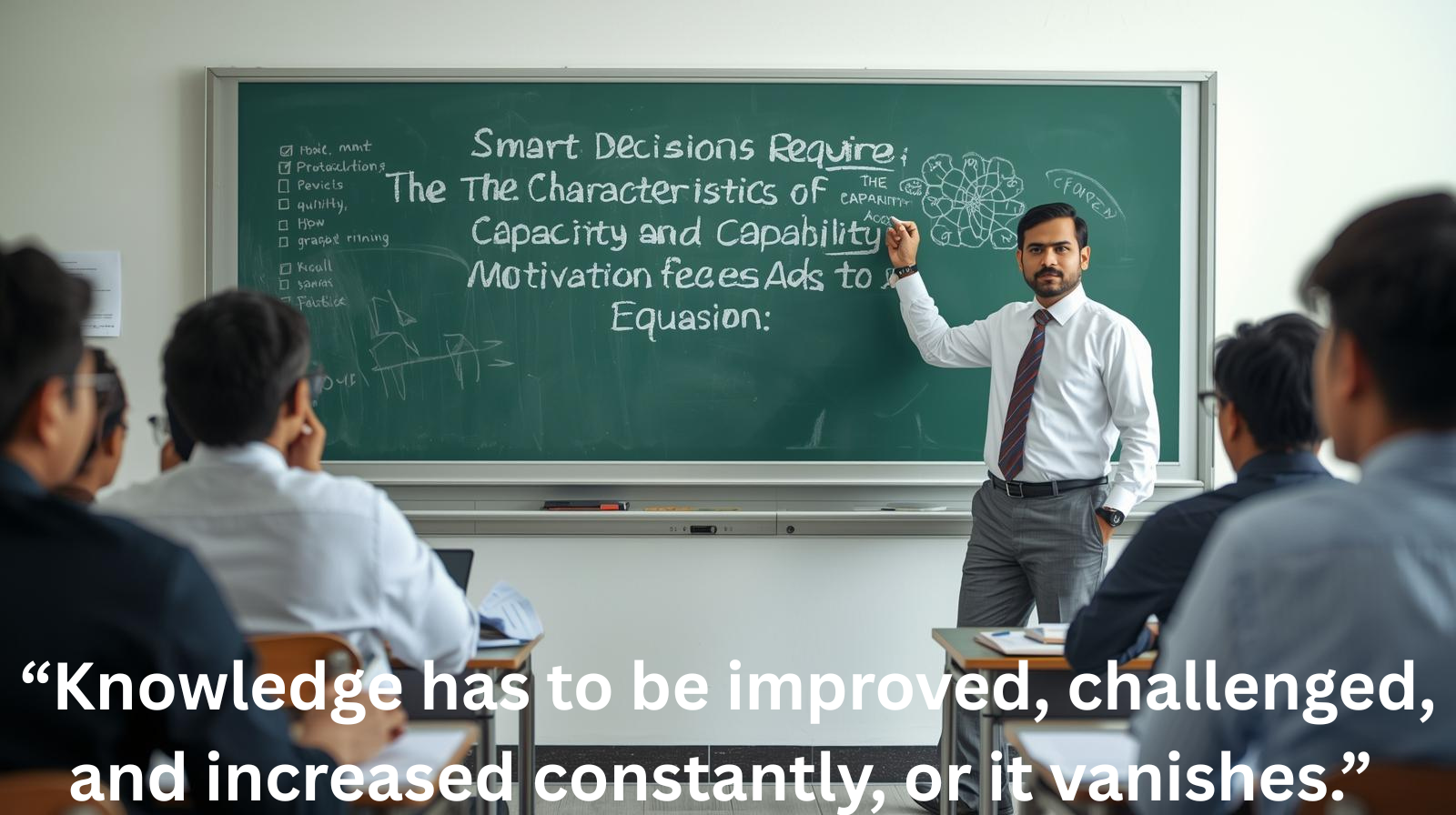
“Knowledge has to be improved, challenged, and increased constantly, or it vanishes.”
In other words, knowledge alone isn’t enough—your ability to apply it is what ultimately matters.
Capacity: The Stored Intelligence Behind Every Decision
Capacity is the raw cognitive infrastructure a person possesses—the memory, knowledge base, and mental bandwidth they bring into any situation.
1. Breadth of Knowledge
This includes facts, experiences, lessons observed, mistakes made, and insights collected over time. Someone with decades of experience often has an extensive reservoir of stored information.
2. Cognitive Bandwidth
Capacity also includes the ability to hold and process multiple variables at once. Working memory limits vary widely—some people can mentally juggle ten inputs; others struggle with two.
3. Mental Potential
Capacity is the size of the bucket, not the quality of what’s inside. It represents the upper limit of what someone could do, not what they will do.
Drucker emphasized the danger of accumulation without purpose:
“There is nothing quite so useless as doing with great efficiency something that should not be done at all.”
Capacity can store information indefinitely—but that doesn’t guarantee it will be applied meaningfully.
Capability: The Power to Turn Knowledge Into Action
Capability is applied intelligence—the set of skills that allow someone to synthesize, judge, and act on the information they hold.
1. Synthesis
High-capability thinkers connect disparate ideas. They identify patterns others miss and can innovate using what they already know.
2. Judgment
Judgment is the filtering mechanism that determines what matters. Drucker stated bluntly that:
“Making good decisions is a crucial skill at every level.”
Capability is ultimately measured by the quality of decisions, not the volume of information.
3. Execution
Capability is where reasoning becomes results. People with strong capabilities:
- Prioritize clearly
- Act decisively
- Adjust when conditions change
- Maintain clarity under pressure
“Results, not attributes, define effective leadership.” —Peter Drucker.
In other words, capability is demonstrated, not declared.
Capacity vs. Capability: The Core Differences
|
Feature |
Capacity |
Capability |
|
Nature |
Quantitative — How much? |
Qualitative — How well? |
|
Growth |
Limited by time, memory, and biology |
Expandable indefinitely through learning |
|
Role |
Stores information |
Applies and transforms information |
|
Analogy |
A giant library |
The ability to write a new book |
|
Outcome |
Possibility |
Performance |
A powerful Drucker line reinforces the distinction:
“Knowledge applied is productivity.”
Capacity gathers. Capability activates
How They Work Together in Decision‑Making
1. High Capacity + Low Capability
A person may hold enormous volumes of data yet struggle to act.
This is the seasoned veteran who:
- Knows the History
- Remembers every case study
- Can recite old frameworks
…but cannot adapt when the variables shift.
Drucker warned against relying on past success:
“Erroneous assumptions can be disastrous.”
2. Low Capacity + High Capability
These are the agile, high‑judgment thinkers—people who excel despite limited experience.
They:
- Learn fast
- Filter aggressively
- Apply what they know with precision
They avoid overload because they aren’t drowning in prior context. They use clarity as a competitive advantage.
3. High Capacity + High Capability
This is the rare combination: the strategic thinker.
These individuals:
- See more
- Understand more
- Do more
They integrate past knowledge with real-time insight—exactly what Drucker meant when he said:
“The most serious mistakes are not being made as a result of wrong answers. The hazardous thing is asking the wrong question.”
Strategic thinkers ask better questions because they have both capacity and capability.
How Background Knowledge Helps—And Hurts
Your background knowledge dramatically expands your capacity. It gives you:
- More patterns to recognize
- More scenarios to draw from
- More cognitive “raw materials.”
But background knowledge also carries risks:
- Old assumptions
- Emotional baggage
- Outdated frameworks
- Overconfidence
Drucker captured this perfectly in a warning that applies directly to capacity:
“The days of the intuitive Manager are numbered.”
In other words, relying solely on experience (capacity) without disciplined thinking (capability) is a recipe for failure.
Capability is what filters the noise. Capacity is what collects it.
Cultivating both capacity and capability empowers you as a leader to make better decisions and guide your team more effectively.
Most leaders overinvest in capacity—degrees, training, experience—and underinvest in capability—decision‑making, synthesis, judgment.
The result?
- Leaders with long résumés but shallow insight
- Teams with massive data but no direction
- Organizations that know more yet do less
Drucker’s famous distinction applies directly here:
“Management is doing things right; leadership is doing the right things.”
Capacity helps you do things right.
Capability enables you to choose the right things to do.
Building Both: A Framework for Better Thinking
To Build Capacity
- Read broadly
- Seek diverse experiences
- Document lessons learned
- Expand your “mental library.”
To Build Capability
- Practice structured decision‑making
- Use mental models
- Challenge your first assumptions
- Conduct after-action reviews
- Study contrasting viewpoints
Drucker reinforces the importance of reflection:
“Follow effective action with quiet reflection.”
Reflection is where capability is strengthened.
Final Takeaway
Capacity is stored intelligence—the total of what you know.
Capability is activated intelligence—your ability to convert knowledge into wise, timely, high-quality action.
One without the other leads to poor decisions, stalled careers, and leadership breakdowns. But together, they form the foundation of sound judgment and strategic excellence.