Summary
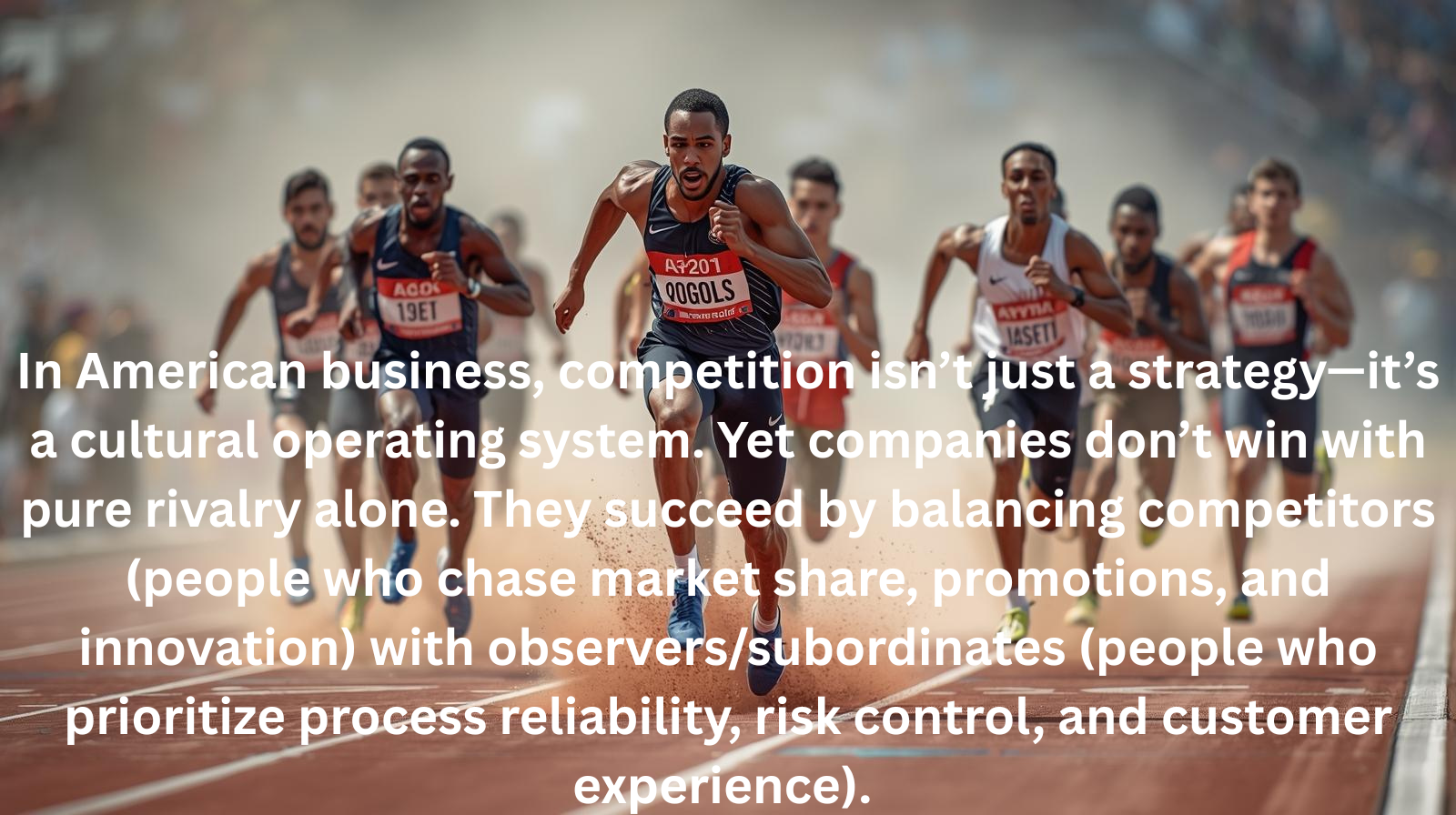
In American business, competition isn’t just a strategy—it’s a cultural operating system. Yet companies don’t win with pure rivalry alone. They succeed by balancing competitors (people who chase market share, promotions, and innovation) with observers/subordinates (people who prioritize process reliability, risk control, and customer experience).
Competitors vs. Observers Sitting on the Sidelines in Business:
How Every Sector Balances Drive and Discipline
In American business, competition isn’t just a strategy—it’s a cultural operating system.
Yet companies don’t win with pure rivalry alone. They succeed by balancing competitors (people who chase market share, promotions, and innovation) with observers/subordinates (people who prioritize process reliability, risk control, and customer experience).
Below is a tour across major sectors—technology, retail, finance, healthcare, manufacturing, energy, and media—showing how this tension plays out, with real-world examples leaders can apply today.
Technology: “Day 1” Competitors vs. “Day 2” Observers
Amazon famously codified its competitive ethos as “Day 1”—an insistence on customer obsession, bold bets, and high‑velocity decisions that prevent bureaucratic drift (“Day 2 is stasis… and death”). Competitors at Amazon push hard: they invent and simplify, “disagree and commit,” and bias for action. Observers and subordinates counterbalance by diving deep, insisting on the highest standards, and maintaining operational excellence across massive logistics networks—roles that prevent chaos in an innovation machine.
Takeaway: Tech firms should pair “two‑pizza team” builders (competitive innovators) with strong operators who enforce metrics, security, and process hygiene; otherwise, speed becomes fragility.
Retail: Cost‑Leadership Competitors vs. Process‑Driven Observers
Walmart’s Everyday Low Price (EDLP) strategy exemplifies relentless market competition, forcing rivals to lower prices and enhance the customer experience. Studies synthesize decades of evidence that Walmart’s prices are often 10–25% lower than competitors’ and that this pricing triggers price drops even when rivals don’t shop at Walmart. Inside Walmart, competitors chase scale and purchasing power; observers/subordinates make EDLP possible by supply chain discipline, automation, and lean inventory that keep costs down day after day.
Takeaway: EDLP only works when competitive pricing is matched by observer roles enforcing standardized replenishment, vendor compliance, and demand forecasting; otherwise, “low price” becomes “low margin chaos.”
Finance: Star Competitors vs. Passive Observers (and Why Both Matter)
Wall Street glorifies competitors—producers and dealmakers who chase alpha. At Goldman Sachs, internal culture highlights agility, collaboration, and apprenticeship, drawing over one million applications annually and promoting performance management to develop “extraordinary careers.” External assessments find that Goldman employees rank in the top percentile for agility and collaboration among peers in finance.
But modern markets are also shaped by passive investors—the observer equivalent. Index funds and passive strategies (pioneered and scaled by Vanguard) now account for roughly half of global mutual fund/ETF equity assets, and decades of data show that most active managers underperform benchmarks net of fees—Vanguard positions indexing as a low-cost, diversified “set‑and‑observe” approach for many investors.
Takeaway: Finance organizations thrive when they harness competitive risk‑takers (e.g., investment banking, structured products) alongside observer disciplines (index/tracking, risk, compliance). This blend stabilizes returns through cycles.
Healthcare: Competitive Integration vs. Observational Quality
U.S. healthcare has seen vertical integration among payers, PBMs, providers, and clinics—competitors assemble end-to-end platforms to steer patients, control costs, and capture value. CVS Health’s multi-year push (Aetna, Signify Health, Oak Street Health) illustrates this strategy, even amid headwinds and regulatory scrutiny across integrated drug channels. CVS continues to invest (e.g., a $20B tech‑enabled experience plan over a decade) to unify data and care touchpoints—an archetypal competitive move.
On the observer side, systems like Mayo Clinic emphasize outcomes, patient satisfaction, and standardized processes—raising “Likely to Recommend” scores from ~83% to ~88% (2017–2021) through structural changes to patient experience. Mayo publicly tracks outcome and process measures and earns top-quality recognition across U.S. ratings—an exemplar of the subordinate disciplines that make care reliable.
Takeaway: Health organizations need competitive integrators (platform builders) paired with observer excellence (quality metrics, patient experience). Ignore either, and you get either fragmentation or sterile bureaucracy.
Manufacturing: Kaizen Competitors vs. Stability Observers
Toyota’s lean/TPS and kaizen show how competition can be continuous yet controlled: frontline workers propose micro-improvements that compound into quality, speed, and cost advantages—without sacrificing reliability. Research and case summaries emphasize the pillars—Just-in-Time, Jidoka, standardized work, and daily problem-solving—where “competitors” are often operators who challenge waste, and “observers” are those who maintain standards and stop the line to fix root causes.
Real world: Incremental kaizen (e.g., tool position changes, material flow tweaks) boosts throughput and cuts defects—examples frequently cited in kaizen literature across TPS practice.
Takeaway: Manufacturing leaders should reward small competitive wins (continuous improvements) and empower observers to halt processes, analyze variation, and protect quality, creating a virtuous cycle.
Energy & Utilities: Project Competitors vs. Grid Observers
NextEra Energy (FPL + NextEra Energy Resources) typifies sector competition: record renewables and storage origination backlogs and multi-GW PPAs (e.g., 2.5 GW in clean energy contracts with Meta across ERCOT, SPP, and MISO). The company reports sustained EPS growth and leading origination volumes in 2024—competitive signals in a capital-intensive market. Leadership commentary underscores an “all‑of‑the‑above” approach—renewables, storage, gas, nuclear—to meet surging demand from data centers.
Observers/subordinates here are the grid planners, reliability engineers, and compliance teams who keep bills low and service resilient while competitive teams chase large PPAs and storage pipelines.
Takeaway: Energy firms should split responsibilities: competitive teams originate, finance, and build projects; observer teams harden grids, manage rates, and ensure regulatory alignment—so growth doesn’t outpace resilience.
Media & Streaming: Growth Competitors vs. Churn Observers
In streaming, Netflix and Disney exemplify the competitive landscape: Netflix surpassed ~302M global subscribers in Q4 2024 before changing disclosure practices; Disney+ sits at ~126–132M, depending on the quarter, with corporate bundles via Hulu and ESPN+. Content spend is aggressive—Netflix at $15.3B in 2024, outpacing rivals—another competitive lever to win attention.
Observers/subordinates inside streamers fight churn mechanics through pricing, ad tiers, ARPU discipline, catalog curation, and live/event experiments—stability work that offsets subscription volatility even as competitors chase buzzy originals and IP.
Takeaway: Media leaders need competitive content bets matched by observer controls (ARPU, bundles, ad tiers, regional pricing) to convert hits into durable cash flows.
How Companies Balance Roles (A Simple Framework)
Think of your organization on two axes:
- X‑axis: Competitive Drive (low → high)
- Y‑axis: Organizational Impact (support → leadership)
Quadrants
· Strategic Competitors (High drive, high Impact): Product owners, dealmakers, innovators.
· Emerging Challengers (High drive, lower Impact): Ambitious specialists who need sponsorship.
· Trusted Specialists (Lower drive, high Impact): Quality, risk, compliance, reliability experts.
· Passive Participants (Lower drive, lower Impact): Minimal engagement—focus on coaching or role redesign.
Best practices across sectors:
- Dual reward systems: Celebrate risk-taking outcomes and process excellence (e.g., Amazon’s “Deliver Results” alongside “Dive Deep”).
- Pairing model: Assign a competitive leader and an observer partner to every major initiative (product–ops, origination–grid, content–churn). Examples abound in NextEra’s growth, FPL’s reliability, and Toyota’s kaizen paired with standard work.
- Metric symmetry: Track win metrics (market share, origination, subs) alongside stability metrics (quality ratings, MLR/compliance, churn/ARPU). Mayo’s public quality dashboards are a model.
- Cultural clarity: Codify principles (e.g., Amazon’s Leadership Principles) so competitors know the boundaries and observers know the priorities.
Bottom Line
Across sectors, competitors drive growth; observers/subordinates ensure it is repeatable, resilient, and compliant. The organizations that win—whether Amazon, Walmart, Goldman, CVS/Mayo, Toyota, NextEra, or Netflix/Disney—build systems where both instincts coexist: pushing forward and holding the line.