Summary
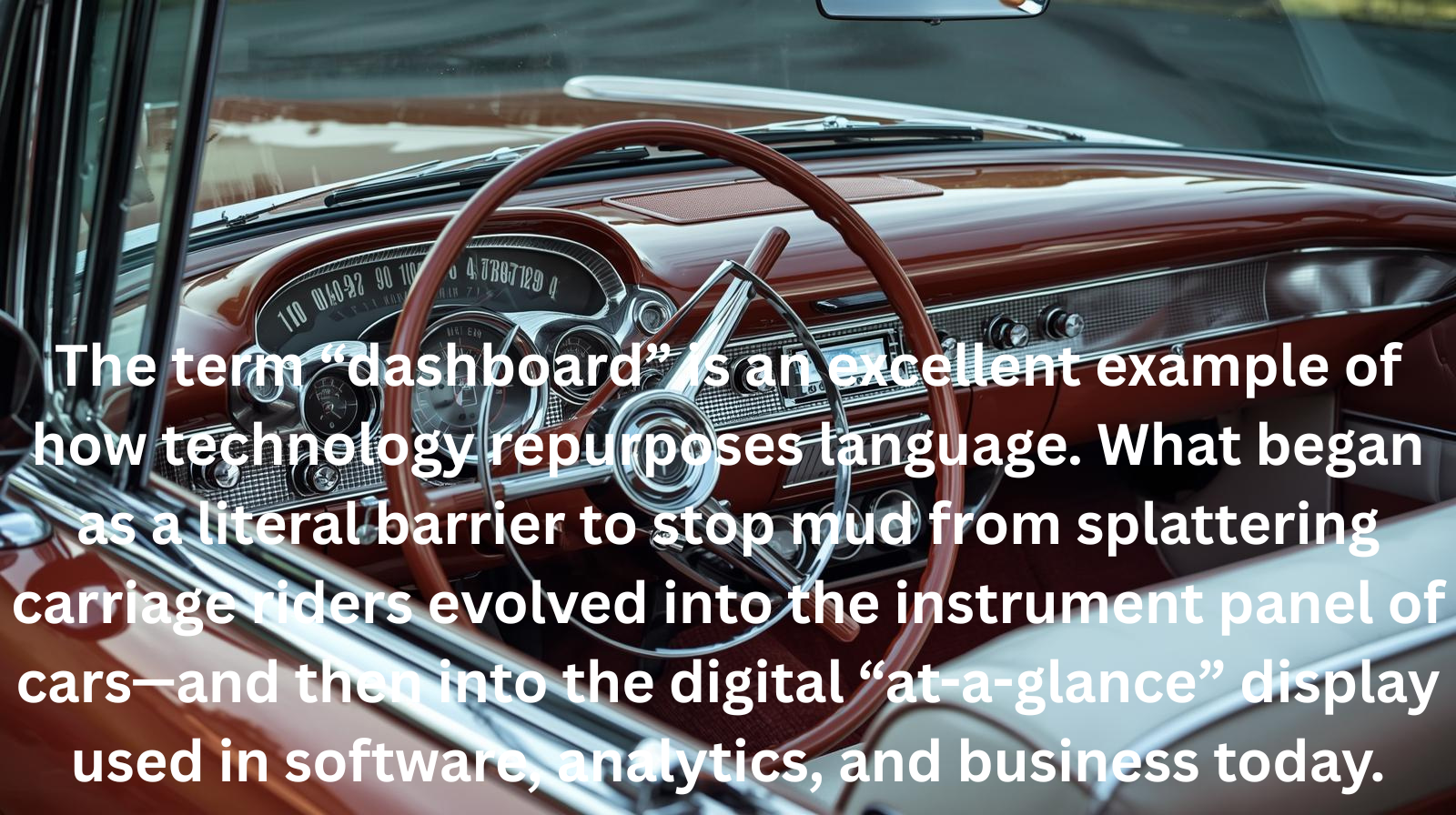
The term “dashboard” is an excellent example of how technology repurposes language. What began as a literal barrier to stop mud from splattering carriage riders evolved into the instrument panel of cars—and then into the digital “at-a-glance” display used in software, analytics, and business today.
1) What does “dashboard” mean today (modern senses)
In contemporary English, dashboard commonly means:
· Vehicle sense: the panel below (or around) the windshield where gauges, indicators, and controls are located.
· Digital/management sense: a single screen or page that summarizes key information—often metrics, status indicators, and controls—for a system, project, or organization.
· Historical sense: a screen/board at the front of a horse-drawn vehicle designed to intercept mud, water, or snow thrown up by hooves.
Merriam-Webster explicitly captures all three of these senses in its entry—vehicle panel, data “graphical report,” and the older horse-drawn splash-guard meaning.
2) The origin: a board that took the “dash” (mid-1800s)
The literal “dashboard.”
Dashboard originally appeared as “dashboard” in the 1840s, describing a wooden board or leather apron mounted at the front of a carriage or sleigh to prevent mud and water from being “dashed” (splashed or thrown) into the vehicle by the horses’ hooves.
Different historical dictionaries cite slightly different “first evidence” years, but they converge on the mid-1840s:
- Merriam-Webster: “first known use” 1842 (in the horse-drawn sense).
- OED: earliest evidence 1847 (and notes the term’s early association with carriage-building).
- Etymonline: traces “dashboard” to 1846 and emphasizes the mud-splash function.
Why the name makes sense: the “dash” in dashboard is tied to the idea of something being thrown violently or splashed against a surface—so the board is where the mud gets “dashed.”
The parts of the word: dash + board
Etymonline breaks the word down transparently as dash (verb) + board (noun)—a board (plank/surface) designed to take the dash (splash/strike) of mud and water.
3) The automotive shift: from splash-guard to instrument panel (late 1800s–early 1900s)
As “horseless carriages” arrived, early vehicle designs borrowed carriage conventions, including the dashboard—at first still serving a protective role.
By the early 1900s, the meaning had broadened: the dashboard became the area where controls and gauges were mounted. Etymonline notes this motor-vehicle sense by 1904, describing it as the panel beneath the windshield where controls and gauges are mounted.
Wikipedia’s overview traces the same evolution: the dashboard initially protected occupants from debris and later served as a convenient location for instrumentation as vehicle complexity increased.
While the object remained in its exact location at the front of the operator, its role shifted from merely blocking debris to organizing information and controls, reflecting a broader evolution from physical protection to facilitating rapid, informed decisions across both vehicles and digital interfaces.
4) The metaphor leap: why software adopted “dashboard” (late 20th century onward)
The modern digital usage is essentially an analogy:
- A car dashboard provides a driver with real-time information (speed, fuel, warnings) and controls that enable action.
- A software dashboard provides users with real-time status (KPIs, alerts, system health) and, in some cases, controls (filters, toggles, workflows) that enable action.
The Oxford English Dictionary notes that “dashboard” developed a computing meaning by the 1990s, marking the period when the metaphor became common and dictionary-stable.
The shift from horse-drawn carriages to digital screens is mirrored today in various fields: business dashboards display KPIs; IT dashboards monitor system health; and management dashboards support decision-making, showing how the concept adapts across contexts.
5) A short timeline of meaning (semantic evolution)
- 1840s: dashboard = protective board/apron on a carriage to intercept mud/water “dashed up.”
- Late 1800s–early 1900s: term carried into early automobiles; still protective, then increasingly functional.
- By ~1904: dashboard = vehicle panel where gauges/controls are mounted.
- By the 1990s: dashboard = computing sense (an at-a-glance control/status display).
- Today: dashboard = a common term for analytics, operations, admin consoles, and KPI summaries in organizations.
6) What the word really implies (the “hidden meaning”)
Across all its senses, the dashboard keeps a consistent functional DNA:
A dashboard is…
- Front-and-center: placed where an operator naturally looks.
- Status + action: it both informs and often enables control (even in early car dashboards as instruments accumulated).
- A protective filter (historically literal, now metaphorical): it “intercepts” the chaos—mud then, data noise now—so you get a usable signal.
That’s why the metaphor fits so well: in software, a dashboard “blocks the mud” of raw logs, events, and spreadsheets and replaces it with a usable, decision-ready view.
7) Related terms and near-synonyms (and why “dashboard” persists)
You’ll often see:
- Instrument panel (especially in technical/automotive contexts).
- Control panel/admin console (standard in software).
- KPI cockpit/scorecard (familiar in management reporting, with slightly different emphases).
Still, “dashboard” persists because it instantly communicates: “Here’s what’s happening, and here’s what you can do about it—quickly.”
Wrap-up: from mud-splatter to metrics
Dashboard originated as a practical, literal innovation—a board that caught the splash of mud—and later became the name for the modern control-and-information surface in vehicles and, later, in the digital world. Its History explains its staying power: the word doesn’t just mean “display,” it implies situational awareness + control, designed for fast decisions.