Introduction: The lowest rung is wobbling
AI is rewriting the rules of work—and the lowest rung on the career ladder may vanish for many roles that used to start around $20/hour or less. Surveys show growing anxiety: over half of U.S. workers report being worried about how AI will be used at work, and a third believe it could reduce their long-term job opportunities.
To support workforce stability, organizations should implement proactive strategies to address these concerns and reassure HR professionals and leaders about future pathways. The trend is based on a national Pew Research Center survey of 5,273 employed adults conducted in October 2024.
The generational split is stark. An extensive multi-country survey from Deutsche Bank found that 24% of workers aged 18–34 are “very concerned” about losing their jobs to AI in the next two years, compared to just 10% of workers 55+.
This is more than perception. Emerging evidence suggests entry-level hiring is already shrinking in AI-exposed occupations, especially software engineering and customer service, while demand for experienced talent rises. Analyses from Stanford’s Digital Economy Lab and media summaries based on ADP payroll data indicate double-digit declines in early-career employment in those fields since late 2022.
Yet the story isn’t uniform. In real-world deployments, generative AI often helps inexperienced workers the most, boosting productivity and retention without harming customer satisfaction, suggesting a way to redesign entry-level pathways rather than eliminate them.
I. Why younger workers are more worried—and why that matters
For decades, younger workers eagerly adopted new tools while older colleagues resisted. AI appears to flip that script by automating the routine tasks that new hires were traditionally assigned to—data entry, report drafting, scheduling, basic research, and bug fixes. Studies of freelance platforms and early corporate hiring signals show that routine, automation-prone work has declined quickly since the launch of ChatGPT and AI image generators, with entry-level writing, coding, and design hit first.
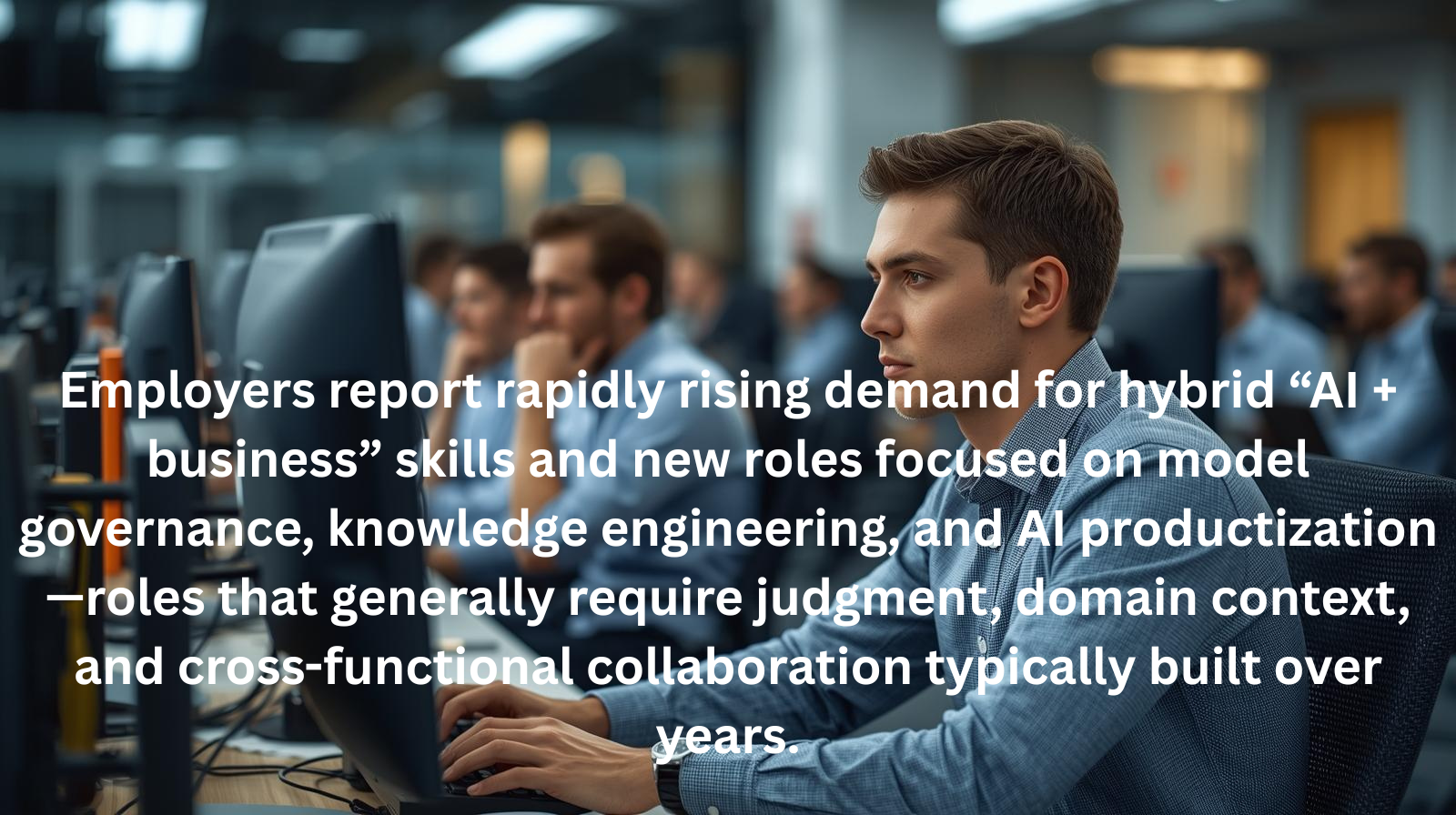
At the same time, employers report rapidly rising demand for hybrid “AI + business” skills and new roles focused on model governance, knowledge engineering, and AI productization—roles that generally require judgment, domain context, and cross-functional collaboration typically built over years.
Gartner’s 2024–2025 research highlights both the upskilling imperative (80% of the engineering workforce through 2027) and the emergence of “AI engineers” who blend software, data, and ML skills.
If organizations proactively develop workforce strategies, they can secure future leadership and expertise, fostering confidence in their approach.
II. The disappearing bottom rung: risks and realities
- Pipeline disruption. When AI handles entry-level work, fewer new hires gain foundational experience (client exposure, internal tooling, failure recovery) needed to advance. Signals from tech companies and venture research show steep declines in graduate hiring in 2024 versus 2023, while senior hiring rose, consistent with AI replacing routine tasks.
- Geographic and occupational unevenness. Brookings finds higher AI “exposure” in white-collar cognitive work than in manual or in-person roles; impacts will vary by metro and industry mix.
- Macro nuance. At the economy-wide level, Yale’s Budget Lab (with Brookings scholars) observes no broad labor market disruption yet, reminding leaders that adoption unfolds over years—even as early-career pockets show sharper effects.
Insight: AI is erasing the grunt work, not the learning curve. If you remove the bottom rung, you remove the staircase.
III. What forward-thinking companies are doing (playbook)
A. Launch “AI‑native” entry tracks
Design roles that begin with AI oversight and optimization rather than rote execution.
These tracks teach new hires how to:
- Prompt effectively, maintain context, and chain tools.
- Evaluate model outputs, spot hallucinations, and document decisions.
- Escalate to experts when judgment exceeds their remit.
This mirrors Gartner’s “AI‑first” trajectory in engineering roles and the creation of new AI governance specialties across data & analytics teams.
Pair this with structured skill rubrics so juniors advance based on demonstrated capability (e.g., reliable model evaluation on real tasks), not on time-in-role that may no longer exist. Defining clear success metrics, such as skill mastery and contribution quality, helps leaders assess the effectiveness of workforce redesign initiatives and ensures alignment with strategic goals. The broader shift to skills-based talent management is accelerating, even as many organizations are still learning how to execute it.
B. Make mentorship the center—AI does the grunt work
Re-engineer early‑career jobs so AI handles repetitive tasks while juniors shadow senior professionals to build judgment. Real-world field experiments show that less-experienced workers benefit most from AI, which helps narrow performance gaps and improve retention—ideal conditions for apprenticeship models.
Harvard Business Review contributors warn that eliminating entry-level roles is short-sighted and advocate redesigning them to focus human effort on creativity, collaboration, and decision-making.
C. Shift from “roles” to project-based progression
Rotate new hires through AI implementation projects across departments (finance, ops, customer success, marketing). They learn about technology adoption, stakeholder management, and cross-functional communication—experiences that build lasting value and embed adaptability into the cultural DNA. McKinsey’s 2025 report on AI maturity emphasizes leadership-led workflow redesign and employee readiness for AI—but gaps persist without decisive steering.
D. Build competency‑over‑tenure advancement
Replace time‑served metrics with evidence of capability:
- Observable behaviors (risk flagging, escalation discipline)
- Output quality (measured via peer review + customer outcomes)
- Reproducible playbooks (how they turned AI outputs into business value)
This aligns with the World Economic Forum’s multi-year view: skills are shifting quickly, clerical/secretarial roles are facing automation, and AI literacy and soft skills (communication, collaboration) are becoming central to employability.
IV. Integrate AI training with core business development
AI isn’t a silo. The winning approach trains AI alongside core disciplines:
- Prompting and financial analysis: Train junior analysts to build economic models and use AI for scenario exploration, sensitivity analysis, and documentation. McKinsey’s global research shows organizations are redeveloping workflows and investing in broad upskilling to capture AI value.
- Bias detection + market research: Train workers to test datasets and outputs for bias while conducting segmentation and insight generation—reflecting the OECD’s warning that general AI literacy supply lags demand and must be scaled inclusively.
- Model evaluation + customer relations: Juniors compare AI recommendations against firm standards while handling live client interactions, improving customer outcomes, and raising retention; this was observed in the large NBER‑summarized experiment.
Insight: Teach AI in context: forecasting with prompts, not prompting without a forecast.
V. Address the worry: evidence, not platitudes
Workers—especially young workers—are right to ask where they’ll start when the entry-level workload goes away. Leaders should respond with transparent data and pathways:
- Acknowledge the anxieties. Half of workers are worried about AI’s Impact, and younger cohorts show significantly higher fear of displacement than older ones.
- Show national context. Economy-wide indicators don’t yet show broad disruption, even as early‑career segments shift—meaning there’s time to shape outcomes before they ossify.
- Commit to reskilling at scale. OECD’s 2025 brief and WEF’s Jobs reports emphasize lifelong learning: expanding AI literacy for all workers, not just specialists, and reorganizing roles as tasks change.
- Invest in human complements. MIT/Stanford productivity studies demonstrate AI augmentation can be a net positive for novices—increasing speed, quality, and retention when paired with sound systems and mentorship.
VI. Practical blueprint: Building an “AI‑native” early‑career ladder
· Map the task stack. Identify entry-level tasks your AI can reliably do (e.g., draft, summarize, QA, simple analysis). Use controlled pilots to confirm accuracy, speed, and error profiles. (Gartner and McKinsey advise leadership-led governance, with clear role definitions and oversight.)
· Redefine the junior job. Swap routinized execution for AI oversight + stakeholder communication—a safer, higher‑value starting point.
· Codify mentorship. Require 1:1 pairing, weekly judgment walkthroughs, and documented decision rationales—AI handles the rote; mentors teach the why. Evidence suggests this design improves novice performance the most.
· Adopt competency-based progression—advance juniors when they meet capability rubrics, not after fixed time periods. WEF and Gartner foresee skills-centric talent systems becoming standard as tasks shift.
· Stand up an AI skills academy. Blend prompt engineering, retrieval‑augmented workflows, evaluation techniques, and domain-specific modules (finance, ops, client comms). Gartner expects widespread upskilling and the emergence of new hybrid roles; the OECD warns that the overall training gap remains wide.
· Rotate through projects. Let new hires deliver tangible outcomes across functions (marketing automation, customer support assistants, forecast simulators), building cross-functional fluency that sustains long-term internal mobility. McKinsey emphasizes workflow redesign and urgent leadership to achieve AI maturity.
VII. Human + AI: where advantage accrues
Competitive advantage will increasingly accrue to organizations that combine technology deployment with human capability development. WEF data shows employers plan both AI reorientation and AI-specific hiring, even as they expect reductions in routine roles; net effects depend on reskilling and role redesign.
The best evidence to date indicates that AI can raise productivity and improve service—especially for less‑experienced workers—when embedded in thoughtful workflows. That gives leaders a choice: pursue short-term cost cuts by removing entry points, or use AI to accelerate learning, judgment, and mobility, preserving the pipeline that makes future leadership possible.
Insight: Treat AI adoption with the same rigor as technical deployment—and the same humanity as leadership development.
Conclusion: Don’t let the bottom rung disappear—rebuild it
AI is eliminating many traditional entry-level tasks. But that doesn’t have to mean the end of entry-level jobs. The organizations that win will rebuild the bottom rung through AI-native apprenticeships, ensuring juniors start with oversight, optimization, and customer exposure while learning to integrate AI responsibly into everyday work.
Do that—and you’ll build a workforce where humans and AI achieve outcomes alone, with stronger pipelines, faster progression, and higher trust. The anxiety is real; so is the opportunity. The next generation is ready. Let’s give them something worth climbing.
The barrier is the public education institution in America. It exists for the benefit of teachers, administrators, and those reporting for compliance with standards unrelated to students’ needs, increased pay, more time off, and early retirement. The kids do not seem to be in the equation. A good start would be to dismantle the Federal Education Bureaucracy and concurrently issue a mandate to teach saleable skills.
Sources for further reading
- Pew Research Center: U.S. workers’ views on AI in the workplace (survey conducted Oct 7–13, 2024; published 25 February 2025). Link
- Deutsche Bank dbDataInsights Survey (2025): Generational differences in AI job‑loss concerns. Link
- Stanford/MIT/NBER: Field experiments on generative AI and novice productivity. Link • Link • Link
- World Economic Forum: Future of Jobs (2023, 2025 coverage). Link • Link
- Gartner: Upskilling imperative and new AI roles in engineering/data. Link • Link • Link
- McKinsey: AI in the workplace (2025) and workflow redesign for AI maturity. Link • Link
- OECD: Bridging the AI skills gap (2025 policy brief). Link
- TechCrunch/entrepreneur/CBS: Evidence of entry-level contraction in AI‑exposed roles. Link • Link • Link
- Brookings/Yale Budget Lab: Geography and macro labor‑market impacts of generative AI. Link • Link