Summary
Yes—a strong “entitlement consciousness” can make insubordination more likely, but it’s rarely the only cause. Think of entitlement as a lens some people use to interpret workplace authority: “Rules are for others,” “I deserve exceptions,” or “I shouldn’t have to be told.” That mindset can lower the internal “brakes” that typically keep employees aligned with legitimate supervision.
Below is a practical, workplace-focused breakdown.
What “entitlement consciousness” means (in plain terms)
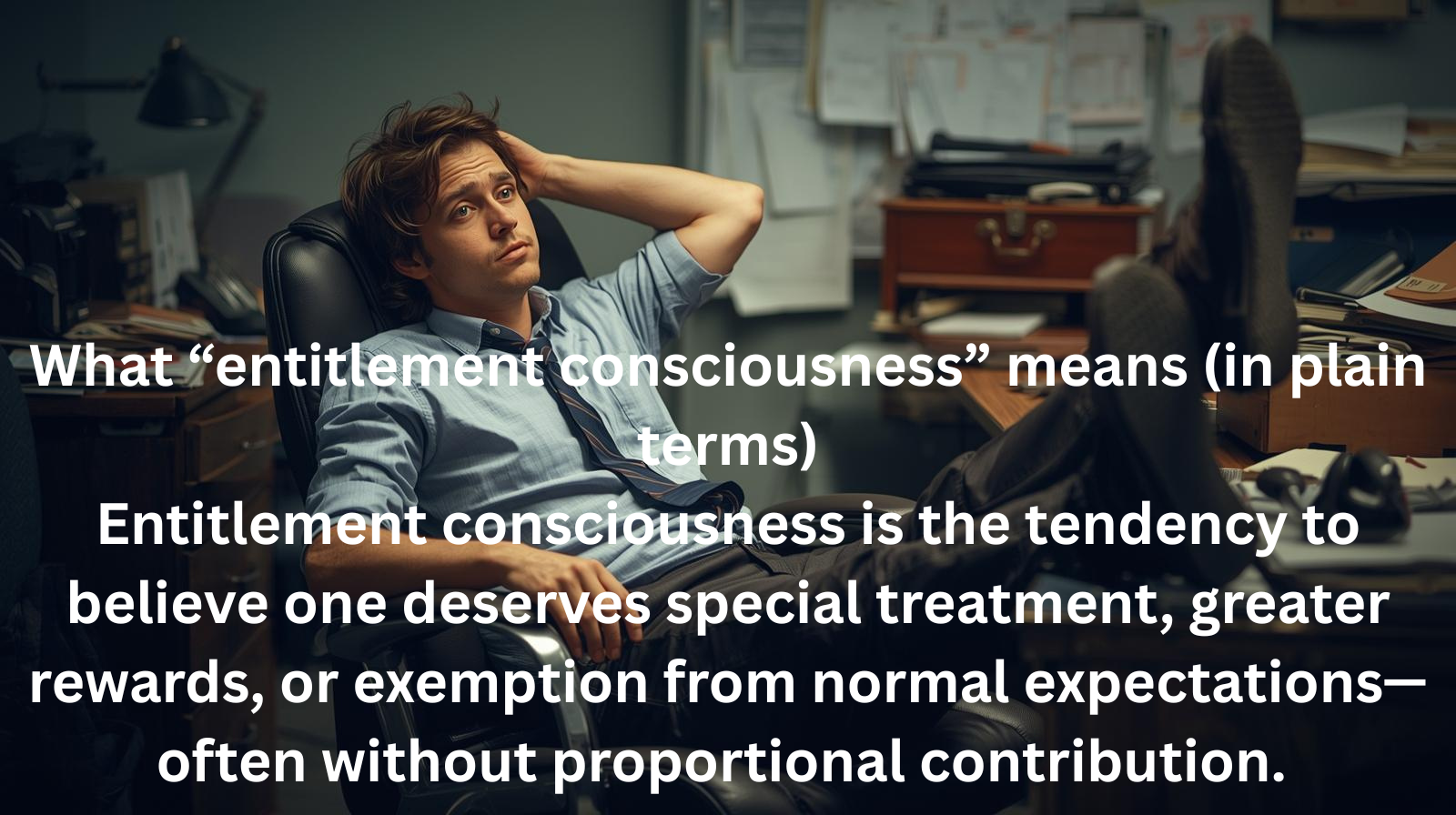
Entitlement consciousness is the tendency to believe one deserves special treatment, greater rewards, or exemption from normal expectations—often without proportional contribution.
It can be:
- Trait-like (stable): a long-standing personality tendency.
- State-like (situational): triggered by status, past success, favoritism, or a culture that rewards bad behavior.
How entitlement can translate into insubordination
Entitlement doesn’t automatically cause insubordination. But recognizing signs and causes can help managers respond effectively, increasing their sense of control and competence.
1) “Rules don’t apply to me” thinking
If someone believes they’re above standard processes, they’re more likely to:
- ignore procedures,
- negotiate every directive,
- refuse instructions that feel “beneath them.”
Typical phrasing: “That’s not my job,” “I don’t do that,” “Get someone else,”” The boss wants me to change my attitude-F-him,” “That’s the way we have always done it.”
2) Status protection and ego threat
Entitled employees often experience regular supervision as a threat to identity (“You’re telling me what to do?”).
That can trigger:
- defensiveness,
- public pushback,
- Refusal framed as “principle” when it’s really pride.
Translation: The directive is less the issue than the perceived insult.
3) Reduced respect for authority (especially if leadership is imperfect)
Everyone notices the Manager's weaknesses; entitled people often treat those weaknesses as permission to disobey.
Pattern: “If you’re not perfect, I don’t have to follow you.”
4) High defiance: resisting control
Some people have a strong aversion to being directed. Entitlement can amplify this, leading to a reflexive:
- “No,”
- “Make me,”
- “I’ll do it my way.”
5) Inflated fairness math (“I deserve more”)
Entitlement shapes fairness perceptions. Even reasonable requests can feel “unfair” if the employee believes they’re owed:
- better assignments,
- preferential schedules,
- exemption from scrutiny,
- I’m worth a lot more than what they pay me.
Result: refusal becomes a “justice” story: “I’m not being respected.”
6) Moral licensing: “Because I’ve done X, I can ignore Y.”
A high performer can start thinking:
- “I hit my numbers so that I can skip the meeting.”
- “I saved the project, so I don’t need to follow your process.”
This is one of the most common real-world forms of entitlement: performance as permission.
But be careful: “Entitlement” can be misdiagnosed.
Managers sometimes label pushback as entitlement when it’s one of these:
Legitimate reasons that can look like entitlement
- Ethical/safety refusal (“This violates policy” or “This is unsafe”)
- Role ambiguity (“I don’t have authority/resources to do this”)
- Broken trust due to disrespectful leadership
- Burnout (low emotional bandwidth; irritability ≠ , entitlement)
- Conflicting priorities (two bosses, two deadlines)
Key point: Entitlement is about unearned exception-seeking. Differentiating legitimate refusals by lawfulness, safety, or scope can help managers feel more assured and precise in their decisions.
Quick diagnostic: Is it entitlement-driven insubordination?
Use observable signals (not mind-reading):
More likely entitlement
- They seek exceptions repeatedly (“I don’t do that,” “Not for me.”)
- They resist basic accountability (time, process, reporting)
- They frame compliance as an insult
- They comply only when it benefits them or preserves their status
- They show a pattern across managers, not just one relationship
Less likely entitlement
- They ask clarifying questions and propose solutions
- They raise safety/legal/policy issues with specifics
- Behavior changed after an apparent trigger (new workload, personal crisis, organizational change)
Why entitlement “works” for some people (and becomes insubordination)
Entitlement-driven insubordination grows when the environment rewards it:
Organizational conditions that enable it
- Inconsistent consequences (star performers get a pass)
- Managers avoid conflict
- Weak role clarity (“everyone does everything”)
- Toxic culture where defiance is normalized
- Short-term pressure that causes leaders to tolerate bad behavior for output
When insubordination carries no cost—or even secures what the person wants—it becomes a strategy.
What to do if entitlement is driving insubordination
1) Make expectations concrete (removes “wiggle room”)
Use “what/when/how measured” language:
- “Submit X by 3 p.m. in Y format. If you can’t, tell me by noon.”
2) Separate the voice from the veto
People can disagree, but they can’t unilaterally decline lawful directives:
- “You can recommend an alternative. Final decision is mine.”
3) Coach once; manage performance quickly if it persists
Entitlement doesn’t usually respond to endless debate. Respond to behavior:
- document refusals,
- set consequences,
- follow through consistently.
4) Avoid public power contests
Correct in private, reinforce standards in public.
5) Remove “special exemptions” that aren’t earned
If you keep granting exceptions, you strengthen entitlement.
6) Reinforce status in healthy ways (especially with high performers)
High performers often want autonomy and respect.
Offer:
- greater discretion with clear non-negotiables,
- leadership opportunities tied to role-model behavior.
Bottom line
Entitlement consciousness can absolutely make some people more prone to insubordination—because it reduces respect for authority, increases resistance to control, and encourages exception-seeking. But it’s best treated as a risk factor, not a diagnosis. The more brilliant move is to focus on patterns of behavior, the context that rewards it, and the consistency of leadership response.