Key Insight
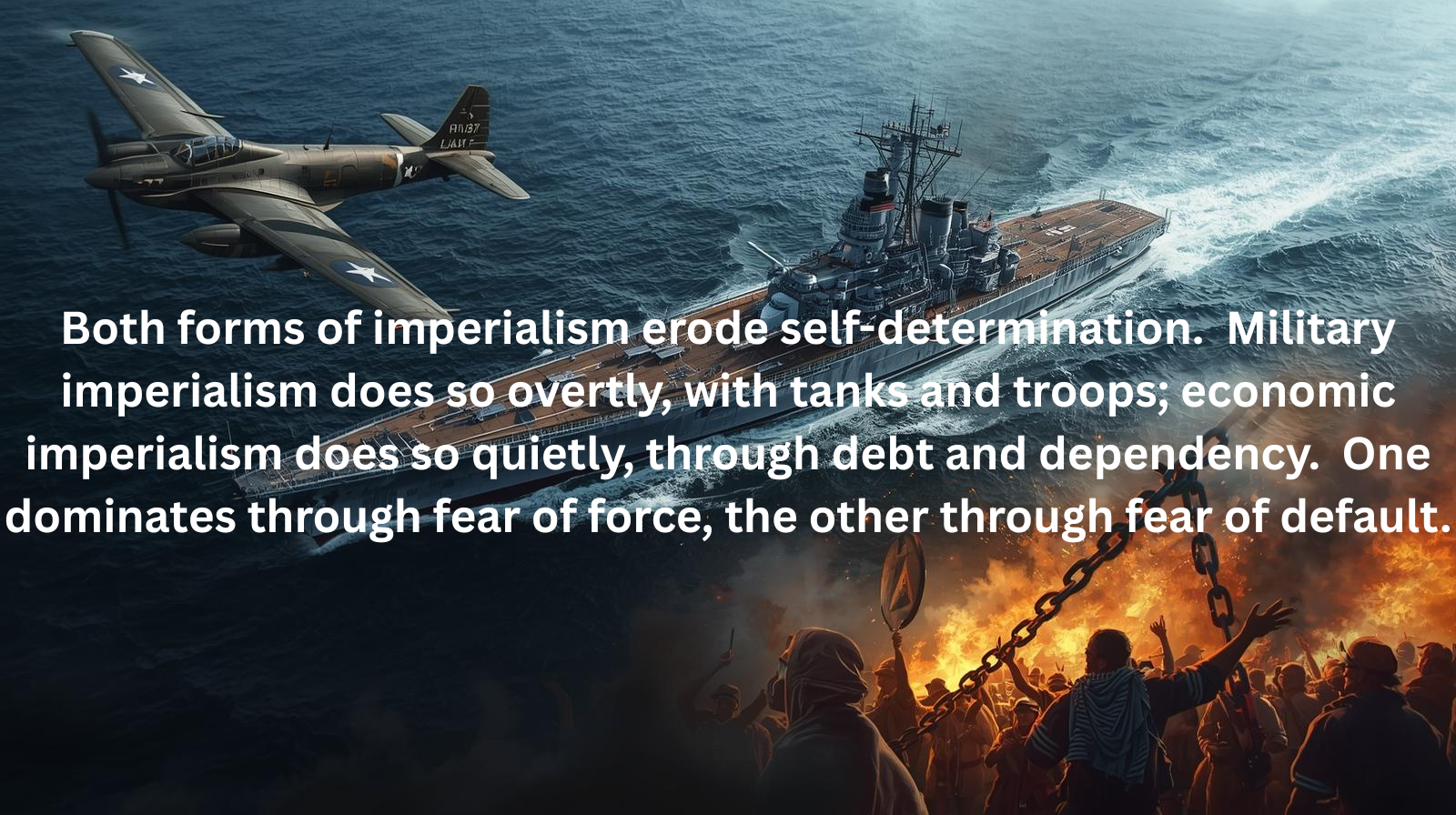
Both forms of imperialism erode self-determination. Military imperialism does so overtly, with tanks and troops; economic imperialism does so quietly, through debt and dependency. One dominates through fear of force, the other through fear of default.
“The most effective empire is one that rules through debt, not domination.”
|
Dimension |
Economic Imperialism |
Military Imperialism |
|
Primary Tool |
Debt, sanctions, trade agreements, corporate concessions |
Armed force, occupation, regime change through direct intervention |
|
Visibility |
Low—contracts, covenants, and compliance regimes operate in technocratic shadows. |
High troop deployments, bombing campaigns, and visible conflict |
|
Consent |
Illusory—policy dictated by creditors or external actors |
None—sovereignty overridden by force |
|
Human Cost |
Diffuse—poverty, austerity, medicine shortages, dependency |
Immediate—civilian casualties, destruction, displacement |
|
Duration |
Long-term—dependency cycles can last decades |
Often shorter but catastrophic—wars end, but leave instability |
|
Justification |
“Stability,” “development,” “human rights enforcement” |
“Security,” “liberation,” “counterterrorism” |
|
Historical Examples |
IMF Structural Adjustment Programs; Guatemala 1954 coup; Venezuela sanctions |
Iraq War (2003); Vietnam; Afghanistan; colonial occupations |
|
Impact on Sovereignty |
Policy levers migrate to creditors and corporations |
Territorial control and governance imposed by the occupiers |
|
Core Logic |
Control through contracts and compliance |
Control through coercion and force |
Sanctions mimic military control because they achieve strategic objectives similar to armed occupation—without deploying troops.
Here’s how:
1. Territorial Paralysis Without Tanks
- Military control deprives a country of its ability to govern by seizing territory and infrastructure.
- Sanctions do the same economically: freezing assets, blocking trade, and cutting off financial systems cripples sovereignty without crossing borders.
“Sanctions are siege warfare by spreadsheet.”
2. Coercion Through Resource Denial
- Armies cut supply lines; sanctions block imports of fuel, medicine, and technology.
- Both create dependency and vulnerability, forcing policy concessions under duress.
3. Civilian Impact Mirrors Collateral Damage
- Bombing destroys hospitals; sanctions starve health systems by restricting medical supplies and banking channels.
- Humanitarian reports show that sanctions can raise mortality and poverty rates, just like prolonged conflict.
4. Regime Destabilization as a Strategic Goal
- Military invasions aim to topple regimes; sanctions often pursue the same end by economic strangulation, hoping internal unrest forces leadership change.
5. Psychological and Political Pressure
- Occupation signals dominance; sanctions signal isolation and punishment.
- Both erode legitimacy and reshape domestic politics under external pressure.
Bottom Line:
Sanctions replicate the logic of war—deny resources, weaken governance, and compel compliance—but do so through financial and trade instruments rather than artillery. They are coercive tools of statecraft, often marketed as “peaceful,” yet their systemic effects resemble military campaigns in slow motion.
Historical examples where sanctions were used as a tool to push regime change or destabilize governments:
1. South Africa (1980s)
- Goal: End apartheid.
- Sanctions: Comprehensive trade and financial sanctions by the U.S., UK, and others.
- Outcome: Combined with internal resistance, sanctions increased economic pressure and international isolation, contributing to the dismantling of apartheid and transition to majority rule.
2. Iraq (1990s–2003)
- Goal: Force Saddam Hussein to comply with UN resolutions and weaken his regime.
- Sanctions: UN-imposed oil embargo, trade restrictions, and financial freezes.
- Outcome: Severe humanitarian Impact; regime weakened but remained until the U.S. military invasion in 2003. Sanctions alone did not topple Saddam but were intended to set the stage for regime change.
3. Iran (2010s)
- Goal: Pressure Iran to curb its nuclear program and weaken hardline leadership.
- Sanctions: The U.S. and the EU imposed bans on banking, oil exports, and asset freezes.
- Outcome: Economic collapse led to negotiations and the 2015 nuclear deal (JCPOA). While not a complete regime change, sanctions were aimed at forcing a policy reversal and weakening the ruling elite.
4. Venezuela (2017–present)
- Goal: Remove Nicolás Maduro and restore democratic governance.
- Sanctions: U.S. and allies targeted oil exports, financial transactions, and government officials.
- Outcome: Severe economic contraction and humanitarian crisis; regime remains in power despite international isolation. Sanctions were explicitly tied to regime-change objectives.
5. Cuba (1960–present)
- Goal: Overthrow Fidel Castro’s communist government.
- Sanctions: U.S. embargo on trade, finance, and travel for decades.
- Outcome: Regime survived despite economic hardship; sanctions entrenched authoritarian control rather than toppling it.
Key Pattern:
Sanctions often aim to mimic military objectives—crippling economies, isolating regimes, and fueling internal unrest—but their success in achieving regime change is mixed. They frequently cause humanitarian harm without guaranteeing a political transition.
Sanctions and military invasions, showing how both operate as tools of coercion:
Sanctions vs. Military Invasions
|
Dimension |
Sanctions |
Military Invasions |
|
Nature of Control |
Economic strangulation—blocking trade, finance, and resources |
Physical occupation—seizing territory and infrastructure |
|
Visibility |
Low—legal and financial instruments, often invisible to the public |
High—troops, tanks, bombing campaigns dominate headlines |
|
Goal |
Force policy change or regime collapse through economic pain |
Force regime change or compliance through direct force |
|
Human Impact |
Diffuse—poverty, medicine shortages, inflation, unemployment |
Immediate—civilian casualties, destruction, displacement |
|
Duration |
Long-term—can last decades (e.g., Cuba embargo) |
Often shorter but catastrophic—wars end, but leave instability |
|
Justification |
Framed as “peaceful pressure” or “Law enforcement.” |
Framed as “liberation,” “security,” or “counterterrorism.” |
|
Historical Examples |
Cuba embargo (1960–present), Iran sanctions, Venezuela sanctions |
Iraq War (2003), Afghanistan (2001–2021), Vietnam War |
|
Impact on Sovereignty |
Policy levers migrate to creditors and sanctioning states |
Territorial control and governance imposed by the occupiers |
|
Core Logic |
Siege warfare by spreadsheet—deny resources until compliance |
Siege warfare by force—deny territory until compliance |
Key Insight
Sanctions mimic military invasions in slow motion:
- Both aim to impede a state’s ability to govern.
- Both weaponize deprivation—one through bombs, the other through blocked supply chains.
- Both seek regime change or policy reversal by making governance impossible.
“Sanctions are siege warfare without soldiers—economic blockades that starve sovereignty.”
Prominent historical examples of military invasions aimed at regime change, which we can use to compare with sanctions-led strategies:
1. Iraq (2003)
- Objective: Remove Saddam Hussein and dismantle alleged WMD programs.
- Method: Full-scale U.S.-led invasion and occupation.
- Outcome: Regime toppled quickly, but led to prolonged insurgency, civil war, and regional instability.
2. Afghanistan (2001)
- Objective: Overthrow the Taliban regime after the 9/11 attacks.
- Method: U.S.-led invasion with NATO support.
- Outcome: Taliban removed initially, but returned to power in 2021 after 20 years of occupation.
3. Vietnam War (1965–1975)
- Objective: Prevent communist takeover of South Vietnam.
- Method: Massive U.S. military intervention.
- Outcome: Failed; North Vietnam prevailed, leading to reunification under communist rule.
4. Panama (1989)
- Objective: Remove Manuel Noriega.
- Method: U.S. invasion (“Operation Just Cause”).
- Outcome: Noriega captured; short occupation followed by restoration of civilian government.
5. Grenada (1983)
- Objective: Overthrow the Marxist government after an internal coup.
- Method: U.S.-led invasion.
- Outcome: Regime replaced; pro-Western government installed.
6. Libya (2011)
- Objective: Remove Muammar Gaddafi during the Arab Spring.
- Method: NATO airstrikes and support for rebels.
- Outcome: Gaddafi was killed; the country plunged into prolonged instability and civil war.
Key Pattern:
Military invasions deliver rapid regime change but often produce long-term instability, civil wars, and humanitarian crises—similar to sanctions in their ultimate goal but far more visible and violent.
Comparison of outcomes between sanctions and military invasions, based on historical patterns:
Sanctions vs. Military Invasions: Outcomes Compared
|
Aspect |
Sanctions |
Military Invasions |
|
Speed of Impact |
Slow—economic pain accumulates over months or years |
Immediate—territorial control and regime collapse can occur in days/weeks |
|
Regime Change Success |
Mixed—often fails (Cuba, Venezuela) or only forces negotiation (Iran) |
High in the short term (Iraq, Panama), but often followed by instability |
|
Humanitarian Impact |
Severe but diffuse—poverty, medicine shortages, inflation |
Severe and direct—civilian casualties, destruction of infrastructure |
|
Political Stability After |
Often worsens—sanctions can entrench authoritarian regimes |
Often worsens—power vacuums lead to civil wars and insurgencies |
|
Cost to Sender |
Low financial and diplomatic costs |
High military expenditure, casualties, and reputational damage |
|
Global Perception |
Framed as “peaceful pressure,” but criticized for harming civilians |
Framed as “liberation,” but often condemned as aggression |
|
Historical Examples |
Cuba (failed), Iran (partial success), South Africa (success), Venezuela (failed) |
Iraq (regime toppled, chaos), Afghanistan (regime toppled, Taliban return), Libya (chaos) |
Key Insights
- Sanctions: Often fail to achieve regime change but cause long-term economic suffering and humanitarian crises. They can entrench regimes by rallying nationalist sentiment.
- Military Invasions: Achieve rapid regime collapse but create power vacuums that lead to insurgency, civil war, and decades of instability.
- Both methods: Share the logic of coercion—forcing compliance by making governance impossible—but differ in visibility and immediacy.
“Sanctions starve slowly; invasions strike fast—but both leave scars that last generations.”
Closing Paragraph:
Whether through bombs or balance sheets, the logic of coercion remains the same: deny resources, cripple governance, and compel compliance. Military invasions strike fast and visibly, toppling regimes at the cost of blood and rubble. Sanctions starve slowly, marketed as “peaceful pressure” while inflicting humanitarian harm and entrenching authoritarianism. Economic imperialism goes further, rewriting laws and policies through debt and dependency, often without a single soldier deployed. These strategies differ in method but share a common outcome: sovereignty becomes negotiable, and liberty erodes under the weight of external power.
The lesson is clear: if freedom is to endure, nations must guard not only their borders but their balance sheets, resisting both the gun and the contract as instruments of modern tyranny.