Summary
Understanding how contracts, sanctions, and coercive economics can undermine various countries’ sovereignty helps my readers recognize their capacity to advocate for transparency and legal safeguards against such tools.
Introduction:
Defining Tyranny
Tyranny is a form of government or a type of behavior characterized by the cruel, harsh, and oppressive use of power. It involves a ruler or a small group exercising unlimited power over others, using it unjustly and unrestrained by Law or a constitution.
Key aspects of tyranny include:
Absolute Authority: Power is concentrated in the hands of one individual or a small group, often acquired or maintained through force or manipulation rather than legal or constitutional means.
- Abuse of Power: The authority is exercised arbitrarily and for the benefit of the rulers, rather than the governed.
- Oppression: The rights and freedoms of individuals are disregarded or actively violated, often leading to a climate of fear and lack of individual expression.
Tyranny by Ledger
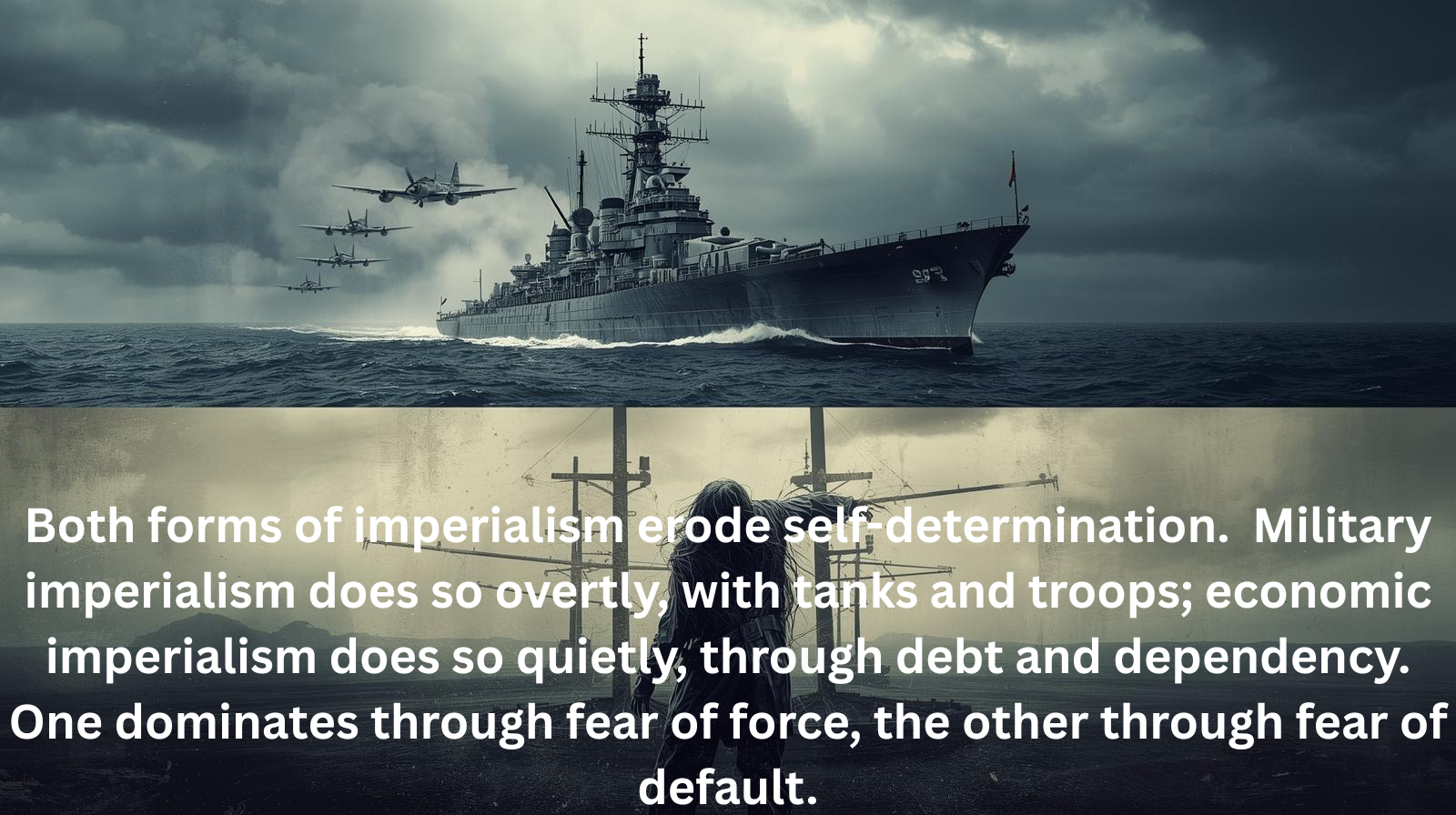
When most people hear tyranny, they picture uniforms and overt repression. In the 21st century, domination more often arrives through balance sheets and bilateral agreements: conditional loans that dictate domestic policy transparently, sanctions that paralyze economies with safeguards, and corporate capture of critical infrastructure. These mechanisms directly erode various countries’ sovereignty by imposing external control over national decisions, often without visible force.
Scholars and official papers describe how structural adjustment programs (SAPs) conditioned access to finance on sweeping reforms—privatization, fiscal cuts, currency devaluation—outsourcing policy levers to creditors; defenders emphasize macro stability, but even sympathetic reviews acknowledge their breadth and power. The effect is not always an immediate collapse; it is the slow normalization of external control over national choices, underscoring the need for transparency and legal safeguards to resist such influence.
Citations:
· IMF explainer on structural adjustment lending, conditionality, and program design (elibrary.imf.org)
· Structural Adjustment overview and critique (Wikipedia)
· Investopedia primer on SAPs, conditions, and austerity trade-offs (Investopedia)
· World Bank literature review on SAPs’ sectoral and environmental impacts (documents1.worldbank.org)
Mechanisms of Economic Imperialism
1) Conditional Lending & Policy Transfer
International Monetary Fund (IMF) and World Bank program stand-buys, extended arrangements, and concessional facilities—exchange financing for detailed reform packages. These are intended to stabilize balance-of-payments crises and restore competitiveness; typically, they require privatizing state assets, removing subsidies, consolidating fiscal policy, and liberalizing trade and capital. While some countries achieved macro improvements, research finds that poverty reduction becomes less responsive to growth in adjustment-heavy environments, indicating a redistribution of costs toward the vulnerable. The controversy is less about whether stabilization matters than who writes the policies and who bears the costs.
Citations:
· IMF description of conditional lending instruments (elibrary.imf.org)
· Structural Adjustment overview (Wikipedia)
· Oxford/Chicago Scholarship chapter on SAPs and poverty sensitivity (academic.oup.com)
· World Bank review of SAPs’ sectoral and environmental channels (documents1.worldbank.org)
2) Sanctions as Economic Warfare
Sanctions are marketed as peaceful alternatives to the use of force. Yet, UN human‑rights officials warn that broad, unilateral coercive measures can impair access to food, medicine, water, and electricity—especially when banks and firms “over‑comply” and block permitted transactions.¹ Legal scholars argue that modern sanctions operate like economic warfare and should be “humanized” along lines analogous to international humanitarian Law, with fundamental safeguards for civilians rather than procedural rhetoric. Empirical work finds high humanitarian and developmental costs in sanctioned countries such as Iran, Afghanistan, and Venezuela; GDP declines, health indicators worsen, and aid delivery is obstructed.³ An official U.S. overview underscores the broad typology—primary, secondary, targeted, and comprehensive—illustrating why poorly designed measures can spill over onto entire populations.
Citations:
· UN OHCHR statement on sanctions’ human‑rights impacts and over‑compliance (ohchr.org)
· Yale Journal of International Law essay on “humanizing” sanctions (yjil.yale.edu)
· CEPR report on humanitarian consequences of sanctions (cepr.net)
· U.S. International Trade Commission brief explaining sanctions mechanics (usitc.gov)
3) Corporate Capture & Resource Concessions
Emphasize how corporate leverage, through contract terms and concessions, decisively influences foreign policy, capturing readers’ interest.
Citations:
· U.S. State Department Foreign Relations of the United States (FRUS) introduction on Guatemala’s political economy and ties to U.S. business (history.state.gov)
· JSTOR Daily synthesis showing private actors’ role alongside CIA support in Guatemala (daily.jstor.org)
Historical Case Studies
Case Study 1: Guatemala, 1954—When Corporate Interests Wrote a Coup
President Jacobo Árbenz advanced land reform (Decree 900) to redistribute idle estates—directly touching holdings of the United Fruit Company (UFCO). A CIA-backed operation (PBSuccess), built atop an earlier attempt (PBFortune), deposed Árbenz and installed Carlos Castillo Armas, reversing reforms and curtailing labor rights. Declassified FRUS volumes and subsequent scholarship detail corporate lobbying, UFCO’s ties to senior U.S. officials, and information campaigns framing land reform as communist subversion. The episode inaugurated decades of authoritarian rule and civil conflict, underscoring how economic imperatives can become regime change, with social costs borne by people experiencing poverty rather than shareholders.
Citations:
· FRUS: Guatemala, 1952–54 (history.state.gov)
· Wikipedia summary of the coup’s actors and outcomes (Bing cached)
· EBSCO Research Starter on UFCO’s role and PBSuccess (ebsco.com)
· JSTOR Daily overview and consequences (daily.jstor.org)
Case Study 2: Venezuela, 1999–present—Institutional Capture Meets Sanctions
Since Hugo Chávez and Nicolás Maduro, Venezuela has undergone constitutional reformation, capture of courts and electoral bodies, and media closures, progressively eroding checks and balances. Academic and policy analysis trace how opposition missteps and executive aggrandizement enabled the regime to consolidate control; the 2024 presidential election drew widespread allegations of fraud and was rejected by several governments. Superimposed on mismanagement and Corruption, financial and sectoral sanctions contributed to humanitarian deterioration: research documents declines in health and living standards, and UN officials warn of over-compliance blocking legitimate humanitarian activity.⁴⁵ The Venezuelan case illustrates economic imperialism’s two faces: internal autocratic capture and external economic pressure that, without careful design, punishes populations while failing to dislodge power.
Citations:
· Notre Dame Keough School analysis of democratic erosion and opposition strategy (keough.nd.edu)
· Canvasopedia brief on institutional capture and repression under Chávez/Maduro (canvasopedia.org)
· Factually compilation of sources on 2024 electoral fraud claims and international responses (factually.co)
· CEPR report on sanctions’ human consequences (cepr.net)
· UN OHCHR statement on sanctions and humanitarian impacts (ohchr.org)
Case Study 3: Structural Adjustment Across the Global South—Policy by Covenant
From the 1980s onward, countries in Sub-Saharan Africa and Latin America implemented structural reforms to access crisis financing. The programs’ conditionality reoriented economies toward export competitiveness and privatization while often cutting public employment and subsidies. A World Bank literature review maps sectoral effects—agriculture, forestry, water, energy—showing how reforms altered resource governance and environmental outcomes. Meanwhile, econometric work suggests poverty reduction becomes less responsive to growth in countries with many adjustment loans, raising questions about distributional effects and democratic accountability. Together, these findings underscore a central point: policy transfer by loan covenant can change a nation’s social contract without a single vote.
Citations:
· IMF description of macro‑adjustment lending (elibrary.imf.org)
· Structural Adjustment overview and criticism (Wikipedia)
· World Bank review of SAPs and environment (documents1.worldbank.org)
· Oxford/Chicago Scholarship chapter on SAPs and poverty sensitivity (academic.oup.com)
Why This Counts as Tyranny
· Consent is Illusory: Decisions that set prices, wages, and public services migrate from parliaments to creditors and compliance desks. Targets of broad sanctions do not vote on their economic paralysis; borrowers do not design many program details.
· Visibility is Low: Technical instruments—licensing regimes, loan covenants, sectoral carve-outs—operate out of public sight yet determine daily life outcomes.
· Human Costs Are Diffuse: Instead of batons, populations face austerity, unemployment, inflation, medicine shortages, and degraded infrastructure—more complex to dramatize, easier to normalize.
Citations:
· IMF conditionality architecture (elibrary.imf.org)
· Structural Adjustment overview (Wikipedia)
· USITC sanctions overview and typology (usitc.gov)
· Yale JIL “humanizing sanctions” analysis (yjil.yale.edu)
· CEPR sanctions Impact report (cepr.net)
· World Bank literature review (documents1.worldbank.org)
Guardrails: How Free Societies Can Resist Silent Tyranny
- Time‑Bound Conditionality & Domestic Ownership: Loan terms should be transparent, narrow, and aligned with locally crafted strategies; parliamentary ratification and public reporting should be mandatory.
- Humanitarian Design of Sanctions: Build automatic, enforceable carve-outs; simplify licensing; require independent audits of civilian impacts and revise measures when harm is documented.
- Contract Transparency & Antitrust: Publish concession agreements and tax rulings; prevent monopolistic control of ports, telecom, energy, and transport by single foreign firms
- Plural Finance: Diversify funding sources (regional banks, South‑South lending, domestic bond markets) to reduce single‑creditor leverage and policy transfer risk.
Citations:
· IMF program design and oversight architecture (elibrary.imf.org)
· USITC sanctions overview; design implications (usitc.gov)
· World Bank review on governance and public‑sector reform effects (documents1.worldbank.org)
· UN OHCHR on humanitarian exemptions and over‑compliance (ohchr.org)
· FRUS Guatemala and corporate influence as a cautionary tale (history.state.gov)
Conclusion: Liberty Requires Economic Self-Government
Economic imperialism rarely announces itself. It arrives as “stability,” “reform,” or “norm enforcement,” but extracts a price: diminished sovereignty and weakened social contracts. Guatemala’s coup shows how corporate interests can reshape a nation; Venezuela illustrates how internal capture and external economic pressure can jointly entrench authoritarianism; decades of structural adjustment reveal how loan covenants can rewrite domestic policy without a vote. The lesson is durable: freedom is not only political; it is economic. If societies wish to remain self-governing, they must bind emergency powers in finance and sanctions with Law, transparency, and accountability, or the quiet logic of tyranny will do what overt force once did—only more efficiently.