Public education in America isn’t built for kids—it’s built for bureaucracy. Federal spending represents just 2.35% of the federal budget—yet nearly 90% of education funding comes from state and local sources, not the feds. Meanwhile, student outcomes lag investment.
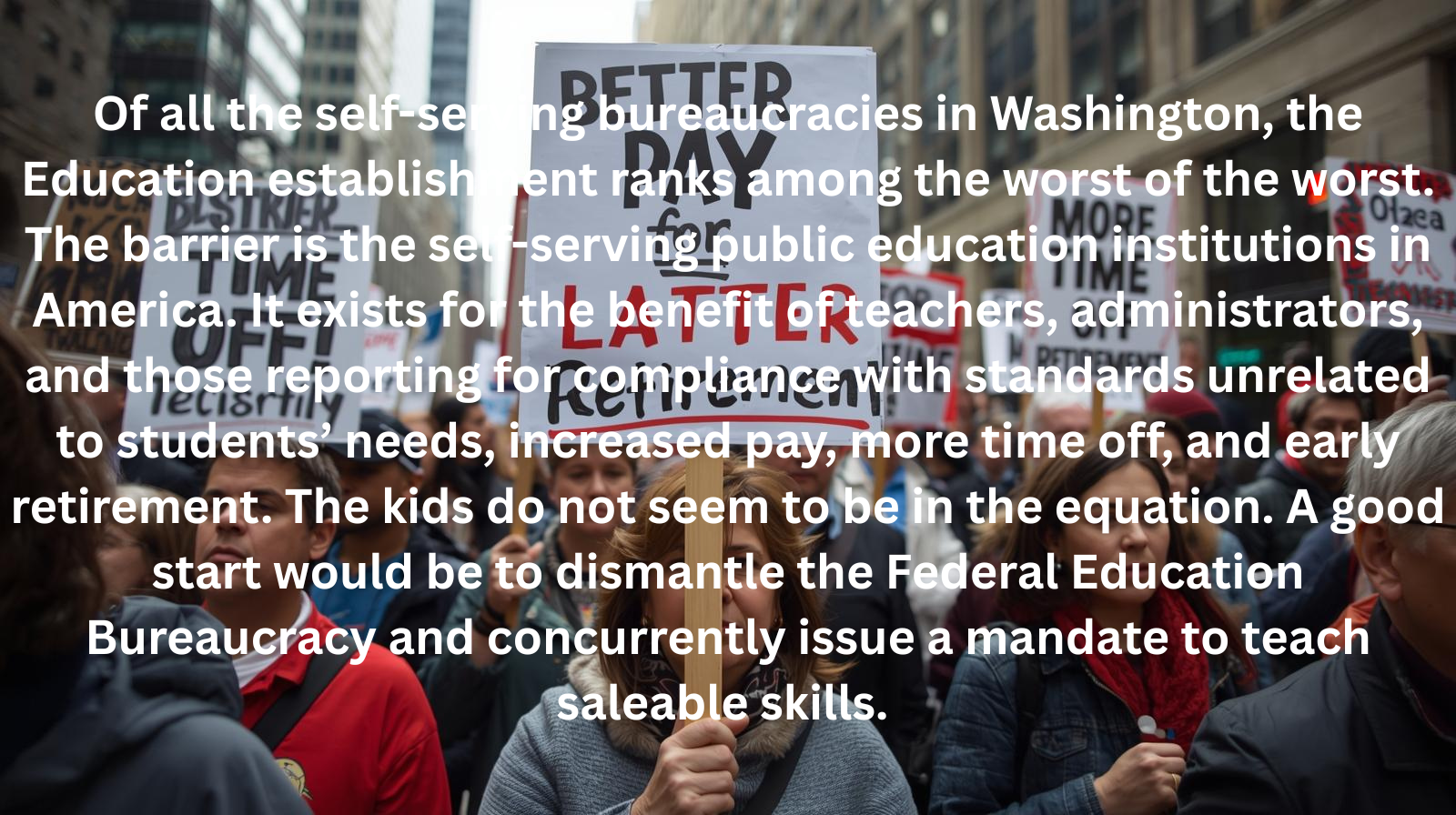
Of all the self-serving bureaucracies in Washington, the Education establishment ranks among the worst of the worst. The barrier is the self-serving public education institutions in America. It exists for the benefit of teachers, administrators, and those reporting for compliance with standards unrelated to students’ needs, increased pay, more time off, and early retirement. The kids do not seem to be in the equation. A good start would be to dismantle the Federal Education Bureaucracy and concurrently issue a mandate to teach saleable skills.
The Real Barrier
“Cutting through layers of red tape in Washington is one essential piece of our final mission,” said U.S. Secretary of Education Linda McMahon, advocating to “break up the federal education bureaucracy and return education to the states.” But critics warn this may not help—and could worsen funding and expertise gaps. Kevin Carey, VP for education at New America, cautions: “Taking education programs and putting them in agencies that have no expertise in education is going to make those programs function worse.”
Employer and Student Readiness Gap
- 84% of hiring managers say high school graduates aren’t prepared for today’s workforce.
- 80% of employers think today’s grads are less ready than prior generations.
- Jamie Dimon, CEO of JPMorgan Chase, urges stronger school–workplace partnerships
“What you’re really short on is the skills you need … it’s getting out and going directly into the schools.”
What’s Broken
- Compliance over competence: Teaching focuses on testing instead of critical thinking.
- Adult-centric incentives: Only 39% of teachers report being “very satisfied,” while 20% plan to leave in two years.
- Skills gap: There could be 5.25 million unfilled skilled jobs by 2032.
Expert Insight
Richard Branson emphasizes another failing:
“Children are taught to pass exams rather than understand concepts and expand their minds.”
Schools don’t teach risk-taking, creativity, or big-picture thinking—skills he believes are essential for business and life.
What Needs to Change
· Recognizing the value of local oversight and funding, while maintaining federal expertise, can empower communities and foster responsible reform that inspires confidence.
· Teaching marketable skills like trades, tech, and entrepreneurship can boost student confidence and pride, demonstrating how reforms can directly improve their prospects and future success.
· Tie rewards to measurable results: Tennessee’s performance-based teacher tenure reforms led to higher-quality teaching and better student outcomes, demonstrating the power of accountability in policy reform.
Why It Matters: A Staggering Reality
-
84% of hiring managers say grads aren’t career-ready.
-
By 2028, the U.S. may face 3 million trade-job vacancies.
-
25% of adults have “very low” financial literacy—leaving them ill-prepared for life’s challenges.
The Bottom Line
Kids are missing from the equation—and that has to change. Reform isn’t about more money or bureaucracy—it’s about serving students. Dismantle structures that serve themselves. Teach skills—reward results. Prepare the next generation for real life.
“Schools teach to pass exams, not to expand minds.” — Richard Branson
“Go directly into schools—the skills are missing.” — Jamie Dimon
Evidence-based case studies
Case Study 1: IBM’s P‑TECH (Grades 9–14) — High School + No‑Cost Associate Degree + Hiring Path
What it is: An industry-linked “early college” model that integrates CTE + STEM + an associate degree within six years (grades 9–14), with mentorships, internships, and first-in-line consideration for partner jobs (IBM originated the model in 2011).
Results & scale: Early cohorts showed strong progression into college coursework by sophomore year, and the model has expanded nationally and internationally with hundreds of industry partners. Independent evaluations by MDRC are tracking Impact, implementation, and cost across NYC P‑TECH schools.
Insight: “Start high school with a hiring plan, not just a diploma plan.”
Why it works: Tight school–college–industry Partnerships, real work-based learning, and a credential that counts in the labor market.
Case Study 2: Career Academies — Proven Long-Term Earnings Gains
What it is: “Schools‑within‑schools” organized around a career theme; academic + technical coursework with employer-supported internships and mentoring.
Results: MDRC’s randomized evaluation across nine urban high schools found sustained earnings gains averaging 11% ($2,088/year) eight years after graduation—nearly $16,704 total—with young men experiencing a 17% increase in earnings (~$3,731/year). Academic completion remained high in both treatment and control groups (90%+ HS or GED; ~50% with a postsecondary credential).
Insight: “Career Academies lift paychecks without lowering academic ambition.”
Why it works: Personalized cohorts, employer partnerships, and work-based learning that translate classroom learning into wage gains.
Case Study 3: Delaware Pathways — Statewide, Scalable Career Pathways
What it is: A statewide 9–14+ career pathways system that connects high school coursework, work-based learning, and industry-recognized credentials aligned to middle‑ and high-skilled jobs.
Results & scale: Grew from <1% of high schoolers (2014–15) to >50% participation by 2021–22, with 24 pathways offered statewide—recognized by Bellwether and JFF as an exemplar for cross-sector partnerships and data-driven scaling.
Delaware now prioritizes credentials of value tied to family-sustaining wages and stackable progression (on‑ramps/off‑ramps) across secondary, apprenticeship, and associate degree programs.
Insight: “Pathways = start earlier, go faster, earn while you learn.”
Why it works: Clear labor‑market alignment, stackable credentials, and state policy that simplifies implementation and measures Impact.
Case Study 4: Utah’s Talent Ready Utah (TRU) & TRAC Youth Apprenticeships — Earn While You Learn
What it is: A state initiative linking K-12, technical colleges, and employers via sector pathways (Aerospace, Life Sciences, AEC, Diesel) and TRAC youth apprenticeships, where students split time between workplace and classroom and earn wages while working toward a degree.
Evidence: A 2025 multi-agency analysis (UEPC) documents Utah’s youth apprenticeship landscape and provides an actionable framework to expand high-quality apprenticeships, aligning agencies and industry to scale.
Insight: “Apprenticeships aren’t the alternative; they’re the accelerator.”
Why it works: Employer-designed standards, paid experience, and alignment from high school through community college, modeled on Swiss VET principles.
Case Study 5: KIPP (Charter Network) — Closing the College Completion Gap
What it is: A public charter network with a college‑preparatory culture and alumni support through college and into early career.
Results: Mathematica’s 2023 study following 2,066 lottery-based applicants found that attending both KIPP middle and high school had large, statistically significant effects:
- +31 percentage points in 4-year college enrollment within three years,
- +19 percentage points in 5-year college completion—nearly doubling persistence and graduation odds versus non-KIPP peers.
Insight: “A continuous 6–12 KIPP experience nearly doubles four-year college completion odds.”
Why it works: College‑prep culture, advising and alum supports, and rigor with relationships that carry beyond high school.
Case Study 6: Finland’s VET Reform — Competence-Based, Work-Integrated, and Flexible
What it is: National reform (2018 onward) making Vocational Education and Training (VET) more competence-based, work-integrated (apprenticeship + on-the-job learning), and stackable—with financing that incentivizes completion and employability.
Key features: Blurring boundaries between general and vocational tracks at upper‑secondary, expanding apprenticeship routes, and guaranteeing eligibility to higher education for vocational graduates—anchored by close school–workplace cooperation.
Insight: “Make the qualification competence-based; make the pathway permeable.”
Why it works: System-level alignment, workplace learning, and lifelong upskilling—a template for states seeking to modernize CTE beyond seat‑time.
Bonus Snapshot: High-Performing Charter Outcomes (NYC)
Success Academy’s 2025 state exam results showed ELA proficiency >90% and Math >96%—nearly double NYC district averages (~56% ELA, ~57% Math)—illustrating how rigorous instructional models + high expectations can drive achievement, while reminding us to attend to culture and equity debates in implementation.
Caveat: NAEP trends in New York remain below pre-pandemic levels with persistent racial gaps—any reform must scale beyond pockets of excellence.
What These Reforms Share (Actionable Lessons)
· Industry at the table from Day 1. Programs align coursework with labor market demand and the value of credentials (Delaware, PTECH, Utah TRU).
· Work-based learning is a core requirement. Internships, apprenticeships, and mentoring—not “extras”—drive outcomes (Career Academies, Utah TRAC, Finland VET).
· Stackable, permeable pathways. Multiple entry/exit points and no dead ends—students can earn while learning and continue to higher education (Delaware, Finland).
· Measure what matters. States track earnings, completion, credentials, and employability—not just seat time or compliance (MDRC studies; Delaware metrics).
· Support through transition. Alums’ advising and persistence support postsecondary completion (KIPP).
Closing
The future of education isn’t about more bureaucracy—it’s about relevance. America’s schools must pivot from compliance-driven systems to career-driven outcomes. Case studies from P-TECH, Career Academies, and Delaware Pathways prove that when schools integrate real-world skills, work-based learning, and industry partnerships, students thrive—and employers win. The question isn’t whether reform is possible; it’s whether we dare to dismantle what doesn’t serve kids and scale what does.
If you’re a parent, demand career-ready programs in your district; if you’re an employer, partner with schools to create internships and apprenticeships. Suppose you’re a policymaker, fund pathways that lead to real jobs—not just diplomas. The next generation is waiting. Let’s give them an education that works.