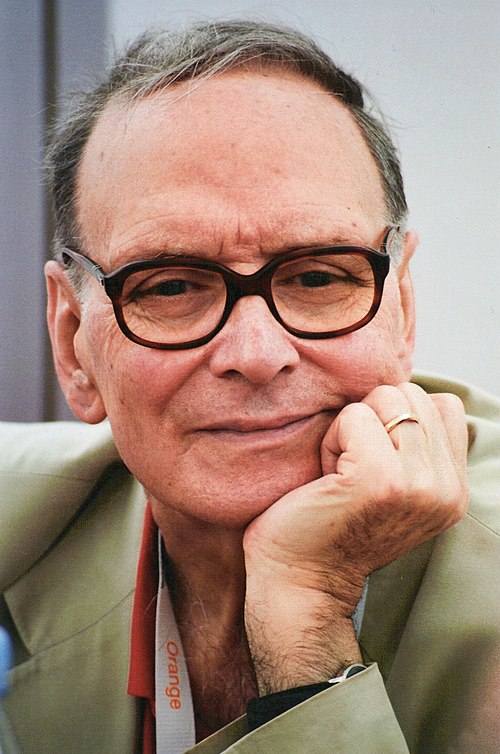
The Maestro Who Redefined Film Music
Ennio Morricone (1928–2020) is widely regarded as one of the greatest film composers in History—a musical architect whose work reshaped the emotional and dramatic possibilities of cinema. A classically trained trumpeter, avant-garde experimenter, and orchestral genius, Morricone composed more than 500 film and television scores over a career spanning six decades. His music is instantly recognizable, often blending haunting melodies with unconventional instrumentation: choral whispers, gunshots, ocarinas, electric guitars, whistles, and church organs. The result was a sound world all his own.
Early Years and the “Spaghetti Western” Revolution
Morricone’s rise to international fame began through his collaborations with director Sergio Leone, a childhood friend who helped define his career and the western genre itself.
Iconic Western Scores
- A Fistful of Dollars (1964)
Introduced the sharp, minimalist motifs—whistles, gunshots, guitar twangs—that defined the Dollars Trilogy. - For a Few Dollars More (1965)
Featured the inventive musical pocket‑watch motif that became a signature narrative device. - The Good, the Bad and the Ugly (1966)
His most famous score, the coyote-like two-note theme, has become inseparable from the genre itself. - Once Upon a Time in the West (1968)
An operatic masterpiece with character-specific leitmotifs, including the haunting “Jill’s Theme.” - Duck, You Sucker! (1971)
A blend of satire, epic romanticism, and political drama.
These works permanently changed how audiences relate to westerns—and how composers approach epic storytelling.
Beyond the West: A Universe of Musical Versatility
Unlike many composers associated with a single genre, Morricone expanded into psychological dramas, political thrillers, crime films, romance, horror, and historical epics. His stylistic range was unmatched. He could pivot from ethereal minimalism to lush orchestral passages or from electronic experimentation to sacred choral writing.
Major Non-Western Scores
- The Battle of Algiers (1966)
A powerful, minimalist score that cleverly merges military rhythms with emotional tension. - Days of Heaven (1978)
A delicate and lyrical score is often cited as one of the most outstanding film soundtracks ever written. - The Mission (1986)
Perhaps his most spiritually profound score, blending indigenous instruments, Western classical traditions, and sacred choral writing. Widely considered one of cinema’s most beautiful soundtracks. - The Untouchables (1987)
Heroic and propulsive, reflecting the moral stakes of De Palma’s Prohibition‑era drama. - Cinema Paradiso (1988)
A deeply sentimental, nostalgic score created with his son, Andrea Morricone. - Once Upon a Time in America (1984)
A sweeping, elegiac musical tapestry—one of his richest emotional achievements. - The Thing (1982)
A rare collaboration with John Carpenter; minimalist, icy, and foreboding.
These works highlight Morricone’s ability to adapt his style to any cinematic world while retaining a distinct musical identity.
Late Career Triumph and Oscar Legacy
Despite his enormous influence, Morricone received only a few Academy Award nominations for decades. However, he was internationally celebrated, receiving numerous awards, including the Golden Globe, BAFTA, and a lifetime achievement award from the Grammy organization, underscoring his global recognition and industry respect.
At age 87, he won the Academy Award for Best Original Score for The Hateful Eight (2015), a milestone that cemented his legacy and acknowledged his influence on modern cinema.
A Lasting Impact
His themes, studied worldwide and sampled across genres, should evoke pride and respect, emphasizing his lasting influence beyond cinema.
Morricone once said, “I consider myself a man of the cinema.”
The world regards him as a maestro whose work fundamentally reshaped the emotional language of motion pictures, inspiring generations of composers and filmmakers.
a) The Good, The Bad, and the Ugly
https://www.youtube.com/watch?v=J9EZGHcu3E8
https://www.youtube.com/watch?v=enuOArEfqGo&list=RDudIY_3s4_XQ&index=4
b) Navajo Joe
https://www.youtube.com/watch?v=syH7pI-qIOs
c) My Name is Nobody
https://www.youtube.com/watch?v=iGZDKuDl3jc
https://www.youtube.com/watch?v=duF1OQho1gc
d) Colona Sonora 1964
https://www.youtube.com/watch?v=oMMh2ibYhKw&list=PL2EchC8usvuBAYsmSBp5QVKyLRYTeDNNT&index=1
e) Days of Heaven
https://www.youtube.com/watch?v=OP5UchXF9YM
f) Two Mules for Sister Sara
https://www.youtube.com/watch?v=oE4MW2HNluw
g) The Untouchables
https://www.youtube.com/watch?v=TY3DtH4KIG8&list=PLqnnuEVGcRQzibfGQmeOvJXgej6xe8PEX
h) Cinema Paradiso
https://www.youtube.com/watch?v=JlQh4PeB8PE
i) The Hateful Eight
https://www.youtube.com/watch?v=7EbmNz0GC2A
j) Kill Bill
https://www.youtube.com/watch?v=C1HHGW0ZFx4
k) Once Upon a Time in the West
https://www.youtube.com/watch?v=dAcIoi0N5tQ
https://www.youtube.com/watch?v=MbXWMIIHsuE
https://www.youtube.com/watch?v=udIY_3s4_XQ&list=RDudIY_3s4_XQ&start_radio=1&t=0
l) IA Fist Full of Dollars
https://www.youtube.com/watch?v=HjjDOdaFZg0
m) The Thing
https://www.youtube.com/watch?v=RrP2VvGeav8
n) Halloween
https://www.youtube.com/watch?v=TOtRAF4Y8f4
o) Once Upon A Time in America
https://www.youtube.com/watch?v=_APmVdXm4Xw
p) The Mission
https://www.youtube.com/watch?v=J5qlWLXbfL4
q) The Mercenary
https://www.youtube.com/watch?v=Uoq0j6Hf3Es
r) For a Few Dollars More
https://www.youtube.com/watch?v=NrNyE4tD-BE
s) The Battle of Algiers
https://www.youtube.com/watch?v=dWJTFMPybYw