Summary
The 80/20 Rule for Clutter: What Estate Clean Outs Teach Us About Living Lighter and Changing Habits. Why most of what you own gets rarely used —and how the “vital few” as opposed to the “trivial many” can free you from the cage of excess.
The first box is always the easiest. It’s the third and fourth that change you—when you realize you’re not sorting objects so much as sorting a life. To help you get started, set small, manageable goals, like decluttering one drawer or shelf at a time, and celebrate each step to build confidence and momentum.
The estate clean-out process often reveals what we truly value, helping homeowners feel empowered and connected to their life stories and choices.
The 80/20 rule, also known as the Pareto principle, highlights that a small part of inputs-about 20%- often produce most results, around 80%. Recognizing this can inspire hope and motivate you to focus on what truly matters in your possessions and habits.
Estate clean-outs don’t just clear houses. They expose what we value.
The 80/20 Rule, Without the Math Lecture
The Pareto Principle—better known as the 80/20 rule—suggests that roughly 80% of results come from about 20% of causes. It’s not always exactly 80/20, but the imbalance shows up everywhere, from wealth and sales to defects and habits.
Joseph Juran’s framing of the 80/20 rule as “the vital few and the useful many” encourages estate planners to feel confident in their ability to focus on what truly matters.
In a home, 80/20 usually looks like this: a small set of items runs your daily life, while the rest becomes background inventory you pay to store, clean, and think about.
You don’t have too much stuff because you’re careless—you have too much stuff because the “maybe” pile keeps winning.
1) You Use 20% of Your Stuff 80% of the Time
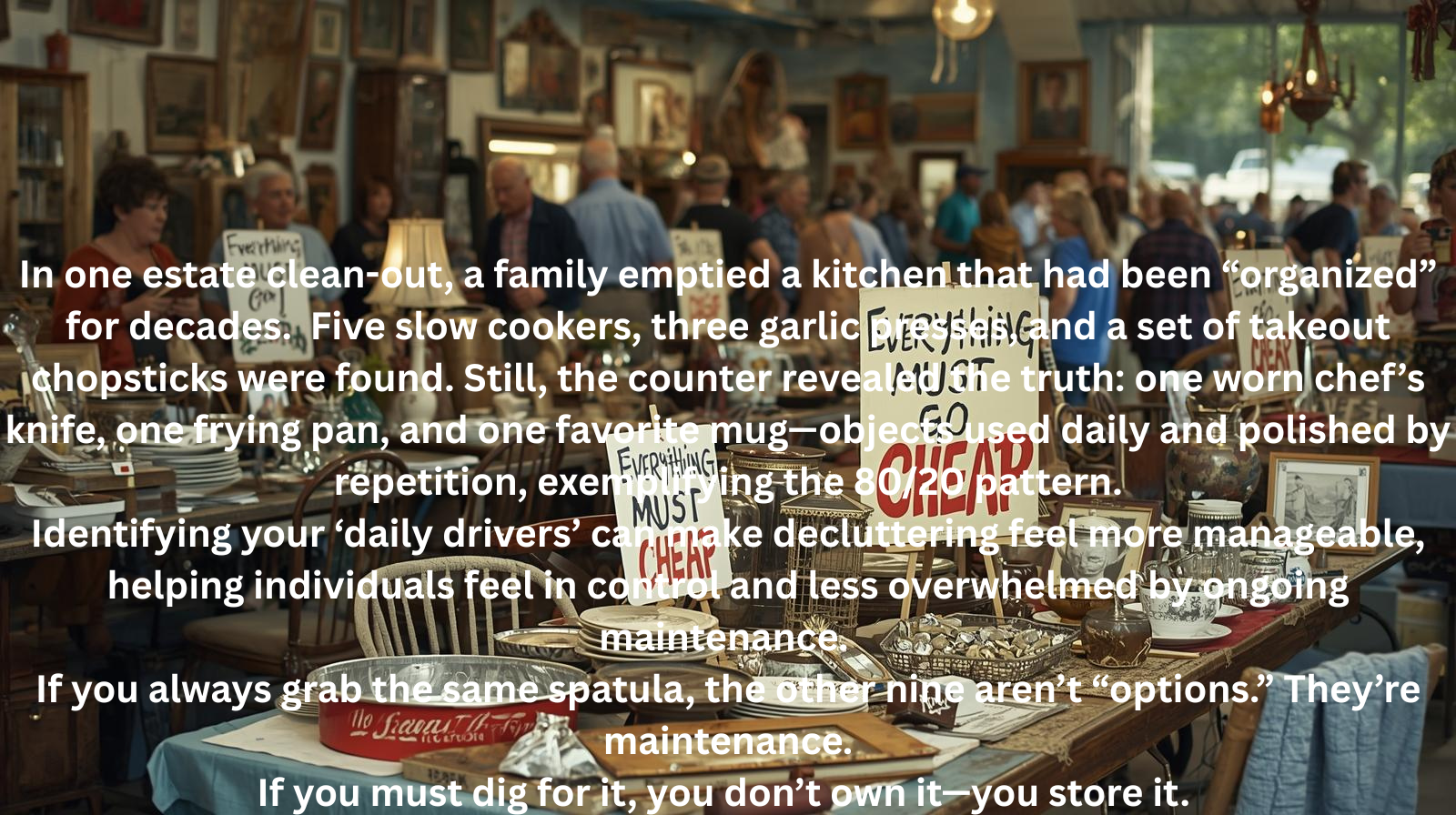
In one estate clean-out, a family emptied a kitchen that had been “organized” for decades. Five slow cookers, three garlic presses, and a set of takeout chopsticks were found. Still, the counter revealed the truth: one worn chef’s knife, one frying pan, and one favorite mug—objects used daily and polished by repetition, exemplifying the 80/20 pattern.
Identifying your ‘daily drivers’ can make decluttering feel more manageable, helping individuals feel in control and less overwhelmed by ongoing maintenance.
If you always grab the same spatula, the other nine aren’t “options.” They’re maintenance.
If you must dig for it, you don’t own it—you store it.
2) You Wear 20% of Your Clothes 80% of the Time
Closets are where we store alternate versions of ourselves: the size we used to be, the job we might land, the invitations we imagine receiving. In estate clean-outs, wardrobes are often the most emotionally loaded rooms because clothing carries identity—who someone was, what they endured, what they hoped for. Offering mindful decluttering tips, such as honoring memories while letting go, can help navigate these emotional hurdles and make the process less overwhelming.
But even in everyday life, most people repeat a small wardrobe core. The “80/20 closet rule” is widely cited because it aligns with lived experience: we rely on a limited set of outfits that fit, flatter, and reduce morning decisions.
Here’s the hidden mechanism: decision fatigue. Research on choice-making found that making many decisions can impair subsequent self-control—exactly the mental depletion that can make estate clean-outs feel daunting and overwhelming.
Estate clean-out moment: someone finds a dress still tagged—bought for an event that never came. It isn’t wasteful. It’s human. But multiply that across decades, and you end up with a closet that becomes a storage unit for “someday.”
3) You Wear 20% of Your Shoes 80% of the Time
Shoes are even more honest than clothes because they’re ruled by physics: comfort, weather, walking distance, and routine. Most households keep “occasion shoes” that rarely touch pavement, while one or two pairs handle daily wear.
During a cleanup after a long illness, a family discovered twenty pairs of formal shoes, pristine, kept “for church” and “for weddings.” The person had attended both less and less over the years. Meanwhile, the everyday sneakers—creased and scuffed—told the truth about real life: errands, appointments, getting through the day.
Even in performance contexts, “shoe rotation” is discussed as maintaining a functional subset suited to real activities, not stockpiling endless pairs.
Your real wardrobe is what works on a Tuesday, not what waits for a perfect Saturday.
4) The “20% of Staff” Claim—A Smarter, More Accurate Version
But there is a legitimate insight underneath: in many modern workplaces, output can be highly skewed, with “star performers” contributing disproportionately. Research on star performance suggests that individual output may follow a power-law distribution rather than a tidy bell curve.
Here’s the caution: turning that reality into forced ranking—an arbitrary “top 20%” cutoff—can backfire. Research on forced distribution systems has linked strict caps on top ratings to higher voluntary turnover among high performers denied top recognition due to quotas.
Juran’s language helps here: “vital few” doesn’t mean everyone else is worthless; it means leadership should focus effort on the areas that deliver disproportionate improvement.
5) Only 20% of Our Stuff Is Truly Desirable—The Rest Is Negotiable
A more workable version of “dump the 80%” is space-based: the 80/20 organizing method recommends filling only 80% of drawers, shelves, and closets, leaving 20% empty as a buffer. This “breathing room” enables daily maintenance and reduces the risk of the organization collapsing during disruptions.
Estate clean-out truth: the fullest homes are rarely the easiest to live in—or to inherit. When every surface is packed, the house becomes a continuous negotiation.
Space isn’t wasted space; it’s operational space.
6) Why We Keep 80% Year After Year
Clutter isn’t just physical; it’s cognitive and emotional.
Decision fatigue is real.
Every object asks a question: keep, toss, donate, relocate. That’s hundreds of micro-decisions, and research shows repeated choosing can reduce later persistence and self-control.
Grief compounds the load.
In estate contexts, grief doesn’t just hurt; it impairs executive function, making it harder to plan and decide. Recognizing how decision fatigue and emotional overwhelm can delay or distort choices, and incorporating strategies such as taking breaks or setting small goals, can help maintain focus and reduce stress throughout the process.
The home becomes a stressful cue.
Research analyzing “home tours” found that describing a home as cluttered/unfinished correlated with less healthy daily cortisol patterns and worse mood outcomes in wives, suggesting the environment can function as a persistent stress signal.
Estate clean-out scene:
A dining table buried in decades of mail. Nobody touched it for years because each envelope represented a choice. The pile didn’t just occupy space—it occupied attention.
7) Why We Don’t Let the 80% Go—Until We Have To
Most people treat decluttering as a moral project (I should be disciplined) instead of a design project (my home should require fewer decisions). That’s why estate clean-outs feel brutal: you’re forced to make in one month the choices someone avoided for twenty years.
This is where Swedish “death cleaning” (döstädning) offers a compassionate alternative: decluttering while you’re alive to reduce the burden on loved ones later. It’s framed as generosity—choosing what happens to your belongings so grieving family members aren’t left to do triage.
Decluttering isn’t about having less. It’s about leaving less unfinished, especially for the people you love.
8) A Practical Exit: The Estate Clean‑Out Rule You Can Use Now
Here’s what estate clean-outs teach, distilled:
Protect the vital 20%
- Put the items you use weekly in the easiest-to-reach places
- Let everything else “earn” its space.
Create a 20% buffer
- Leave shelves and drawers partially empty so life can land without chaos.
Reduce decisions before you reduce stuff.
- Use a simple sorting system (keep/donate/sell/discard), which estate clean-out guides routinely recommend to prevent overwhelm.
The opposite of clutter isn’t perfection, it’s relief.
The “Don’t Leave Them a House of Decisions” Checklist
- Start with low-emotion zones (garage, pantry) before bedrooms and memorabilia.
- Pull out duplicates first (mugs, tools, linens).
- Keep one “memory box” per person—and label it.
- Make an “exit plan” (donation pickup date, estate sale contact, dump run).