Summary
Ever wonder why we say someone is “fiddling around”? The phrase marries the tactile fussiness of the fiddle (violin) with the habit of busy hands, fuzzy goals—a neat label for tinkering without a clear outcome.
What It Means Today
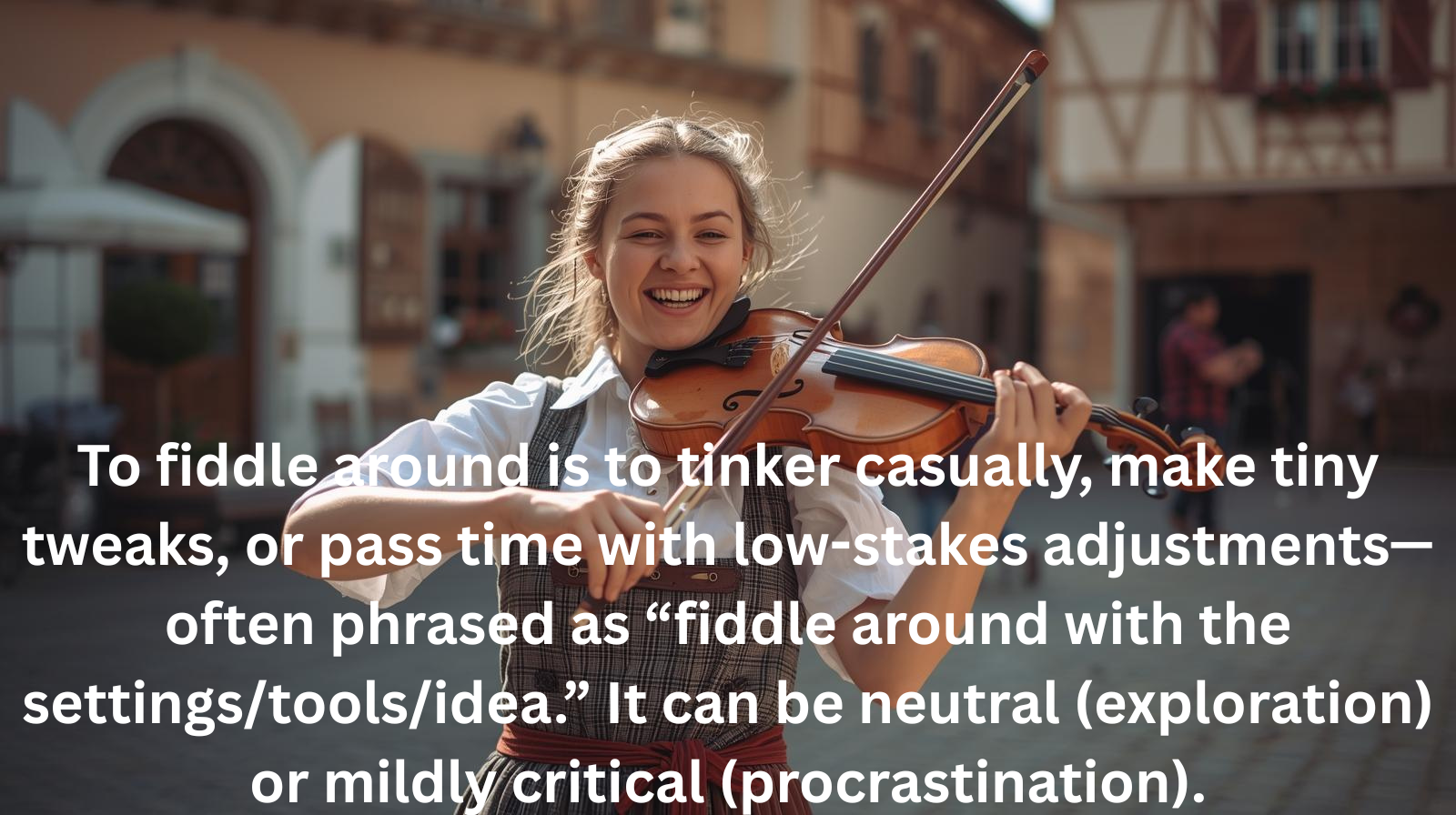
To fiddle around is to tinker casually, make tiny tweaks, or pass time with low-stakes adjustments—often phrased as “fiddle around with the settings/tools/idea.” It can be neutral (exploration) or mildly critical (procrastination).
Where It Comes From
The word fiddle descends from medieval Germanic and English roots for bowed instruments—think the Anglo-Saxon “fithele” and its kin. By the Renaissance, the fiddle/violin was central to both courtly dance and street performance. Over time, “to fiddle” extended beyond music to mean restless handling, laying the groundwork for the idioms “fiddle with” and “fiddle around.”
Why It Sticks
“Fiddling around” names a universal impulse: learning by touch, procrastinating with purpose, or soothing nerves through motion. It’s the language of curiosity—and sometimes, of avoidance.
“To ‘fiddle around’ is to keep your hands busy while your goal stays fuzzy.”
Fiddling Around: How a Musical Metaphor Became Our Word for Aimless Tinkering
Ever wonder why we say someone is “fiddling around”? The phrase marries the tactile fussiness of the fiddle (violin) with the habit of busy hands, fuzzy goals—a neat label for tinkering without a clear outcome.
What It Means Today
To fiddle around is to tinker casually, make tiny tweaks, or pass time with low-stakes adjustments—often phrased as “fiddle around with the settings/tools/idea.” It can be neutral (exploration) or mildly critical (procrastination).
Where It Comes From
The word fiddle descends from medieval Germanic and English roots for bowed instruments—think the Anglo-Saxon “fithele.” Over time, “to fiddle” extended beyond music to mean restless handling, laying the groundwork for the idioms “fiddle with” and “fiddle around.”
Historical Snapshots
- Medieval & Renaissance Performers: Itinerant fiddlers tuned and retuned in public—visible, fussy handwork that later became the metaphor for minor, uncertain adjustments.
- Shakespeare’s “Fiddlestick” (1590s): In Romeo and Juliet (Act 3, Scene 1), Mercutio quips, “Here’s my fiddlestick,” brandishing his sword. The joke ties the bow to provocation and trifling—a seedbed for later “fiddling” as petty activity.
- “Fiddlesticks!” (17th–18th c.): The exclamation “Fiddlesticks!” emerged as a curt dismissal—“nonsense!”—cementing the triviality associated with fiddling.
- Workshop Culture (18th–19th c.): Clockmakers, instrument makers, and machinists performed minute adjustments—the archetypal “fiddly” work. The notion that someone “fiddles with” a mechanism maps onto these painstaking micro-tweaks.
- “Second Fiddle” (19th c.): Orchestral hierarchy gave us “Play second fiddle”—a metaphor for subordinate roles—different idiom, same instrument-as-metaphor pattern that feeds “fiddling” language.
- “Fiddling While Rome Burns” (enduring trope): The Nero story survives as a critique of misplaced priorities—doing something trivial while disaster looms. (Historically anachronistic; the modern violin didn’t exist in ancient Rome.)
- Wireless & Motor Age (early 20th c.): People fiddled around with the dial on radios and the mixture screws on carburetors—tiny twists for hoped-for improvement, often without precise results.
- Lab Benches & Control Panels (mid‑20th c.): Oscilloscopes, tuners, and analog boards invited knob-twiddling—the scientific cousin of “fiddling around,” adjusting parameters to “see what happens.”
- Hobbyist Computing (1970s–1980s): From the Homebrew Computer Club to garage kits, enthusiasts fiddled around with jumpers, BASIC settings, and memory switches—experimental, hands-on discovery.
- Digital Era (1990s–today): We fiddle with settings in apps, sliders in photo editors and DAWs, and endless beta toggles—screen-age equivalents of tuning pegs.
Why It Sticks
“Fiddling around” names a universal impulse: learning by touch, procrastinating with purpose, or soothing nerves through motion. It’s the language of curiosity—and sometimes, of avoidance.
“To ‘fiddle around’ is to keep your hands busy while your goal stays busy.”