Article
The modern stress test: everyday life, one surprise away from inadequate.
Financial stress is rarely a single catastrophe. More often, it’s the slow pressure of ordinary life—rent due, groceries up, insurance rising—colliding with income that doesn’t flex when prices do. When the Federal Reserve asked Americans about their financial situation in its 2024 Survey of Household Economics and Decision-making (SHED), 73% said they were “doing okay” or “living comfortably.” However, this level is lower than the 2021 peak, indicating that financial stability has become more fragile despite steady employment. Inflation—especially for essentials—remains a significant concern, with many reporting that price increases over the past year have worsened their finances.
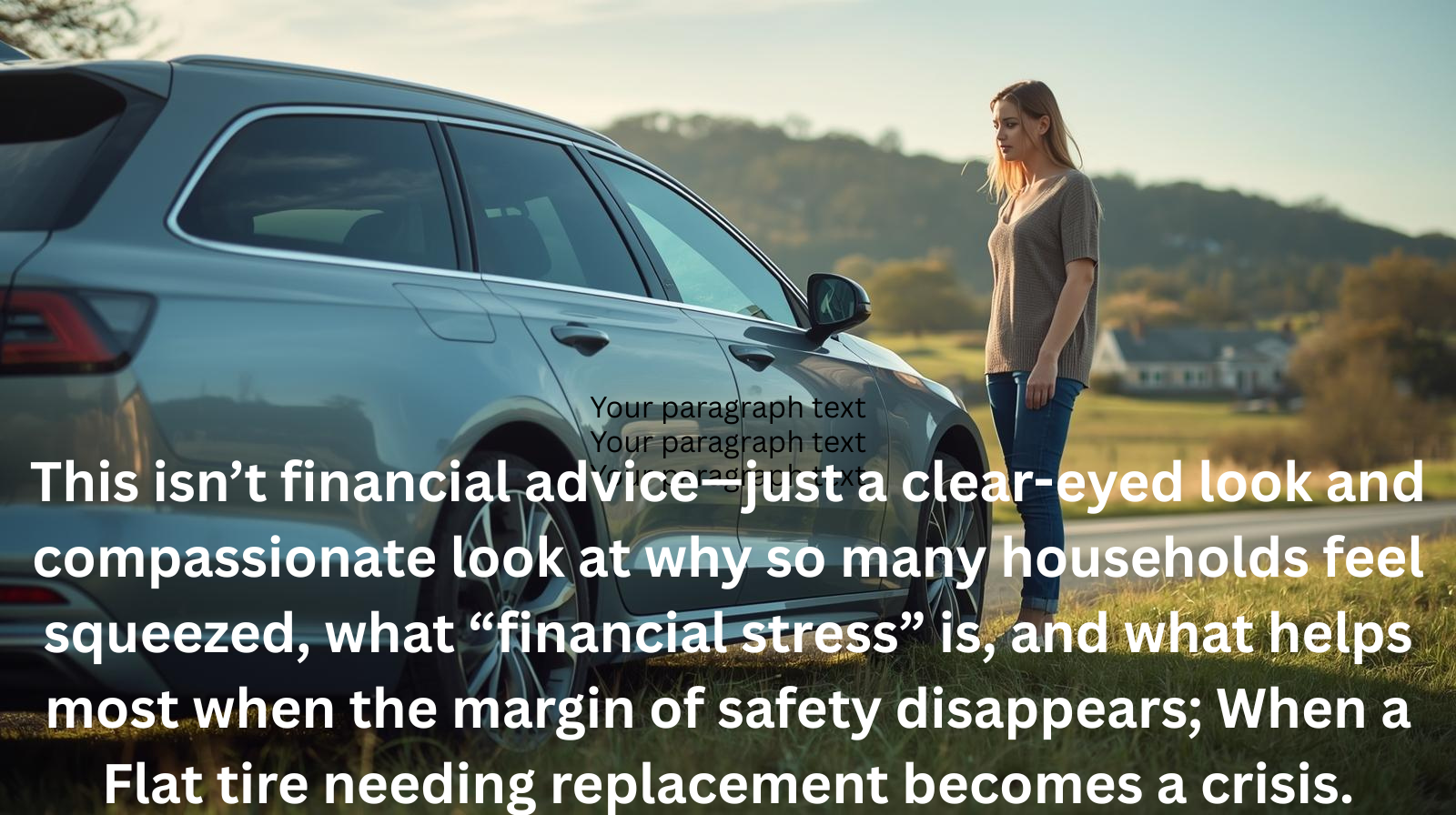
That stress shows up in the most straightforward question imaginable: Could you cover an unexpected $400 expense? In 2024, 63% of adults said they could pay it with cash, savings, or a credit card they’d pay off quickly, meaning 37% would have to borrow, sell something, or couldn’t pay at all. This question highlights the narrow margin on which many households operate, where even minor emergencies can cause significant financial strain.
Even more stark: among those who couldn’t cover it with cash equivalents, 13% of all adults said they wouldn’t be able to pay the $400. That’s not a portrait of reckless living; it’s a portrait of a thin margin and systemic breakdown.
The wage side of the squeeze: when “working” isn’t the same as “getting ahead.”
One reason financial stress persists is that pay hasn’t consistently moved with costs—especially at the bottom of the wage ladder. The federal minimum wage is $7.25/hour and has been unchanged since 24 July 2009. In inflation terms, CPI-based calculations suggest that $7.25 in 2009 is roughly equivalent to about $10.95 in 2025 purchasing power—illustrating how a frozen nominal wage becomes a pay cut in real life.
Even if you’re not earning the federal minimum, the broader low-wage landscape is large. Using CPS extracts, the Economic Policy Institute’s tracking and related state-by-state summaries estimate that about 30% of U.S. workers—~45.2 million people—earn less than $20/hour. In other words, millions are employed, but many are paid wages that struggle to keep pace with contemporary costs.
The housing multiplier: the bill that grows even when you’re “doing everything right.”
If wages are the engine, housing is the hill. High housing costs turn small shocks into big problems because rent (or a mortgage) is a fixed obligation that doesn’t negotiate when your hours get cut, or your car breaks down. Harvard’s State of the Nation’s Housing 2025 describes an environment where high home prices, elevated interest rates, and rising costs such as insurance and taxes increase household strain, while high rents keep cost burdens widespread. This systemic issue makes it difficult for households to maintain financial stability even when wages are steady, thereby amplifying financial stress across the economy.
California is the stress test in bold print. PPIC notes that renters constitute a large share of households and that a severe rent burden (paying 50% or more of income toward housing) is a persistent problem, especially among lower-income renters with fewer options. The result is a budget that behaves like it’s already “spent” before groceries, gas, utilities, and childcare even arrive.
When one job isn’t enough: the rise of the “portfolio paycheck.”
Financial stress is also about volatility: unpredictable scheduling, variable tips, seasonal slowdowns, and gig work that fills holes but rarely builds security. BLS data indicate that multiple jobholding remains a meaningful feature of the economy: in 2024, approximately 8.431 million people held more than one job, representing roughly 5.2% of employed persons (annual averages).
And the Fed’s SHED report shows how common side-income strategies have become: in 2024, people reported earning money via “gigs,” including selling things (13%) and doing short-term tasks like rides or odd jobs (9%), with many saying those activities were essential to making ends meet—while also wishing the pay were more consistent. That’s financial stress in practice: not just “working,” but constantly patching.
Recognize that safety nets are vital for working people, helping them feel supported and less alone during financial challenges.
One of the most significant misunderstandings in public discourse is that assistance programs serve only the unemployed. In reality, the safety net often functions as a stabilizer for people who work in low-paid or irregular-hour jobs. The Center on Budget and Policy Priorities estimates that approximately 15.7 million workers live in households that participated in SNAP in the past year (based on ACS analysis), underscoring the prevalence of “work + assistance” among low-wage workers.
This isn’t just about compassion; it’s about how the system is currently structured. UC Berkeley’s Labor Center has documented how low wages shift costs to public programs—Medicaid/CHIP, SNAP, and related supports—thereby creating a “public cost” for low-wage labor markets. When pay is too low or too unstable, the gap doesn’t disappear—it gets funded somewhere else.
The debt pressure valve: when the only flexibility is borrowing
When households don’t have slack, credit becomes the shock absorber. However, that shock absorber can become a long-term burden. The New York Fed reports that total household debt reached $18.59 trillion in Q3 2025, while credit card balances stood at $1.23 trillion, with delinquency measures remaining elevated. The same report notes that 4.5% of outstanding debt was in some stage of delinquency in Q3 2025, with transitions into early delinquency holding steady overall.
For credit cards specifically, bank-reported metrics indicate delinquency rates of approximately 3% in Q3 2025, and research notes that delinquency rates rose from pandemic lows and have remained a concern since 2021. This is why financial stress feels like a treadmill: credit can keep you moving—until it becomes the incline.
Medical debt: the stress that arrives as a bill, not a diagnosis
Few things produce financial stress as quickly—and as unfairly—as health costs. KFF estimates that Americans owe at least $220 billion in medical debt, and that about 14 million people (6% of adults) owe more than $1,000. In comparison, about 3 million (1%) owe more than $10,000 (based on government survey data). The Peterson-KFF analysis also underscores that medical debt persists even among insured individuals because deductibles and cost-sharing can generate bills that households cannot absorb.
That matters because medical debt doesn’t just “sit there.” It can reduce credit access, destabilize housing options, and compound anxiety—turning a health event into a financial event with a longer tail than the original illness.
The psychology of financial stress: why it’s exhausting even when nothing “bad” happens
Financial stress isn’t only about math; it’s about mental bandwidth. People who are financially strained don’t just have less money—they have fewer good options and less room to think. The Fed’s SHED report shows that many people respond to inflation by adjusting spending, a constant process of micro‑tradeoffs: switching brands, skipping purchases, delaying plans. That’s emotionally taxing because it never ends. Decision-making becomes daily rather than occasional.
Add the reality that “job switching” may no longer feel like a guaranteed step up: the Fed found that people who changed jobs in 2024 were less likely than in prior years to say the new job was better overall—another signal that mobility can feel stuck even in a solid labor market. Financial stress thrives in that environment: costs rise, but the ladder feels shorter.
Visual context: wages, inflation, and California’s higher floor
To connect the story to a simple picture, here’s the wage-vs-inflation chart we built—now including the California minimum wage alongside the federal minimum and the inflation-adjusted $7.25 since 2009. This chart does not indicate that California is “easy.” It’s showing that some states have raised the floor while the federal baseline stayed flat—and that even the inflation-adjusted “keep up” line has moved meaningfully upward over time.
What helps: practical relief vs. structural fixes
Financial stress is partly a matter of personal tactics—but it’s also a structural condition. On the practical side, the Fed’s $400 question reveals why emergency savings matter: even a small buffer changes the entire emotional experience of daily life. But the same data also suggest why “just save more” often lands like a lecture: if a third of adults can’t cover $400 without borrowing or selling, the problem isn’t motivation—it’s that too many budgets don’t have spare capacity.
Structurally, the big levers are clear in the data:
- Pay that keeps pace with costs (or at least doesn’t fall behind inflation), especially at the bottom end of the wage distribution.
- Housing affordability, because the rent burden turns normal setbacks into crises.
- Protection from predatory or destabilizing financial risks, including fraud and aggressive debt collection—both highlighted in recent SHED findings and policy discussions.
- Health-cost and medical-debt safeguards are necessary because medical bills remain a significant source of financial instability.
Closing: the real definition of financial stress
Financial stress occurs when your life requires stability, but your finances are fragile. It’s the feeling of being employed and still bracing for Impact; of juggling work, housing, and debt while hoping nothing breaks. The Federal Reserve’s data indicate that a substantial share of Americans cannot afford even a modest emergency without borrowing, selling, or forgoing payments—and that inflation remains the primary concern shaping daily behavior.
Meanwhile, housing costs and rising household debt loads help explain why so many people feel like they’re running faster to stay in place. The hard truth is that financial stress isn’t always a sign of bad choices; often, it’s a sign of an economy that sells “normal life” at premium prices while paying too many people on a budget plan.