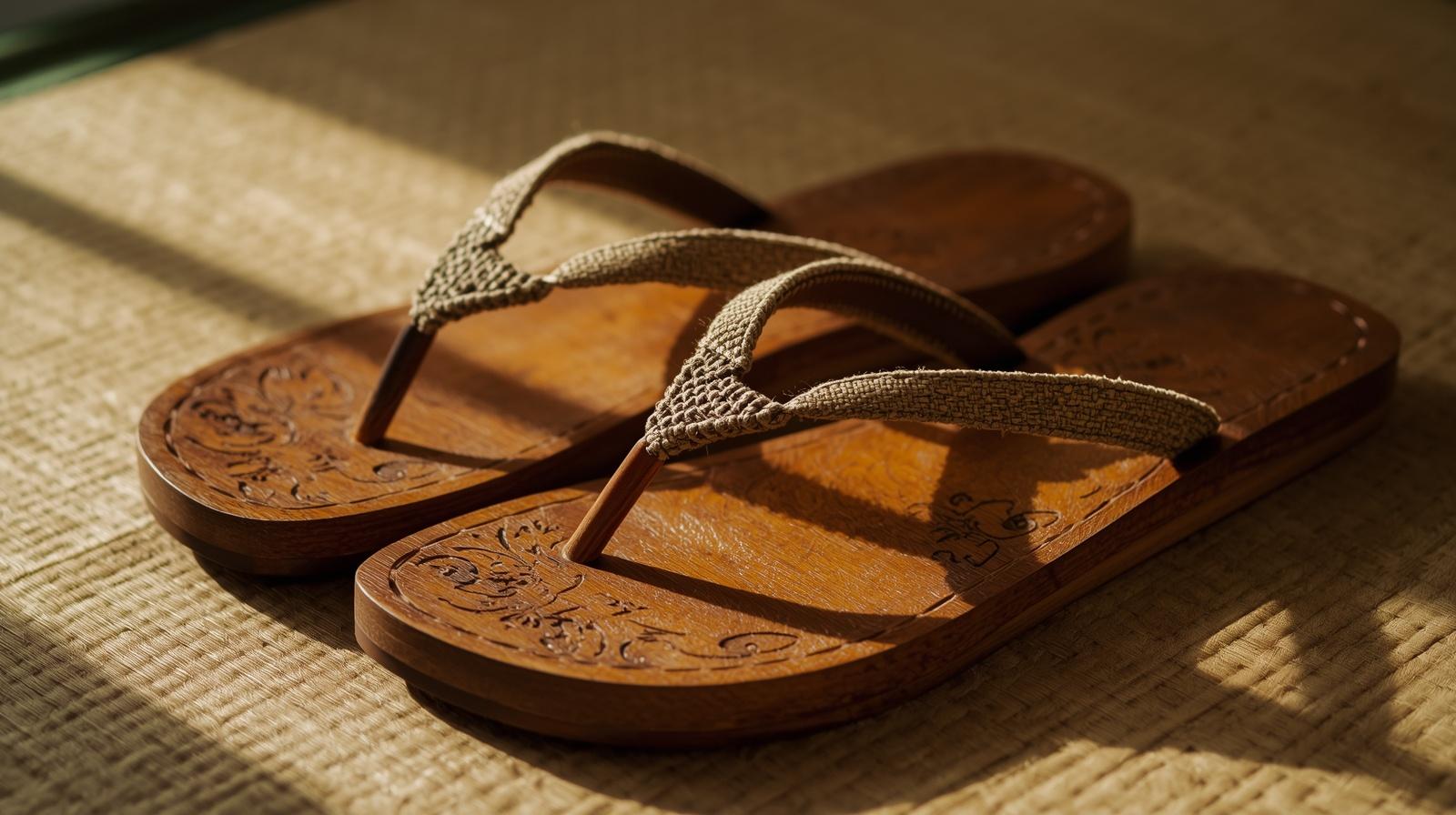
Flip-flop is a word that suggests an action, a reduplicative word from early modern English.
· 16th century (1520s): Related echoic forms like flip-flap described loose, flapping movements or sounds.
· 17th century: The term “flip-flop” referred to anything that flaps, reverses, or moves back and forth, such as a flapping sound, a somersault, or something physically turning over.
Footwear Meaning (Modern Common Usage)
By the late 1950s and into the 1960s, “flip-flop” had become the prevailing term in both American and British English for rubber or plastic thong sandals, a name derived from the characteristic sound they made when walking. [etymonline.com]
Although similar sandal designs have been utilized for millennia across regions such as Egypt, India, and Japan, the term itself is of contemporary origin rather than ancient. The style that achieved widespread popularity in the United States was significantly influenced by the Japanese zōri, introduced domestically by U.S. soldiers returning after World War II.
Figurative Meaning (Politics, Policy, Opinion)
- Late 19th to early 20th century:
Flip-flops acquire a figurative sense, meaning:
A complete or abrupt reversal of position or direction
- This sense grew naturally from the physical idea of turning over or alternating states. By around 1900, it was used metaphorically and later became especially common in political language to criticize inconsistency.
Example:
“The candidate flip-flopped on taxes.”
“When I asked her to marry me, she flip-flopped with her answer."
Technical Meaning (Electronics)
- 1930s onward:
In electronics, a flip-flop is a binary switching circuit that alternates between two stable states (on/off, 0/1).
This use again reflects the core idea of alternation and reversal.
Summary Table
Meaning |
When it emerged |
Core idea |
Flapping/turning motion |
16th–17th c. |
Repetitive movement or sound |
Somersault / physical turn |
17th–18th c. |
Turning over |
Policy or opinion reversal |
~1900 |
Abrupt change of direction |
Thong sandal |
1950s–60s |
Sound is made when walking |
Electronic circuit |
1930s |
Alternating stable states |
Bottom Line
All definitions of flip-flop derive from a core concept:
alternation—movement, sound, or position shifting back and forth
Whether referring to footwear, politics, or electronics, the term consistently denotes notions of instability, reversal, or rhythmic switching, originating from sound imitation rather than abstract theorization.
Contemporary examples of “flip-flop” usage, categorized by definition and context. These illustrate how the term is currently employed through everyday communication, media, business, politics, and technology.
1. Footwear (Literal, Everyday Use)
Meaning: A casual thong sandal, typically rubber or plastic.
Examples:
- “I grabbed my flip‑flops and headed to the beach.”
- “The hotel requires shoes—no flip‑flops in the dining room.”
- “He showed up to the meeting in shorts and flip‑flops, which surprised everyone.”
This usage remains the most literal and the most globally understood.
2. Politics & Public Policy (Figurative, Critical Tone)
Meaning: An abrupt or opportunistic reversal of position.
Examples:
- “Voters criticized the senator for flip-flopping on border policy.”
- “Her flip-flop on tax reform hurt her credibility during the campaign.”
- “The press highlighted multiple flip-flops in the candidate’s debate answers.”
This is one of the most emotionally charged uses, implying inconsistency or bad faith.
3. Business & Corporate Strategy
Meaning: A sudden change in direction, often viewed as reactive or poorly planned.
Examples:
- “The company’s flip-flop on remote work created Employee confusion.”
- “After months of resistance, management flip-flopped and approved the merger.”
- “Investors dislike strategic flip-flops that signal weak leadership.”
Common in earnings calls, analyst reports, and management commentary.
4. Personal Decisions & Everyday Speech
Meaning: Indecision or changing one’s mind.
Examples:
- “I keep flip-flopping about whether to sell the house.”
- “Stop flip-flopping and just pick a restaurant.”
- “He flip-flopped three times before choosing a college.”
This usage is informal and neutral to mildly critical.
5. Media, Journalism & Commentary
Meaning: Reversal of stance, narrative, or framing.
Examples:
- “The outlet was accused of a flip-flop in its editorial position.”
- “Public reaction forced a rapid flip-flop in the company’s messaging.”
- “Commentators noted the administration’s flip-flop within 48 hours.”
Often paired with words like “sudden,” “embarrassing,” or “high‑profile.”
6. Technology & Electronics (Technical Term)
Meaning: A flip-flop circuit—a bistable device that alternates between two states (0/1).
Examples:
- “A D-type flip-flop stores one bit of data.”
- “The counter is built using JK flip‑flops.”
- “Each clock pulse causes the flip-flop to change state.”
This meaning is precise, neutral, and foundational in digital systems.
7. Sports & Physical Movement (Less Common, Still Current)
Meaning: A backward or forward handspring or sudden bodily turn.
Examples:
- “The gymnast landed a clean flip‑flop during her routine.”
- “He tripped and did an awkward flip-flop down the slope.”
More common in gymnastics, cheerleading, and informal descriptions.