Summary
The idiom “not a leg to stand on” vividly conveys that a claim or defense lacks support. In professional legal practice, this rhetorical flourish must be rendered into precise doctrinal language grounded in rules, statutes, and precedent. This article maps the idiom to the principal procedural and substantive doctrines that dispose of unsupported claims: failure to state a claim (Rule 12(b)(6)), lack of standing, summary judgment (Rule 56), pleading and evidentiary insufficiency, jurisdictional defects, and claims foreclosed by controlling authority. It also provides model formulations for briefs and oral arguments, a quick-reference table, and practical guidance for using idiomatic clarity without sacrificing professional tone.
The Idiom’s Core Meaning
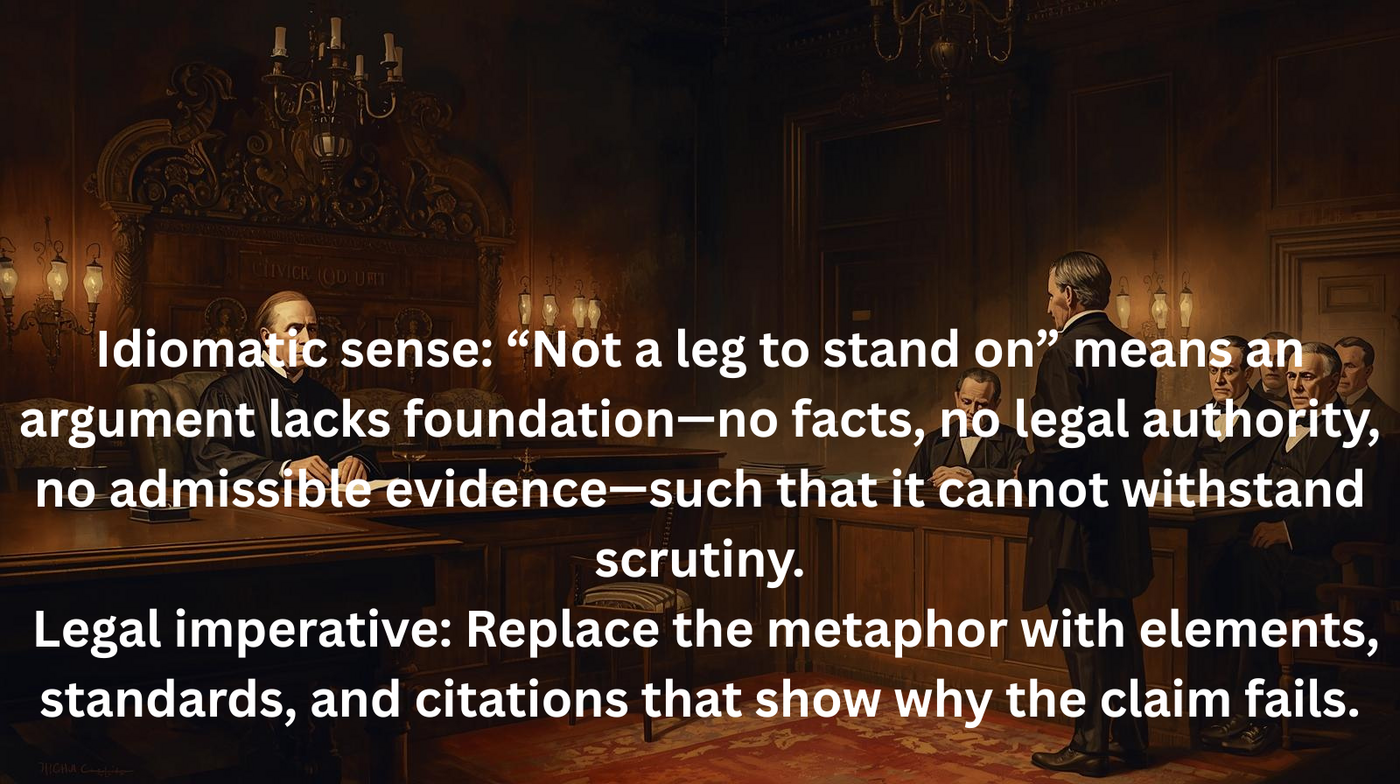
Idiomatic sense: “Not a leg to stand on” means an argument lacks foundation—no facts, no legal authority, no admissible evidence—such that it cannot withstand scrutiny.
Legal imperative: Replace the metaphor with elements, standards, and citations that show why the claim fails.
Doctrinal Equivalents: Where “No Leg to Stand On” Lives in Law
1) Failure to State a Claim — Rule 12(b)(6)
Doctrinal translation: The complaint does not allege facts that, if true, plausibly establish each element of the cause of action.
Professional phrasing:
- “Plaintiff’s allegations fail to state a claim upon which relief can be granted under Rule 12(b)(6).”
- “The complaint omits facts necessary to establish duty and causation, and therefore cannot proceed.”
Practice notes:
- Identify the elements of the claim.
- Show which elements lack factual support.
- Use “plausibility” language and point to the record or the pleadings.
2) Lack of Article III Standing
Doctrinal translation: The plaintiff lacks injury-in-fact, causation, or redressability; the court is without power to adjudicate.
Professional phrasing:
- “Plaintiff lacks Article III standing; no concrete, particularized injury is alleged.”
- “The claimed injury is neither fairly traceable to defendant’s conduct nor redressable by this court.”
Practice notes:
- Distinguish between constitutional standing (jurisdictional) and prudential standing (statutory or zone-of-interests).
- When standing fails, the case is dismissed without reaching the merits.
3) Absence of Evidence — Summary Judgment (Rule 56)
Doctrinal translation: There is no genuine dispute of material fact because the nonmovant lacks admissible evidence on an essential element.
Professional phrasing:
- “Plaintiff offers no admissible evidence establishing causation; summary judgment is warranted under Rule 56.”
- “On this record, no reasonable factfinder could find liability.”
Practice notes:
- Separate inadmissible materials (hearsay, unauthenticated documents) from evidence that counts.
- Link insufficiency to the element on which the nonmovant bears the burden at trial.
4) Claims Foreclosed by Statute or Controlling Precedent
Doctrinal translation: The legal theory is preempted, barred, or disallowed by binding authority (statutory text, regulations, or precedential decisions).
Professional phrasing:
- “Controlling authority precludes recovery on these allegations.”
- “The statute’s plain text forecloses plaintiff’s theory; the claim fails as a matter of Law.”
Practice notes:
- Quote dispositive language (statute/regulation).
- Identify binding precedent (same jurisdiction or higher court).
- Offer limiting principles if policy concerns arise (e.g., “floodgates”).
5) Pleading Defects and Heightened Standards
Doctrinal translation: The claim does not satisfy heightened pleading (e.g., fraud, consumer protection, civil RICO) or relies on conclusory assertions.
Professional phrasing:
-
“The fraud count fails for lack of particularity—no misrepresentation, time, place, or speaker.”
-
“Bare assertions of ‘deception’ do not meet the heightened pleading standard.”
Practice notes:
- Identify the specific heightened standard and its requirements.
- Itemize the missing particulars (who/what/when/where/how).
6) Jurisdictional Defects (Subject-Matter or Personal)
Doctrinal translation: The court lacks subject-matter jurisdiction (e.g., no federal question or diversity) or personal jurisdiction (no minimum contacts).
Professional phrasing:
-
“The court lacks subject-matter jurisdiction; the complaint alleges no federal claim and diversity is absent.”
-
“Defendant lacks minimum contacts with the forum; exercising jurisdiction would offend due process.”
Practice notes:
-
Jurisdictional flaws render the case non-justiciable, independent of merits.
-
Raise early; defects may be raised at any time regarding subject-matter jurisdiction.
7) Evidentiary Exclusion — Gatekeeping Failures
Doctrinal translation: Essential proof is inadmissible (e.g., unreliable expert methodology, hearsay without exception), leaving no evidentiary foundation.
Professional phrasing:
-
“Excluding the proffered expert testimony leaves plaintiff without evidence on causation.”
-
“Unauthenticated records cannot create a genuine dispute of material fact.”
Practice notes:
-
Tie exclusion to specific rules (e.g., reliability, relevance, foundation).
-
Explain why exclusion is case-dispositive.
Model Language: Replacing the Idiom in Briefs and Oral Argument
A) Brief (Motion to Dismiss)
Plaintiff’s claims fail as a matter of Law. The complaint does not allege facts establishing duty or causation—both essential elements of negligence—thereby failing to state a claim under Rule 12(b)(6). In addition, binding authority forecloses recovery on the theory advanced.”
B) Brief (Summary Judgment)
“There is no genuine dispute of material fact. Plaintiff presents no admissible evidence of causation, and the expert testimony is inadmissible for lack of reliable methodology. Accordingly, judgment should be entered under Rule 56.”
C) Oral Argument (Dispositive Motion)
“Cutting to the dispositive issues: there is no jurisdictional hook, and even if there were, the record contains no admissible evidence on causation. Under the governing standard, these claims cannot proceed.”
D) Client Advisory / Internal Memo
“As currently framed, the case lacks the foundational elements needed to survive dismissal or summary judgment. We recommend amending to plead specific facts supporting duty and causation and developing admissible evidence to avoid gatekeeping challenges.”
Quick-Reference Mapping: Idiom → Doctrine → Professional Phrase
|
Idiom |
Doctrine |
Professional Phrase |
|
Not a leg to stand on |
Rule 12(b)(6) failure |
“Fails to state a claim; essential elements are not plausibly alleged.” |
|
Not a leg to stand on |
Article III standing |
“No concrete injury; causation/redressability are absent.” |
|
Not a leg to stand on |
Rule 56 summary judgment |
“No admissible evidence on a material element; no genuine dispute.” |
|
Not a leg to stand on |
Foreclosed by Law |
“Statute/precedent precludes recovery on these allegations.” |
|
Not a leg to stand on |
Heightened pleading |
“Particularity missing; allegations are conclusory.” |
|
Not a leg to stand on |
Jurisdictional defects |
“Court lacks jurisdiction; dismissal is required.” |
|
Not a leg to stand on |
Evidentiary exclusion |
“Essential proof inadmissible; claim collapses.” |
Style and Strategy: Using Idioms Without Losing Credibility
- Anchor Immediately to Authority
Follow any metaphor with the rule, element, citation, and record cite. Rhetoric without scaffolding undermines credibility. - Prefer Elements Over Flourish
Replace “weak” or “baseless” with element-based analysis: identify missing facts and tie them to doctrinal failure. - Know Your Forum and Audience
Idioms are more persuasive in oral argument and client communications than in appellate briefs. Trial judges vary—observe local practice. - Avoid Ad Hominem
Aim critiques at arguments and evidence, not at opposing counsel. Phrases like “smoke and mirrors” should be rare and fact-backed. - Calibrate Tone
Avoid “open-and-shut” unless it truly is. Use “dispositive, foreclosed, jurisdictionally barred” for precision. - Use Sparingly
One carefully chosen idiom can sharpen a point; a flurry can look glib. Let doctrine and record carry the weight.
Applied Examples: Transforming Rhetoric into Doctrine
Example 1 — Consumer Fraud Claim
Idiomatic critique: “Plaintiff’s fraud claim has no leg to stand on.”
Doctrinal rewrite:
- “The fraud claim fails because it lacks particularity: no identified misrepresentation, time, place, speaker, or reliance details. Without these particulars, the count does not meet heightened pleading requirements and must be dismissed.”
Example 2 — Product Liability
Idiomatic critique: “Their case has no leg to stand on after the expert was excluded.”
Doctrinal rewrite:
- “Excluding the expert testimony leaves the plaintiff without admissible evidence on causation—a required element. Summary judgment is appropriate because there is no genuine dispute of material fact.”
Example 3 — Employment Claim
Idiomatic critique: “The retaliation theory has no leg to stand on.”
Doctrinal rewrite:
- “Plaintiff cannot establish the causal link between protected activity and adverse action. Absent admissible evidence on causation, the claim fails under Rule 56.”
Conclusion
“Not a leg to stand on” is a valid rhetorical signal, but professional advocacy demands doctrinal precision. Translate the metaphor into the specific legal standard: identify the missing elements, the absence of admissible evidence, the presence of jurisdictional defects, or controlling Law that forecloses the theory. When idiom becomes doctrine—backed by authority and facts—arguments gain clarity, credibility, and persuasive power.