Summary
The following is a brief explanation, followed by quotes from well-known figures. The purpose of the article is for organizational training.
Most professionals are trained to manage tasks, follow procedures, and keep things “running.” That works—until you want to build wealth, scale a business, or drive outsized Impact. Then the game changes. The people who create disproportionate value don’t worship process; they engineer outcomes. Yet the answer isn’t to abandon process—it’s to sequence it correctly and use it in the service of results.
The playbook explains how to balance process discipline with a results focus, ensuring professionals view results-driven practices as adaptable rather than rigid, thereby maintaining rigor while fostering flexibility.
Results First, Process Second
Results-thinking begins with a clarifying question: “What specific, measurable outcome aligns with our organizational goals and context?” This helps readers understand how to tailor the guidance to their unique situations, making it more applicable and persuasive.
“What outcome must exist at the end of this?”
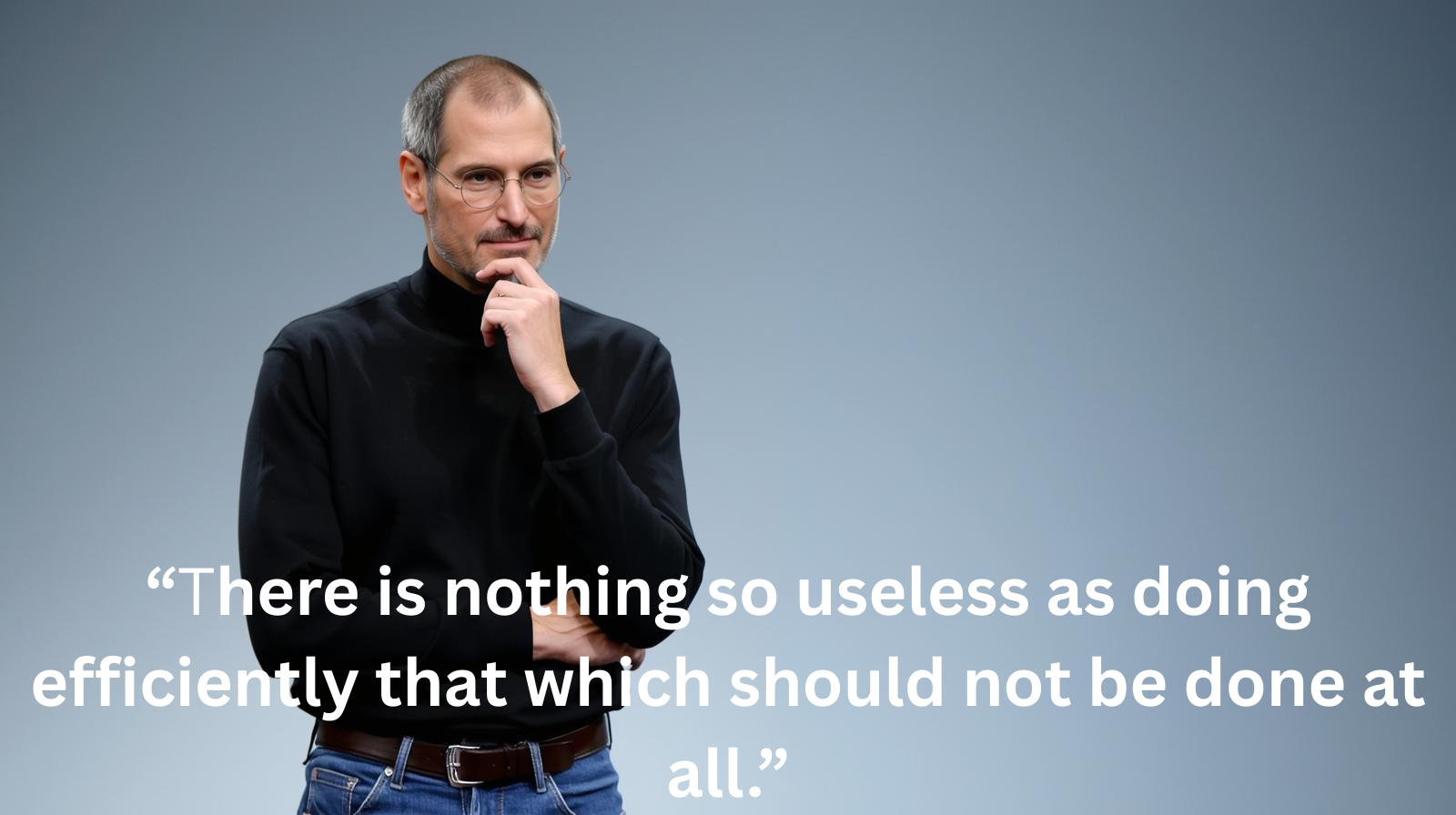
Peter Drucker warned:
“There is nothing so useless as doing efficiently that which should not be done at all.”
Steve Jobs echoed:
“Deciding what not to do is as important as deciding what to do.”
Jobs also tied this directly to innovation:
“Innovation distinguishes between a leader and a follower.”
Microsoft CEO Satya Nadella emphasized that innovation is a learning cycle, not a static plan:
“The true scarce commodity of the future will be human attention and innovation, not efficiency.”
NVIDIA CEO Jensen Huang frames innovation as aggressive priority-setting:
“Do the hardest work first.”
Experimentation reveals the signal; process amplifies it.
Impact over Effort is key. Results-thinkers focus on the effect of actions, making the audience feel empowered and motivated to prioritize meaningful work and drive value.
Process-thinkers measure Effort.
Results-thinkers measure Impact.
Deming:
“In God we trust; all others must bring data.”
Patton:
“A good plan, violently executed now, is better than a perfect plan next week.”
Tesla and SpaceX CEO Elon Musk:
“If the rules are such that you can’t get things done, you have to change the rules.”
Jeff Weiner, former LinkedIn CEO, on innovation through outcomes:
“If you want faster innovation, you need to measure the right things.”
When your scoreboard shifts from Effort to effect, everything changes.
Redefine Deadlines as Outcomes
A task deadline says:
“Finish the report by Friday.”
A results deadline says:
“By Friday, deliver a plan that increases conversion by 10%.”
Thomas Edison:
“Vision without execution is hallucination.”
Salesforce CEO Marc Benioff:
“Speed is the new currency of business.”
Amazon’s Andy Jassy, now CEO:
“Speed matters in business. Many decisions are reversible and do not need extensive study.”
And Elon Musk:
“Focus on signal over noise.”
Results-driven deadlines foster innovation by demanding brighter—not longer—work.
Seek the 80/20 Move
Process-thinkers ask, “What’s the next step?”
Results-thinkers ask:
“Which action creates the biggest Impact with the least effort?”
Charlie Munger:
“Show me the incentive, and I will show you the outcome.”
Albert Einstein:
“Everything should be made as simple as possible, but not simpler.”
Google CEO Sundar Pichai:
“The important thing is to be moving forward. Don’t wait for perfection.”
Innovation thrives where simplicity meets boldness.
Eliminate Orphaned Processes
Organizations accumulate rituals that no longer matter.
Jeff Bezos:
“Be stubborn on vision, flexible on details.”
Indra Nooyi:
“Leadership is hard. But results matter. And if you don’t deliver, you don’t stay in the game.”
Twitter cofounder Jack Dorsey (on eliminating anything nonessential):
“Make every detail perfect and limit the number of details to perfect.”
Warren Buffett:
“Chains of habit are too light to be felt until they are too heavy to be broken.”
Innovation requires pruning—making space for what actually drives progress.
Shift from Accuracy to Effectiveness
Process-thinking worships precision.
Results-thinking rewards effectiveness.
Reid Hoffman:
“If you’re not embarrassed by the first version of your product, you launched too late.”
Phil Knight:
“Just do it.”
Jeff Bezos on the importance of iterative innovation:
“Our success is a function of how many experiments we do per year, per month, per week, per day.”
Perfect is slow.
Slow losses.
Innovation demands motion.
Separate Strategy from Execution
Jim Collins:
“Good is the enemy of great.”
Sun Tzu:
“Strategy without tactics is the slowest route to victory. Tactics without strategy is the noise before defeat.”
Apple CEO Tim Cook:
“We’re not focused on the numbers. We’re focused on the things that produce the numbers.”
Netflix’s Reed Hastings links this to innovation culture:
“Don’t let rules get in the way of doing the right thing.”
Outcome thinking clarifies strategy; process supports execution.
Install a Results–Process Flywheel
A sustainable growth loop looks like this:
· Define the result.
· Take fast action.
· Measure.
· Codify what worked.
· Delegate or automate.
· Raise the bar.
Meta CEO Mark Zuckerberg:
“Move fast and build things.”
Former Google CEO Eric Schmidt:
“Innovation comes from the freedom to fail.”
Henry Ford:
“If you always do what you’ve always done, you’ll always get what you’ve always got.”
Innovation accelerates when action and learning are continuous, fostering a culture of curiosity and commitment to growth.
Upgrade Your Identity and Environment
Napoleon Hill:
“What the mind can conceive and believe, it can achieve.”
Malcolm X:
“The future belongs to those who prepare for it today.”
Shopify CEO Tobi Lütke:
“The world is being built by people who try.”
Innovation is ultimately a mindset—a choice to think in possibilities, not procedures.
The Real Choice
Results create wealth.
Process multiplies it.
But only when used in the correct order.
Remember Drucker’s warning about useless efficiency.
Remember Jobs’s clarity.
Remember Nadella’s learning mindset, Bezos’s flexibility, Huang’s urgency, Nooyi’s accountability, and Musk’s insistence on removing obstacles.
Remember that innovation is the engine behind all meaningful results.
As Steve Jobs said:
“Innovation is the only way to win.”
Adopt this stance, and you’ll feel the shift: faster cycles, sharper focus, cleaner priorities, better outcomes.
Keep it long enough, and results stop being accidents—they become identity.
You can polish processes forever, or you can build a system that produces outcomes.
Choose outcomes.
Then build a process worthy of what you can achieve.