Summary
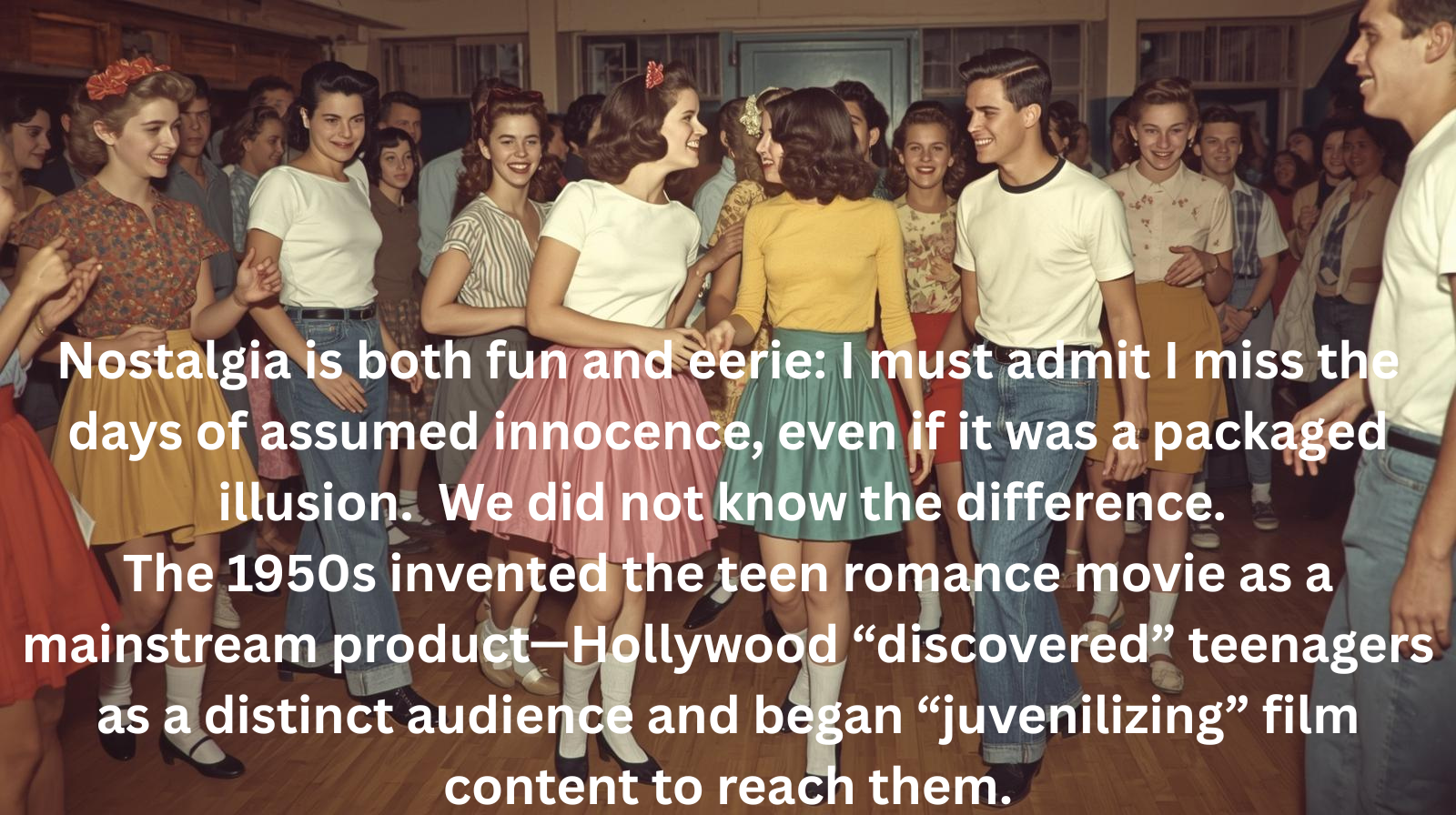
Nostalgia is both fun and eerie: I must admit I miss the days of assumed innocence, even if it was a packaged illusion. We did not know the difference. The 1950s invented the teen romance movie as a mainstream product—Hollywood “discovered” teenagers as a distinct audience and began “juvenilizing” film content to reach them.
The 1960s didn’t simply continue that trend; it split it in two: early in the decade, teen romance became sunnier and more packaged (beaches, music, clean fun), and by the late 1960s, it turned more adult, anxious, and culturally turbulent, invoking a sense of evolving relevance for the audience.
If 1950s teen romance asked for permission, 1960s teen romance began asking what the rules were—and who they served.
Video:
Bobby Socks To Stockings
https://www.youtube.com/watch?v=TYpnIDzMzhE
1) The Big Difference: What Adults Thought Teen Romance Was “For.”
1950s: Romance as a moral lesson (and a reputation test)
In the 1950s, teen romance was often framed as something adults needed to supervise, manage, or worry about—part of a larger cultural conversation about youth, conformity, and the “proper” path to adulthood.
Even when the love story was central, the surrounding world tended to be thick with parental judgment, community standards, and anxiety about “respectability”—a pattern visible in melodramas that stage teen love alongside adult hypocrisy and social control.
1960s: Romance as lifestyle (early) → romance as identity crisis (late)
By the 1960s, teen romance increasingly came packaged as youth leisure—a set of activities, fashions, and soundtracks sold as a complete experience.
Then, as the decade darkened and politics intensified, American film turned toward youth-culture stories marked by cynicism toward established values and a new permissiveness following the introduction of the MPAA ratings system in 1968.
The 1950s treated teen romance as a problem to manage; the 1960s treated it first as a fantasy to sell, then as a symptom of a changing world.
2) Where Love Happens: Settings Shift from “Community” to “Escape.”
1950s: Small towns, homes, and social surveillance
A signature 1950s move is placing teen romance where everyone can see it—schools, neighborhoods, family spaces—so that love becomes a public drama with consequences.
Even beach-adjacent romances like Gidget (1959) still feel like a coming-of-age negotiation with parents and social norms, not a world where teens truly run the show.
Videos:
https://www.youtube.com/watch?v=V6LJMCuhZxw
https://www.youtube.com/watch?v=ng0aIpHT7uU
https://www.youtube.com/watch?v=Y5suc-Yexpw
1960s: Fort Lauderdale, Malibu, and the geography of getaway
In the early 1960s, teen romance films leaned into destination storytelling—places that function like temporary free zones. Where the Boys Are (1960) centers its romantic premise on spring break travel, aligning adolescent desire with mobility and seasonal escape.
Beach party films that arrive mid-decade go further: their core elements include teen/college-age protagonists, romance arcs, musical acts, and a world in which adults appear primarily as comic antagonists or buffoons.
Videos:
https://www.youtube.com/watch?v=bItmUyZxODg
https://www.youtube.com/watch?v=41_jI3vsuyE
The 1950s put teen romance under a porch light; the 1960s moved it to the shoreline and told adults to stay out of frame.
3) Tone and “Heat”: From Earnest Melodrama to Winking Pop
1950s: Earnestness, angst, and the stakes of growing up
The decade’s teen romance films often feel earnest because they’re built on anxiety: generational conflict, social consequences, and the fear that one wrong choice can define a future.
Even films not categorized as “romance” in a narrow sense—like Rebel Without a Cause (1955)—treat teen connection as emotionally urgent, and the movie’s later canonization (including National Film Registry recognition) underscores its cultural weight.
1960s: The “clean fun” fantasy (mid-60s) + the late-60s edge
The decade’s teen romance films often feel earnest because they’re built on anxiety about growing up. Still, by the late 1960s, films expressed cynicism toward established values, reflecting a sense of disillusionment and cultural change that resonated with audiences’ awareness of societal shifts.
The 1960s didn’t replace 1950s earnestness; it bracketed it with mid-decade escapism and late-decade disillusionment.
4) Adults on Screen: Authority Figures Become Comedy Props (Until They Don’t)
1950s: Parents and institutions shape the plot
In many 1950s teen romances, adult institutions—parents, schools, town leaders—are not optional; they are the gatekeepers and moral referees.
This is part of what made the “teenpic” concept necessary: the films both validated teen identity and simultaneously framed it within adult concerns about youth behavior.
1960s: Adults become caricatures in beach films; return as social forces in late 60s
The beach party genre’s own definition highlights how adults are typically non-parental antagonists or comic relief, while teen trends (surfing, dancing, cars, music) carry the narrative.
Then, in the late 60s, films reintroduce adult society as a serious target—youth-culture cinema becomes less about flirting under supervision and more about confronting (or escaping) the values of the older generation.
In mid-60s teen romance, adults are the punchline; by late-60s, adulthood itself becomes the problem.
5) Music as Romance Technology: From “Featured Song” to Full Formula
1950s: Rock ’n’ roll enters the teen story
Rock-oriented teen films in the 1950s demonstrated that music could draw youth to theaters; Rock Around the Clock (1956) was designed to capitalize on a hit and the teen appetite for the new sound.
Rock Around The Clock:
https://www.youtube.com/watch?v=ZgdufzXvjqw
This aligned with a broader teen-market awakening that scholars associate with the rise of teenpics and the industry’s targeting of youth audiences.
1960s: Music becomes structural—especially in beach party films
Beach party films explicitly include original songs and teen-oriented musical acts as core elements, functioning as both story fuel and marketing pipeline.
The Frankie Avalon/Annette Funicello pairing became central to that cross-media teen-idol logic—singers and actors folded into a single, repeatable romance product.
The 1950s introduced music as a youth signal; the 1960s turned it into a production formula.
6) How “Teen Romance” Expands by the Late 1960s
By the late 1960s, the “teen romance” umbrella extended to films that weren’t set in high school and weren’t primarily about courting, but were deeply concerned with youth intimacy, alienation, and generational mismatch.
The Graduate (1967) is often cited as a landmark for its portrayal of post-graduation malaise and generational alienation, using romantic entanglement as a satirical lens on the promises of adulthood.
https://www.youtube.com/watch?v=KVNFaxJspMQ
And Zeffirelli’s Romeo and Juliet (1968) became widely popular among teenagers in part because it cast leads close to the characters’ ages, making classic romance feel newly immediate to youth audiences.
https://www.youtube.com/watch?v=KVNFaxJspMQ
https://www.youtube.com/watch?v=KVNFaxJspMQ
By 1968, teen romance wasn’t just “who likes whom”—it was a way to talk about the entire generational handoff happening in real time.
1950s Teen Romances (typical traits)
- High stakes: reputation, family conflict, moral scrutiny.
- Earnest tone: melodrama and angst are familiar.
- Adults matter: parents/institutions drive consequences.
- Music emerges as a youth marker (rock films).
1960s Teen Romances (typical traits)
- Early 60s: travel/escape romances (spring break).
- Mid-60s: beach party fantasy—clean fun, adults as comic obstacles, music built-in.
- Late 60s: youth-culture cinema becomes more cynical; ratings system increases permissiveness.
- Romance expands into generational satire and classical teen casting.