Summary
You won’t hear much about the national crisis in the mainstream media or on the nightly news.
Overview
Functional illiteracy is not an abstract metric—it’s a lived experience that constrains health, work, family life, and civic participation in a nation that runs on text. In the U.S., large-scale assessments of adult skills show that roughly one in five adults performs at or below Level 1 on the PIAAC literacy scale—meaning they struggle with basic reading tasks such as filling out forms, following multi-step written instructions, or making straightforward inferences from short texts. On a scale, researchers estimate that low adult literacy reduces productivity and participation by up to $2.2 trillion annually in lost economic output—about 10% of GDP.
Below, we translate the daily reality into concrete domains, share case studies of people and programs, and lay out a practical, evidence-informed policy agenda that meets the problem where it actually lives: workplaces, clinics, homes, community classrooms, and ballot boxes. Clarifying the roles of health and education agencies can facilitate coordinated action and resource sharing.
What Functional Illiteracy Means—By the Numbers
The National Center for Education Statistics (NCES) reports that 79% of U.S. adults demonstrate medium to high English literacy skills (Level 2+), leaving about 21% with low English literacy (Level 1 or below).
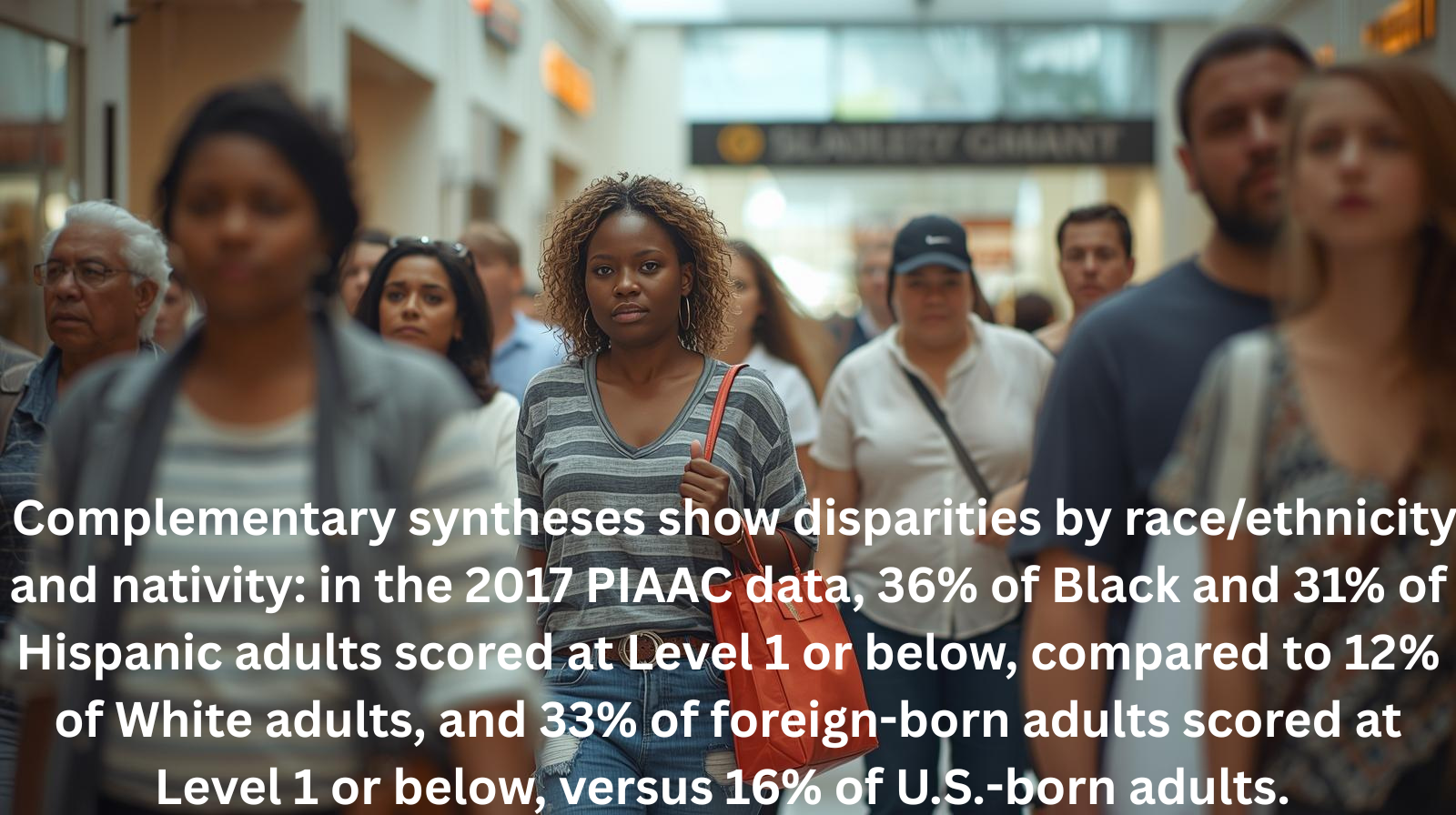
These low skills limit the ability to compare information, paraphrase, and make even low-level inferences from written text. Complementary syntheses show disparities by race/ethnicity and nativity: in the 2017 PIAAC data, 36% of Black and 31% of Hispanic adults scored at Level 1 or below, compared to 12% of White adults, and 33% of foreign-born adults scored at Level 1 or below, versus 16% of U.S.-born adults.
Health literacy gaps highlight the critical role health officials can Play in reducing disparities. Addressing these deficits can lead to better health outcomes and lower system costs, making their work more impactful.
A Day in the Life: Where the Barriers Show Up-Community leaders can see how health, safety, and family issues directly affect their communities, emphasizing their role in solutions.
Health and safety. A patient discharged after a procedure receives multi-page instructions—dosages, warnings, and when to call a doctor. Adults with low health literacy are more likely to misunderstand dosing, miss screenings, or misuse devices, contributing to worse outcomes and higher system costs.
Work and wages. Modern jobs—even “frontline” roles—expect employees to read SOPs, safety protocols, shift notes, and digital dashboards. PIAAC-based analyses consistently show strong positive links between foundational literacy/numeracy and wages and employment; returns often increase when skill use at work is frequent. Employers themselves report productivity and retention hits from low literacy; in recent surveys, roughly one-third said their average employee lacks sufficient literacy to do the job well.
Family and schooling. Parents with low literacy face barriers in helping children with homework, communicating with schools, or navigating portals. Multi-generational approaches that build adult skills alongside children’s literacy show measurable gains in attendance, reading scores, and family engagement.
Civic participation. Ballots and propositions are often written at a high school level, even as many adults read below the sixth-grade level. That gap, plus complex ID and registration requirements, can depress turnout in low-literacy communities. The legacy of literacy tests is gone, but literacy barriers still functionally exclude voters—a problem worsened when polling places close or procedures change.
Digital life. Terms of service, appointment portals, and benefits applications presume fluent reading plus digital navigation. Evidence suggests that complex, multitasking-prone screen environments can hinder deep reading and comprehension for many users, magnifying barriers for those already struggling.
Case Studies: What Works—and Why
Case Study 1: Family Literacy—Toyota & NCFL (National Center for Families Learning).
Over three decades, the Toyota Family Literacy Program has supported adult learners (mainly immigrant parents) in improving their English and literacy while building capacity to support children’s education. Meta-analyses and program evaluations report higher student attendance, improved reading outcomes, and increased family engagement in participating communities. The program’s design is instructive: contextualized adult learning, parent–child learning time (PACT), and wraparound supports that reflect the realities of school, work, and home.
Case Study 2: Workplace Literacy Partnerships.
ProLiteracy’s workplace literacy guide, developed with Pitney Bowes, documents practices for embedding job-relevant reading, math, and digital skills into employer partnerships—aligning instruction with actual tasks, safety materials, and advancement pathways. Results include better job performance and retention when programs are co-designed with employers and delivered at or near the job site. Broad employer surveys (ALL IN/FTI) echo demand: literacy shortfalls are widespread, with expected tens of billions in lost revenue due to training delays, errors, and turnover—underscoring the ROI of integrated literacy upskilling.
Case Study 3: Health Literacy Innovation—Mock Patient Portals.
Adult education programs in Arizona piloted simulated electronic health portals to teach patients how to navigate appointments, messages, refills, and lab results. Learners practiced safely, built vocabulary for medical interactions, and transferred skills to real systems—demonstrating the value of contextualized digital health literacy in foundational classrooms.
Case Study 4: Individual Journeys in Community Programs.
Qualitative studies of adult learners in local literacy centers highlight the pivotal roles of tutor empathy, individualized interventions, and practical, goal-linked tasks (e.g., reading workplace instructions, budgeting, and parental communication). Participants describe “a chance for making a change,” with motivation and supportive relationships driving persistence and skill gains.
Policy Recommendations: A Practical Playbook
1) Make Integrated Education and Training (IET) the default for adult ed.
Under WIOA Title II (AEFLA), IET simultaneously delivers adult basic education, workforce preparation, and occupational training, using occupationally relevant materials and a single set of learning outcomes. Evidence and field experience point to IET’s scalability and relevance across sectors—bridge programs, pre-apprenticeships, integrated ESL/Civics, and corrections education. States should fund IET across skill levels, build sector partnerships, and measure outcomes using wage records and credential attainment data. To ensure sustainability, exploring diverse funding streams and public-private partnerships is essential. Practical resources and state presentations show how to align IET with content standards, structure concurrent instruction, and expand access via Ability-to-Benefit pathways.
2) Fund community-rooted family literacy at scale.
Approaches like NCFL’s integrated parent–child learning deliver dual-generation returns—better child attendance/reading and stronger adult skills for work and life. Federal/state grants should prioritize family literacy in Title II competitions, integrating ESL, adult basic education, and school partnerships; philanthropic co-funding can extend reach to immigrant and low-income communities.
3) Embed health literacy in adult education and clinical workflows.
Given that most adults struggle with health literacy, fund contextualized curricula (e.g., medication labels, care navigation, patient portals) in adult ed, and require plain-language standards in healthcare systems. HHS/CDC materials and Milken Institute guidance offer frameworks for assessment, simplification, and staff training. Health systems should track preventable error rates tied to comprehension, redesign patient materials, and partner with community classes.
4) Incentivize workplace literacy partnerships.
Offer tax credits or competitive grants for employers who co-develop job-embedded literacy/digital skills training with local adult ed providers—on paid time, with advancement pathways and industry-recognized credentials. ProLiteracy’s workplace guide is a blueprint for aligning instruction to actual workflows; ALL IN’s recommendations quantify employer pain points and support sector-specific interventions.
5) Improve ballot accessibility and voter information design.
States and counties should adopt plain-language standards for ballots and proposition summaries, provide visual and multilingual aids, and expand assisted voting protocols without compromising privacy. Research digests highlight that many ballot texts exceed typical adult reading levels; investigative analyses link low literacy to lower turnout, suggesting usability reforms could boost participation. While the Voting Rights Act abolished historical literacy tests, modern accessibility obligations require proactive design and outreach.
6) Treat digital reading as a distinct skill—and teach it that way.
Reading online is different: multitasking environments, hyperlinks, and mobile interfaces Impact comprehension. Educators and program designers should teach strategies for screen reading (e.g., distraction management, annotation, chunking, link evaluation) and offer hybrid materials to support “deep reading.” Reviews and practitioner guides emphasize that digital formats can hinder comprehension for longer, complex texts; explicit instruction can mitigate those effects.
7) Build the evidence base and performance accountability in adult ed.
IES/NCEE reviews call for more rigorous evaluation of adult education strategies. States should fund randomized or quasi-experimental evaluations of IET, workplace partnerships, and health literacy curricula; use wage records to measure Impact; and publish negative and positive findings to guide practice.
8) Connect literacy to regional growth strategies.
Economic studies suggest that raising adult literacy levels would materially boost local and national GDP. State economic development plans should treat adult literacy as infrastructure—funding provider capacity, digital tools, and wraparound supports (transportation, childcare) to unlock labor participation and wage growth.
Addressing Common Counterpoints
“Isn’t this mostly a K–12 problem?”
Early reading matters, but adult skill development is where the economy actually recovers lost ground. PIAAC data track adult skills directly; targeted adult education improves employability, earnings, and non-pecuniary outcomes. Returns to cognitive skills remain significant across cohorts and contexts, with instrumental-variable and policy “natural experiments” suggesting that standard estimates may understate the true labor-market payoff.
“Can we really afford this?”
The $2.2 trillion potential gain dwarfs the incremental cost of expanding adult education and literacy partnerships. Employers already spend heavily on remedial training; aligning that spend with proven models (IET, contextualized workplace literacy) can improve productivity, safety, and retention.
“Will digital tools fix it?”
Digital platforms can expand access, but design matters. Without explicit instruction, screen reading often reduces comprehension for complex texts; good digital literacy teaching, usability, and plain-language content are required.
Measuring Success: A Short, Actionable Dashboard
- Participation & Persistence: Adult ed enrollment and term-to-term persistence in IET and family literacy programs, disaggregated by skill level and language.
- Credentials & Wage Gains: Industry-recognized credentials earned; pre-/post-wages via state wage record matching under WIOA.
- Health Outcomes: Rates of correct medication use, preventive care uptake, and avoidable ER visits among program participants versus matched controls.
- Workplace KPIs: Safety incidents, error rates, retention, and promotion rates in employer-partner programs.
- Civic Engagement: Voter turnout changes in precincts targeted with plain-language ballot reforms and voter education.
Conclusion: Build for the Way People Actually Live and Work
Functional illiteracy is a daily barrier to safety, prosperity, and democratic voice. The good news is that the challenge is solvable when we design programs around real tasks—health portals, job SOPs, school communications, ballots—and deliver instruction contextually, alongside training and support. The evidence base (though still growing) points to integrated models like IET, dual-generation strategies, health literacy curricula, and workplace partnerships as practical engines of change.
The payoff is both human and economic: more confident parents, safer patients, productive workers, and informed voters—and a country that recovers trillions in output by unlocking the potential of its adults.