Summary
The reason is best understood as a combination of complex security strategy, Arctic geopolitics, and resource economics—all amplified by climate change and intensifying great-power competition. Below are the main drivers most often cited by analysts and reporting, along with the key constraints that make outright “ownership” extraordinarily difficult.
The Arctic and North Atlantic military geography, with Greenland’s position between North America and Europe, underscores its vital role in U.S. security, reassuring the audience of its strategic significance.
Greenland’s position between North America and Europe, near the Arctic, makes it a key strategic point for long-range threats such as ballistic missiles passing over the pole, underscoring its geopolitical importance since WWII and the Cold War.
Two military concepts show up repeatedly in coverage:
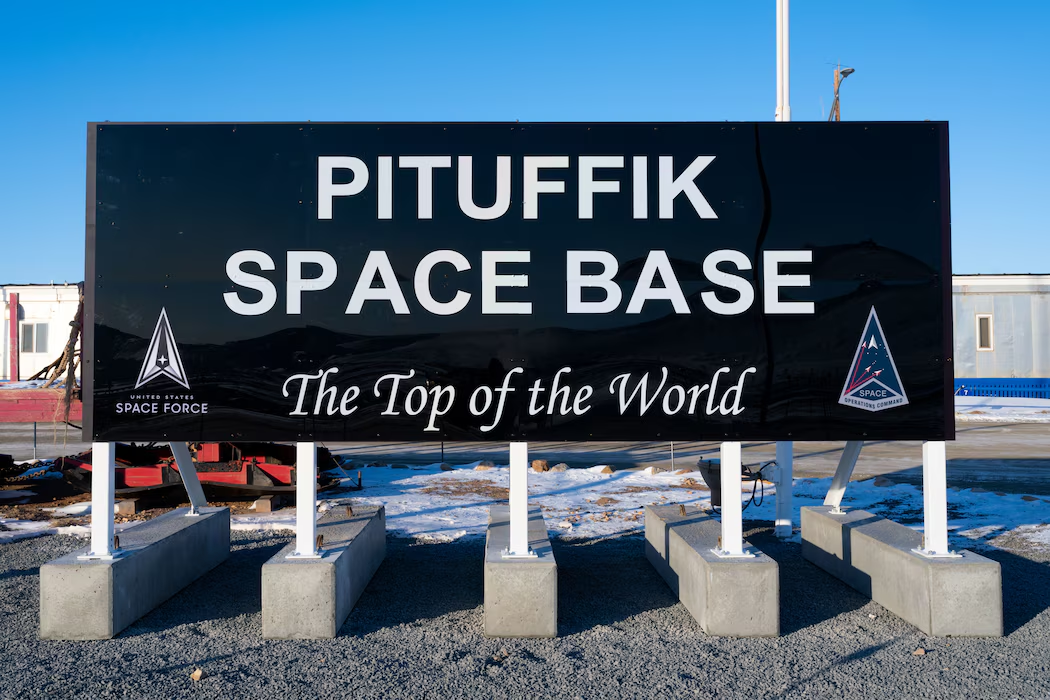
- Greenland hosts the U.S. military’s Pituffik Space Base, which supports missile warning, missile defense, and space surveillance, making it a central element of Washington’s regional security strategy.
- The GIUK gap: Greenland anchors the Greenland–Iceland–UK (GIUK) gap, a maritime “chokepoint” where NATO has historically monitored Russian naval movements between the Arctic and the North Atlantic. That makes Greenland relevant not only for U.S. homeland defense but also for broader NATO Atlantic security.
1951 Agreement between The United States and Denmark
The agreement provides that the U.S. will have broad military access to multiple locations across the vast island landmass. The agreement allows the U.S. to "construct, install, maintain, and operate" military bases across Greenland, "house personnel, "control landings, takeoffs, anchorages, moorings, movements, and operation of ships, aircraft, and waterborne craft."
Why “ownership” is mentioned: Some argue that tighter U.S. control would simplify or expand military basing, radar, and surveillance operations, though many experts note that the U.S. already has extensive access under existing agreements.
Three Relevant Articles of 1/8/26
https://cnb.cx/49vmIJe
https://www.cnbc.com/2026/01/07/greenland-rubio-denmark-trump.html
https://www.nytimes.com/2026/01/07/world/europe/trump-greenland-denmark-us-defense-pact.html?unlocked_article_code=1.ClA.PD-q.cpCoyMGW7ecS
2) Competition with Russia and China in the Arctic
Another recurring rationale is that Greenland is increasingly important in a region where Russia has expanded Arctic military activity, and China has sought a greater Arctic role (including its “near‑Arctic state” framing and interest in polar shipping concepts).
U.S. officials and commentators often frame Greenland as a “strategic outpost” that helps deter adversaries and monitor activity in the Arctic and North Atlantic. This framing is prominent in recent reporting explaining Trump’s renewed emphasis on Greenland and the administration’s rhetoric about national security priorities in the Arctic.
That said, some analyses dispute claims about the degree of adversary presence “around Greenland” specifically, arguing that the U.S. already enjoys the practical security advantages it needs through alliances and basing agreements, which should instill confidence in current security arrangements.
3) New (and future) Arctic shipping routes as ice melts
As Arctic sea ice thins, shipping routes become more navigable for longer periods, thereby increasing the economic and strategic value of Arctic waters. Greenland’s position near emerging Arctic routes makes it relevant to trade and maritime security planning.
This doesn’t mean Greenland suddenly becomes “the new Panama Canal,” but it does mean the region’s maritime traffic, infrastructure interest, and strategic attention are trending upward. That’s one reason Greenland repeatedly appears in discussions of long-term U.S. and allied security posture in the Arctic.
4) Critical minerals and supply chain strategy (rare earths, graphite, lithium, etc.)
Greenland has been repeatedly described as mineral-rich, and analysts often tie the island’s appeal to the global scramble for critical minerals used in advanced manufacturing, clean energy, and defense applications.
Key points often cited:
- Greenland contains deposits of rare earth elements and other critical minerals (e.g., graphite, lithium) that are critical to modern technology and defense supply chains.
- The strategic logic is often framed as reducing reliance on China, which has long dominated key segments of rare-earth supply chains.
- Greenland’s government is pursuing a development strategy for mineral resources, emphasizing sustainability and governance, suggesting this is not an “open-pit Gold rush” but a politically managed sector.
While Greenland’s mineral deposits are promising, turning resources into supply requires infrastructure and careful management, highlighting the opportunity for sustainable development that benefits all parties.
5) Why do many experts say the U.S. doesn’t “need” to own Greenland to achieve key goals
A major counterpoint—especially from security analysts—is that the United States already has significant strategic benefits without sovereignty:
- The U.S. benefits from longstanding agreements operating Pituffik with Denmark and Greenland, which already provide reliable cooperation and security assurances, reducing the need for territorial ownership.
The distinction matters: U.S. strategic objectives-such as missile warning, surveillance, and Arctic presence-are effectively achieved through longstanding alliances and agreements with Denmark and Greenland, which already provide reliable cooperation and security assurances. This demonstrates that the U.S. does not require territorial ownership to meet its security needs, aligning with the emphasis on the sufficiency of existing alliances.
Greenland is a self-governing territory within Denmark, and despite discussions about ownership, it is not for sale. Both Danish and Greenlandic leaders have repeatedly emphasized their right to self-determination, thereby fostering respect for Greenland’s political agency and complicating any notion of outright ownership, both legally and politically.
Denmark retains authority over certain areas, such as foreign affairs and defense, while Greenland manages many domestic matters and has an established pathway to potential independence through a referendum.
Both Danish and Greenlandic leaders have repeatedly rejected any sale or annexation, emphasizing self-determination. Recent reporting notes a strong pushback and the view that Greenlanders must decide Greenland’s future, not be purchased.
There are also alliance implications: Denmark is a NATO ally, and coercion or force would trigger a significant crisis for transatlantic security architecture (and has been described by analysts as potentially catastrophic for NATO cohesion).
7) Historical context: Trump’s idea is unusual in tone, not unprecedented in U.S. History.
Greenland has featured in U.S. strategic thinking for more than a century, including a post-WWII offer (often referred to as the Truman-era) and earlier discussions following the Alaska Purchase. This History is frequently cited to show that Greenland has long been viewed as strategically valuable, even if a purchase never materialized.
Bottom line
Why Trump is interested: Greenland offers a rare combination of strategic geography, an existing U.S. military foothold, proximity to evolving Arctic routes, and potential critical mineral resources—while also sitting at the center of renewed Russia/China Arctic competition.
Why “owning” it is another matter: Greenland’s legal status, Greenlandic self-determination, Danish sovereignty arrangements, and NATO politics make purchase/annexation extremely contested—while many analysts argue the U.S. can pursue most security objectives through existing alliances and agreements.
Pituffik Space Base (pronounced roughly “bee-doo-FEEK”) is the United States’ northernmost military installation, located in northwestern Greenland—a self-governing territory within the Kingdom of Denmark. The U.S. Space Force operates it and is best known for its role in missile warning, missile defense support, and space surveillance.
Quick definition (in one sentence)
Pituffik Space Base is a U.S. Space Force base in Greenland that provides critical early-warning and surveillance capabilities—especially for threats traveling over the Arctic—while supporting U.S. and NATO operations. Where is it?
- Northwestern coast of Greenland, in a remote Arctic region, between North America and Europe, and on routes relevant to Arctic security.
- Its geography makes it strategically valuable because polar routes are among the most direct paths between major military powers in the Northern Hemisphere.
What does it do (missions)?
Pituffik’s core functions, as described in recent reporting, include:
1) Missile warning & missile defense support
The base supports systems that detect and track potential missile launches or trajectories approaching the Arctic.
2) Space surveillance/space domain awareness
It also supports tracking of objects and activities in space, which is central to modern defense and satellite operations.
3) Support to U.S. and NATO operations
Because Greenland sits at the gateway between the Arctic and the North Atlantic, the base is often discussed as part of a broader U.S./NATO security posture in the region.
Why is it strategically important?
There are two recurring reasons:
A. Arctic “line-of-sight” for threats
The Arctic is a critical corridor for long-range threats and surveillance because the shortest routes between North America and Eurasia can run near or over the pole. Pituffik’s location enables monitoring of that region.
B. It sits near key North Atlantic / Arctic security geography
Analysts often reference Greenland’s role near the GIUK gap (Greenland–Iceland–UK), a historically significant area for monitoring naval movement between the Arctic and Atlantic.
History: Is Pituffik the same as Thule Air Base?
Yes—Pituffik Space Base is the installation formerly known as Thule Air Base.
- The U.S. began building the modern base during the early Cold War era (commonly cited as 1951, tied to a U.S.–Denmark defense framework for Greenland).
- The base was renamed in 2023 to reflect Greenlandic heritage and better align with its Space Force mission set.
Legal status: How can the U.S. operate a base on Danish/Greenlandic territory?
Pituffik operates under longstanding defense arrangements between the United States and Denmark, including a foundational 1951 defense agreement frequently referenced in policy analysis and reporting.
In other words:
- Greenland is not U.S. territory, and
- The U.S. presence is based on agreements with Denmark (and Greenland’s evolving self-government), not on sovereignty.
What Pituffik is not
To avoid common misconceptions:
- It is not a large American “city-base” in Greenland; it’s a remote, specialized installation with highly technical missions.
- It is not proof that the U.S. “owns” Greenland; it reflects military access and cooperation under treaty arrangements.
Why are you hearing about it more lately?
Pituffik has become a centerpiece in discussions about Greenland’s strategic value because it already provides the U.S. and NATO with significant Arctic security advantages—one reason some analysts argue the U.S. can achieve many objectives without “owning” Greenland.
If you want, I can go one level deeper:
- A plain-English explanation of missile warning vs. missile defense and what kind of sensor bases like Pituffik typically support (without getting into sensitive details), or
- A short timeline: WWII → Cold War buildout → Space Force era → 2023 rename.
Below is a plain‑English explanation of missile warning systems—what they are, how they work, what they don’t do, and why places like Pituffik Space Base matter to that mission.
What is a “missile warning system”?
A missile warning system is a network of sensors and command centers designed to detect a missile launch as early as possible, track its flight, estimate where it might land, and alert decision-makers (and, in some cases, civilians) quickly enough to respond. In the modern U.S./NATO posture, missile warning is tightly linked to space surveillance and air/missile defense planning, but it primarily focuses on detection and notification rather than interception.
Missile warning vs. missile defense (the key distinction)
- Missile warning answers: “Was something launched? From where? What type? Where is it headed? When could it arrive?”
- Missile defense answers: “Can we intercept it? Which interceptor? When and where?” (Missile warning data often feeds missile defense, but they’re not the same mission.)
Think of missile warning as the smoke alarm and missile defense as the sprinkler system. The alarm is valuable even if you don’t have sprinklers.
The basic architecture: “Space + Ground + Brains”
Missile warning systems usually rely on three layers:
1) Space-based sensors: “See the launch.”
Space systems can detect a launch because missile engines produce intense heat—especially in the first minutes after ignition. Space sensors provide broad coverage and fast initial detection. (Exact platforms vary over time, but the concept is consistent.)
2) Ground-based radars: “Track the object.”
Once a launch is suspected, powerful ground radars can help track the missile or warhead(s) and refine trajectory estimates as the object travels. Greenland’s location is particularly relevant because polar routes are among the most direct for some long-range threats.
3) Command-and-control: “Fuse, validate, alert.”
Data from multiple sensors is sent to command centers, where it is:
- correlated (do multiple sensors see the same thing?),
- validated (is it likely real or a false alarm?),
- modeled (projected flight path and potential Impact areas),
- and broadcast as warnings to military leadership and, in some cases, civil authorities.
Step-by-step: What happens during a suspected launch?
Here’s a simplified “signal chain”:
· Detection: Space sensors register a heat signature consistent with a launch.
· Confirmation: The system checks other sensors and historical patterns (to reduce false alarms).
· Tracking: Radars (and/or additional sensors) begin tracking the object.
· Trajectory estimation: Software estimates whether the object is ballistic and projects possible Impact zones.
· Warning dissemination: Alerts go to defense commands and relevant leadership.
· Response options: Depending on the scenario, responses could include defensive readiness, interceptor cueing, or continuity-of-government steps.
Important: This process is designed to be rapid, but it must also be cautious—false alarms are a known risk in early-warning systems.
Why Greenland (and Pituffik) can matter for missile warning
Missile warning is partly about physics and geometry: the Arctic is a strategic corridor because it sits “between” North America and Eurasia on a globe.
- Reports and analyses regularly note that Pituffik Space Base supports missile-warning and space-surveillance missions for the U.S. and NATO.
- Greenland also lies near the GIUK gap, a region tied to North Atlantic security monitoring—more naval than ballistic, but relevant to the overall warning/surveillance posture.
A base at Pituffik is valuable not because it “stops” missiles on its own, but because it supports the sensor and communications network that enables early detection and characterization of threats.
What missile warning systems are good at (and not good at)
Strengths
- Speed: Early detection can buy crucial minutes for decision-making.
- Coverage: Space sensors can watch large areas continuously.
- Redundancy: Multiple sensors reduce the risk of a single point of failure.
Limits/challenges
- False alarms: Unusual heat sources, sensor glitches, or rare atmospheric effects can confuse systems. Mitigate this by cross-checking data.
- Complex attacks: Decoys, multiple warheads, or nontraditional trajectories can complicate tracking and prediction.
- Decision pressure: Even with good data, the human side—interpretation and decision-making under time pressure—is inherently complex.
Why this matters in public debates about Greenland
A recurring point in current analysis is that the U.S. already has missile-warning advantages in Greenland through existing agreements and the Pituffik base, leading some experts to argue that “ownership” of Greenland is not required to achieve core security objectives.