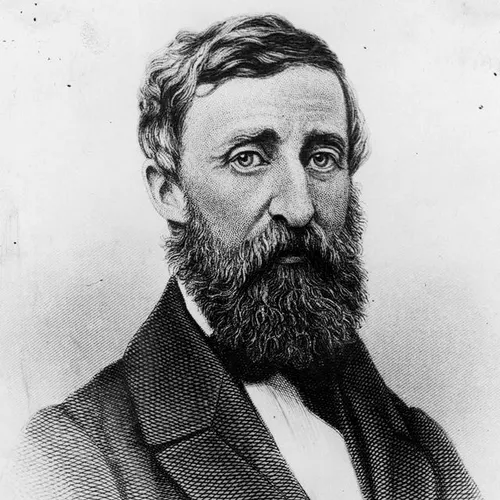
Thoreau begins with one of his most enduring declarations:
“That government is best which governs least.”
But his argument is not anarchistic. Instead, he insists that government becomes dangerous when it replaces moral judgment with collective inertia, emphasizing that conscience should guide decisions rather than majority rule.
“Can there not be a government in which majorities do not virtually decide right and wrong, but conscience?” This question underscores the importance of moral judgment over collective inertia, encouraging the audience to trust their moral compass.
For Thoreau, obedience to unjust laws implicates the citizen in injustice itself. He urges individuals to withdraw their cooperation from immoral systems:
“If the machine of government is of such a nature that it requires you to be the agent of injustice to another, then I say, break the Law.”
Thoreau believed that the proper place for a just person under an unjust government was not in passive compliance but in principled resistance—even if that resistance brought punishment, as exemplified by his own brief imprisonment, which became a powerful symbol of moral defiance.
“Under a government which imprisons any unjustly, the true place for a just man is also a prison.”
The essay also challenges the idea that reform should come slowly through conventional political processes. Thoreau rejected the notion that one must wait for a majority to approve moral action:
“It is not desirable to cultivate a respect for the Law, so much as for the right.”
His call was clear: moral responsibility rests first with the individual, not with institutions. This idea has profoundly influenced modern social movements, including Gandhi’s nonviolent resistance and King’s civil rights campaigns, illustrating its enduring relevance.
Thoreau closed his argument with a hopeful vision of a government genuinely aligned with moral principle:
“I please myself with imagining a State at last which can afford to be just to all men, and to treat the individual with respect as a neighbor.”
More than 175 years later, Civil Disobedience continues to inspire those who believe that moral courage begins with refusing to cooperate with wrong. Thoreau’s words remain a reminder that justice often starts with one person willing to say no, fostering hope that individual actions can lead to social change.