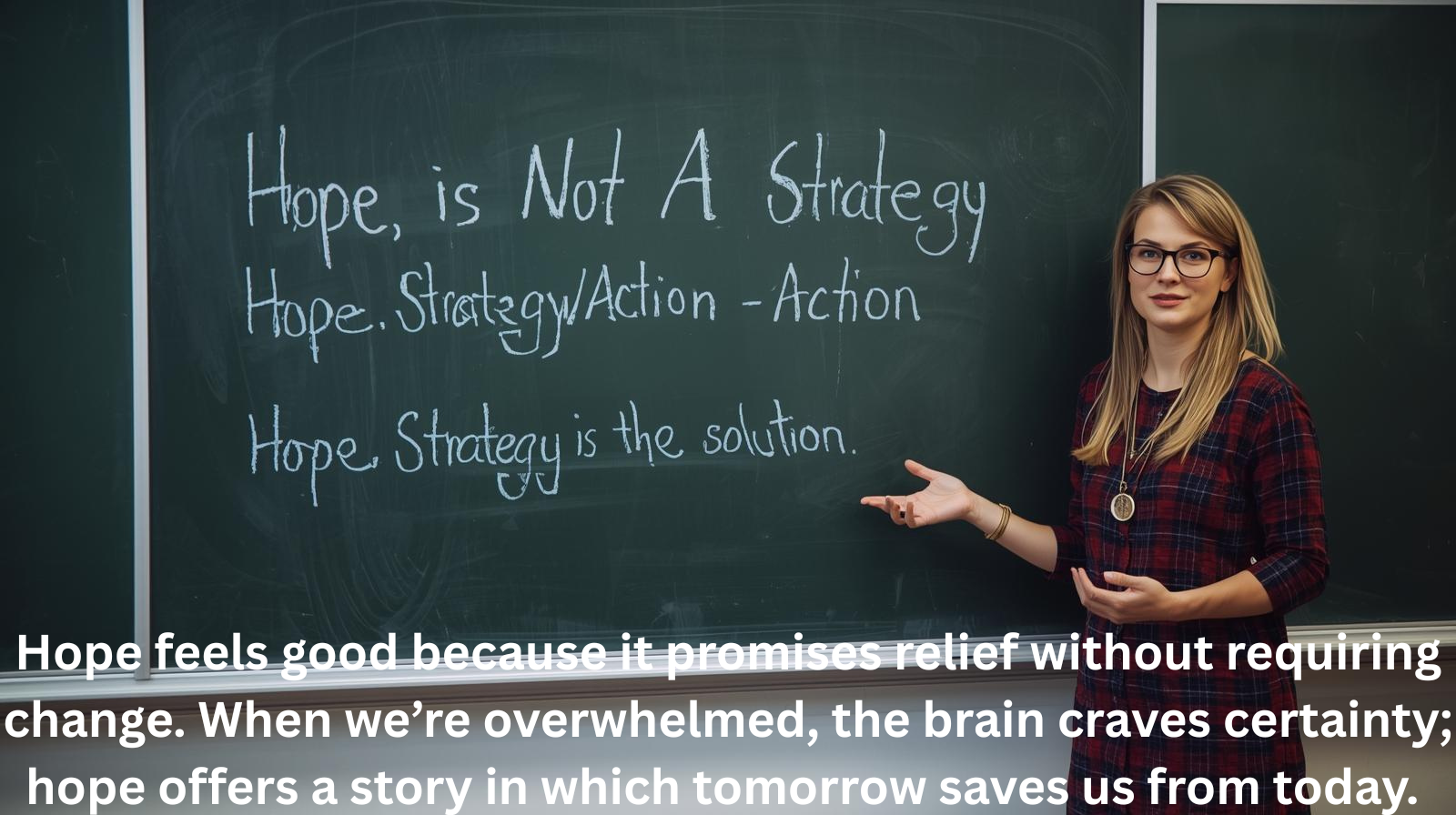
Hope is fuel—but it’s not a map:
It helps us endure uncertainty, stay the course, and keep going when results are slow to come. But when hope becomes the only plan, it transforms from a virtue into a vice. People and businesses stall, risks compound, and problems metastasize under the comforting illusion that “things will get better” on their own. In a world where margins are thin, and shocks arrive without warning—an unexpected car repair, a client loss, a rate spike—hope without action is a slow-motion failure.
This article examines how the psychology underlying the “hope-as-strategy” mindset influences decision-making, leading to costly outcomes in personal finance and business, and offers a practical framework for shifting from hope to disciplined execution.
The Seduction of Hope:
Hope feels good because it promises relief without requiring change. When we’re overwhelmed, the brain craves certainty; hope offers a story in which tomorrow saves us from today.
Psychologically, it’s reinforced by:
- Optimism bias: We overestimate favorable outcomes and underestimate risks.
- Present bias: We overweight immediate comfort (avoid tough decisions) and underweight future consequences.
- Avoidance coping: We delay uncomfortable actions—budget cuts, hard conversations, risk hedges—in favor of narrative soothing: “Let’s wait and see.”
In short, hope lets us defer pain. But deferred pain rarely disappears; it accrues interest.
When Hope Replaces Action: Real-World Scenarios:
Personal finance:
A family rides a tight budget. The car makes a “weird noise.” They hope it’s minor. It isn’t. The $838 repair lands in a month already stretched. Without a plan—emergency fund, sinking fund for auto maintenance, or a negotiated payment schedule—hope becomes debt at 22.9% APR, and the next surprise becomes a crisis. The issue isn’t morality—it’s math. When income is fixed, and expenses are volatile, hope cannot balance the ledger.
Small business:
A service firm loses a major client. The founder says, “Pipeline will rebound.” It can—if the team increases outbound, tightens pricing, and diversifies revenue. Without those actions, the firm burns cash as if tomorrow were guaranteed. Waiting becomes a strategy, and payroll becomes a countdown.
Health and wellness:
A leader feels burned out. They hope it eases after “this busy season.” Two quarters later, they’re training a replacement. Fatigue is a leading indicator. Without intervention, delegation, and boundaries, the system fails, and hope cannot restore health on its own.
In each case, hope envisions a better future; execution enables you to arrive there.
The Costs of Hope-Only Thinking:
- False security:
Believing that the future will fix the present leads to underinvestment in contingency planning. You trade uncertainty for fragility.
- Decision drift:
Waiting appears harmless—until you account for opportunity cost. Every month without a pricing change, renegotiated vendor terms, or new outbound volume puts you behind the curve relative to compounding competitors.
- Risk concentration:
When hope replaces diversification (of income streams, suppliers, marketing channels), your exposure to single points of failure increases—one rate move, one policy change, one client departure.
- Narrative lock-in:
The longer we tell ourselves “it’ll turn around,” the harder it becomes to admit conditions changed. Pride becomes expensive.
A Better Approach: Hope + Strategy + Action:
Hope has its place. It fuels perseverance, anchors values, and sustains morale under uncertainty. But it must be paired with a plan.
Here’s a flexible framework you can adapt for personal finances, startups, or large enterprises, helping you turn hope into measurable action across contexts.
1) Clarify the Objective (Outcome > Intention). Define clear, measurable goals such as revenue targets, cash buffers, or debt reduction that need to be achieved within 90 days. This helps your audience feel assured that their efforts are focused and achievable.
- Define the win: What specifically needs to be true 90 days from now? Revenue target, cash buffer, debt reduction, customer mix.
- Quantify the gap between the Current state and the required state. Put numbers on the problem; fuzziness invites hope to take over.
2) Build a Risk-First Plan (Assume Variance)
- Identify key risks: income volatility, repair costs, client churn, regulatory changes, and interest rate sensitivity.
- Create contingencies:
- Personal: 3–6 months expenses, dedicated sinking funds (auto, medical, home), insurance adequacy without overpaying.
- Business: Revenue diversification, expense tiers (must-have vs. nice-to-have), vendor redundancies, and credit lines arranged before you need them.
3) Operate by Leading Indicators (Move Before Lagging Data). Monitor early signals such as pipeline velocity, win rates, and customer churn flags. This approach empowers your audience and puts them in control of their progress.
- Track early signals: Pipeline velocity, win rates, AR aging, inbound quality, website conversions, customer churn flags.
- Set tripwires: Pre-agreed thresholds that trigger a specific action (e.g., “If cash runway < 4 months, cut variable spend by 10% and increase outbound by 30% for 6 weeks”). Tripwires remove emotion from timing.
4) Execute Cadences (Rhythm Beats Intensity)
- Weekly sprints: 3–5 needle-moving actions with owners and deadlines.
- Monthly reviews: Compare plan to actuals; adjust with humility, not ego.
- Quarterly resets: Reassess assumptions; markets evolve faster than narratives.
5) Measure What Matters (Scoreboard, Not Sentiment)
- Personal finance: savings rate, debt amortization pace, emergency fund progress, and forecasts of unavoidable expenses (maintenance, medical, insurance).
- Business: Cash runway, gross margin, net promoter score, sales cycle length, marketing CAC vs. LTV, and other key performance indicators that reflect overall health.
6) Communicate Clearly (Tell the Truth Early). To yourself: Write down the plan. To your team or family: Share the why and the how. Transparency helps your audience feel trusted and secure in uncertain situations.
- To yourself: Write down the plan. Vague hope dissolves under written specificity.
- To your team/family: Share the why and the how. Transparency reduces anxiety and increases buy-in.
- To partners/vendors/lenders: Negotiate before you’re in distress. Early communication widens options.
Case Snapshot: Converting Hope to Action
The Car Repair Moment:
You’re staring at an $838 estimate. Hope says, “Maybe next month.” Strategy says:
- Ask for options: Prioritize safety-critical items; defer non-essentials.
- Negotiate: Request OEM vs. aftermarket price comparison; ask about shop promotions; seek written quotes from two competitors.
- Structure payment: Explore zero-interest promotional financing, but only if you have a payoff plan; otherwise, set a fixed repayment schedule you can meet.
- Prevent recurrence: Establish a $50–$100 monthly automatic savings fund and schedule routine maintenance. Prevention beats reaction.
I hope it isn’t bad; it’s incomplete. Pair it with structure, and you buy yourself time and traction.
Leadership: Hope That Mobilizes, Not Sedates
Leaders must project confidence without promising inevitability.
The formula:
- Name reality: “We’re down 15% in Q2; pipeline velocity fell 12%.”
- Define the plays: “We will expand outbound to three channels, reduce non-critical spend by 8%, and rebalance our customer mix.”
- Show the math: “At current burn, we have 7 months of runway; with these changes, we extend to 12.”
- Invite participation: “Here’s how each team contributes. Here’s how we’ll measure weekly.”
This isn’t pessimism; it’s earned optimism—morale grounded in method.
Common Objections (and Better Responses)
- “We don’t have time to plan.”
You do have time to fail. A two-hour plan that saves a month of wandering is a bargain. - “We’ll lose momentum if we change.”
You already lost momentum. Realign before the slope steepens. - “Things always work out.”
Sometimes they do. The problem is “always.” Strategy increases the odds and reduces the downside when it does not.
A Practical 30-Day Challenge
- Write a one-page plan: Outcomes, risks, tripwires, key actions.
- Cut one avoidable expense: Reallocate to emergencies or sinking funds.
- Diversify one revenue channel: New outreach list, new offer, new partner.
- Establish two leading indicators: review them weekly and make decisions based on the data.
- Schedule one complicated conversation: Vendor, partner, or client—clarify terms and expectations.
- Automate prudence: automated savings transfers; calendar-based preventive maintenance; blocked time for pipeline work.
Small, consistent motions outrun big, sporadic ones.
Closing: Hope Is the Spark—Process Is the Engine
We need hope. It sustains people when numbers are low and pressure is high. But hope without structure quietly asks the future to fix the present. That isn’t kindness; it’s abdication. Whether you’re running a household on a fixed income or steering a company through a choppy market, the path forward is the same: tell the truth, build the plan, set the tripwires, and move your feet. Let hope light the way—but let process, discipline, and measurable action get you there.