Summary
Repetition is foundational to skill learning because it strengthens neural pathways, improves efficiency, and transforms effortful actions into automatic routines. However, individual differences such as age, prior experience, or learning style can influence how effectively repetition works for each person. Research across motor learning, cognitive psychology, and neuroscience shows exactly how repeated practice produces measurable improvements in skill.
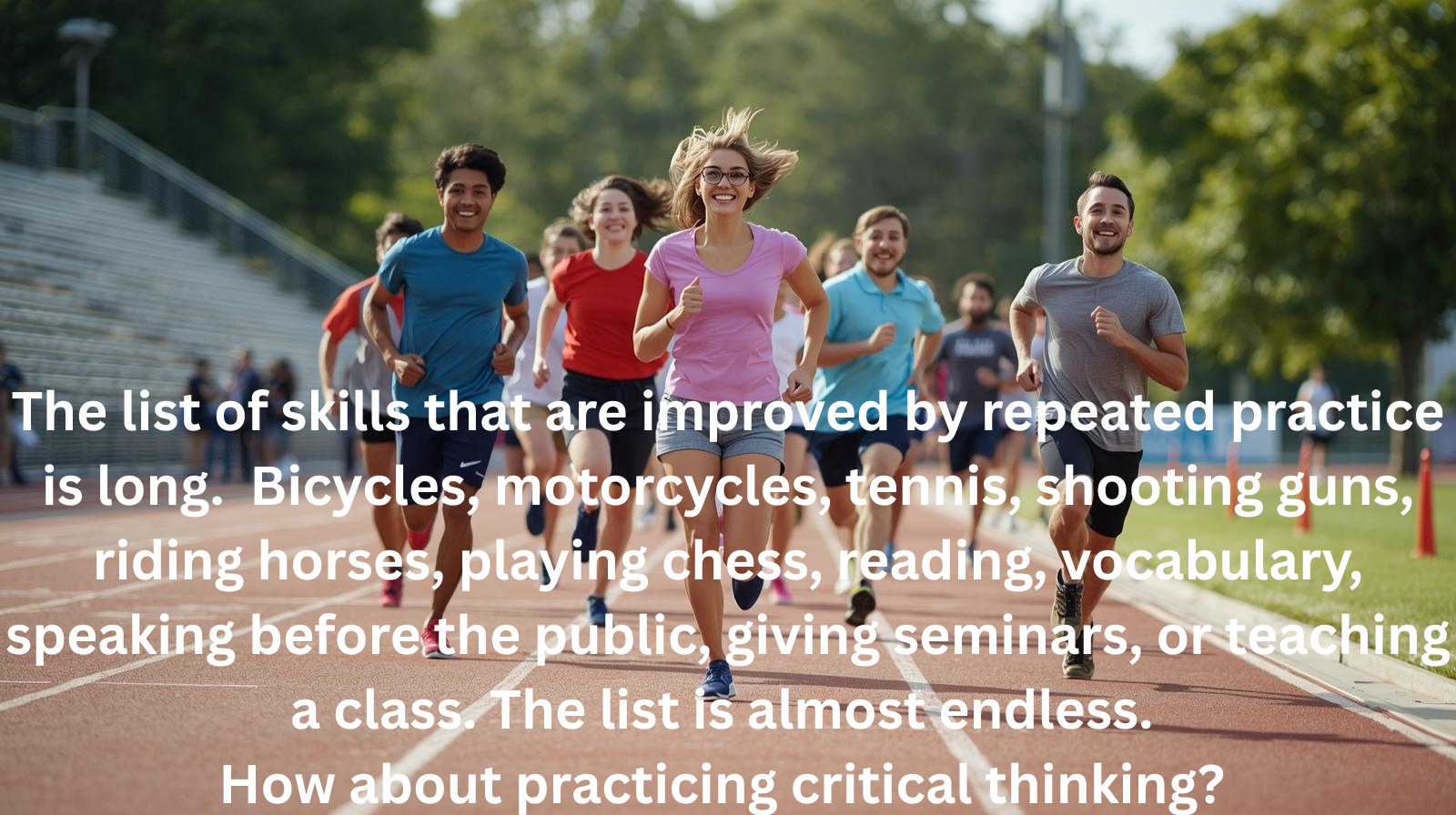
How about practicing critical thinking?
1. Repetition strengthens procedural memory (the engine of skill learning)
Procedural memory enables the acquisition and automation of motor routines and cognitive skills. Studies of typically developing children found that repeated practice significantly improved performance in both motor tasks (e.g., object assembly) and cognitive-motor tasks (e.g., mirror drawing). Each trial improved speed and efficiency, and gains persisted even after a delay.
What does this mean:
Repetition converts a consciously guided action into a smoother, semi-automatic skill stored in procedural memory.
2. Repetition builds and strengthens neural pathways through neuroplasticity
Neuroscience research shows that when you repeat a movement or skill, the same neural circuits fire. Over time, repetition strengthens these circuits, making the skill easier and more efficient. Psychology Today notes that repetition “fires and rewires the brain,” reinforcing connections that support learning and performance.
Similarly, Applied Behavior Analysis(ABA)-based motor-skill research notes that repetitive practice “promotes the formation of neural pathways,” thereby improving accuracy, speed, and muscle coordination.
What this means:
The brain literally reorganizes itself (neuroplasticity) so the skill becomes faster, smoother, and more precise.
3. Repetition improves muscle memory and motor efficiency
Repetitive practice consolidates movement patterns, thereby reducing the conscious effort required. This leads to:
- faster response times,
- better coordination, and
- more efficient muscle activation.
Motor skill research shows that repeated actions increase consistency and reduce cognitive effort because movement patterns become automated.
What this means:
Repetition turns “thinking through each step” into “just doing it.”
4. Repetition increases speed and accuracy through iterative refinement
The PLOS One study found that with each repeated attempt, children assembled more pieces in less time and improved precision in mirror‑drawing tasks. These gains occurred quickly across the first few repetitions. [journals.plos.org]
Research on ABA therapy similarly reports that repetition helps learners imitate, refine, and adjust their performance with each iteration.
What this means:
Skill improves not merely from doing it again, but from the brain’s ability to compare the previous attempt, correct errors, and improve on the next one.
5. Repetition enhances long-term retention — especially when spaced
Psychology Today notes that repetition, combined with distributed practice, strengthens learning by reinforcing neural pathways across multiple intervals, thereby improving mastery and consolidation.
Cognitive research shows that retention correlates strongly with the number of sessions in which a skill is practiced, rather than with the raw number of repetitions in a single session.
What this means:
Skill repetition spread across time makes learning far more durable.
6. Repetition helps automate complex motor sequences
Motor‑skill neuroscience highlights that repetition gradually transforms skills from controlled, effortful sequences into chunked, automatic routines.
Research on how repetition affects motor‑skill neural pathways shows that repeated practice refines the nervous system’s ability to produce smoother, quicker, more efficient movement patterns.
What this means:
Complex skills — like playing piano, typing, or swinging a golf club — become fluid through repetition.
7. Repetition must be in the correct form: variety matters too
One study found that excessive trial-to-trial repetition can improve short-term performance but reduce long-term skill acquisition. A “Minimal Repeats Group,” which faced varied trial sequences, learned more effectively over time than a group with consecutive repetition.
What this means:
Pure repetition builds skills, but repetition with variation often produces deeper, more flexible skill learning.
Bottom Line: Why Repetition Works for Skill Learning
Across studies, repetition aids skill learning by:
✔ Strengthening procedural memory
✔ Reinforcing neural pathways through neuroplasticity
✔ Building muscle
✔ Improving speed, accuracy, and efficiency through iterative refinement
✔ Deepening long-term retention when spaced over time
✔ Automating complex motor sequences