There are four types of cockroaches (CRs) that dwell in Cockroachville, symbolizing different societal classes:
Those who believe in:
· Those Self-sufficient,
· Those with Individual accountability,
· Those who subscribe to Productive activities
· Moochers, foraging for free stuff
· much like citizens in human society.
Of course, productivity is encouraged, and those able-bodied CR’s who refuse to work for food are disparaged. The non-self-reliant are brought to kitchens, parlors, and tables when humans are present, posing a high risk of being stepped on or crushed. The leaders of Cockroachville are quick to inform the nonproductive/moocher CRs that they would be sacrificed first. The village of Coackroachville functioned well. Adults supervised all infants, children, and individuals with disabilities.
Kids were taught by Cockroach education, such as “Jiminy Cricket-Cockroach.”
Each young coachroach(CR) learned that it was a good idea to “Whistle while they work”-collecting food droppings and burrowing into closed boxes for some tasty morsels. They were taught to “Play safe and not be fools”- and not get stomped on by one of those pesky humans.
The productive CRs also understand that some special-needs roaches require care. The babies, older people, and some of those who may have had a few legs chopped off had special needs. Some CR’s may be only temporarily nonproductive. They began with good intentions but required care for a period to regain strength before returning to foraging. There are provisions in the Cockroachville book of rules to care for these Cohorts.
There is a 4th class of CR’s.
· They complain about the requirement of hunting and gathering.
· Many take multiple days off because of sore legs, headaches, or other minor ailments.
· The progression was systematic in avoiding productivity.
· They would avoid, hide, excuse, and then become outright belligerent.
· The entitled CRs, who earned the right to remain minimally productive, declare they deserve a share of all gathered morsels, fostering a sense of unfairness and exploitation.
· Even if a distant CR relative were visiting, they would refuse to work.
· The size of this group grew until the moocher class became the majority.
· They complained, and complained, always demanding a larger share of food droppings gathered by the productive class.
· This complaining moocher class is also sometimes referred to as the parasitic class.
· Upon declaring their retirement, they demanded their share of the food droplets and benefits for life.
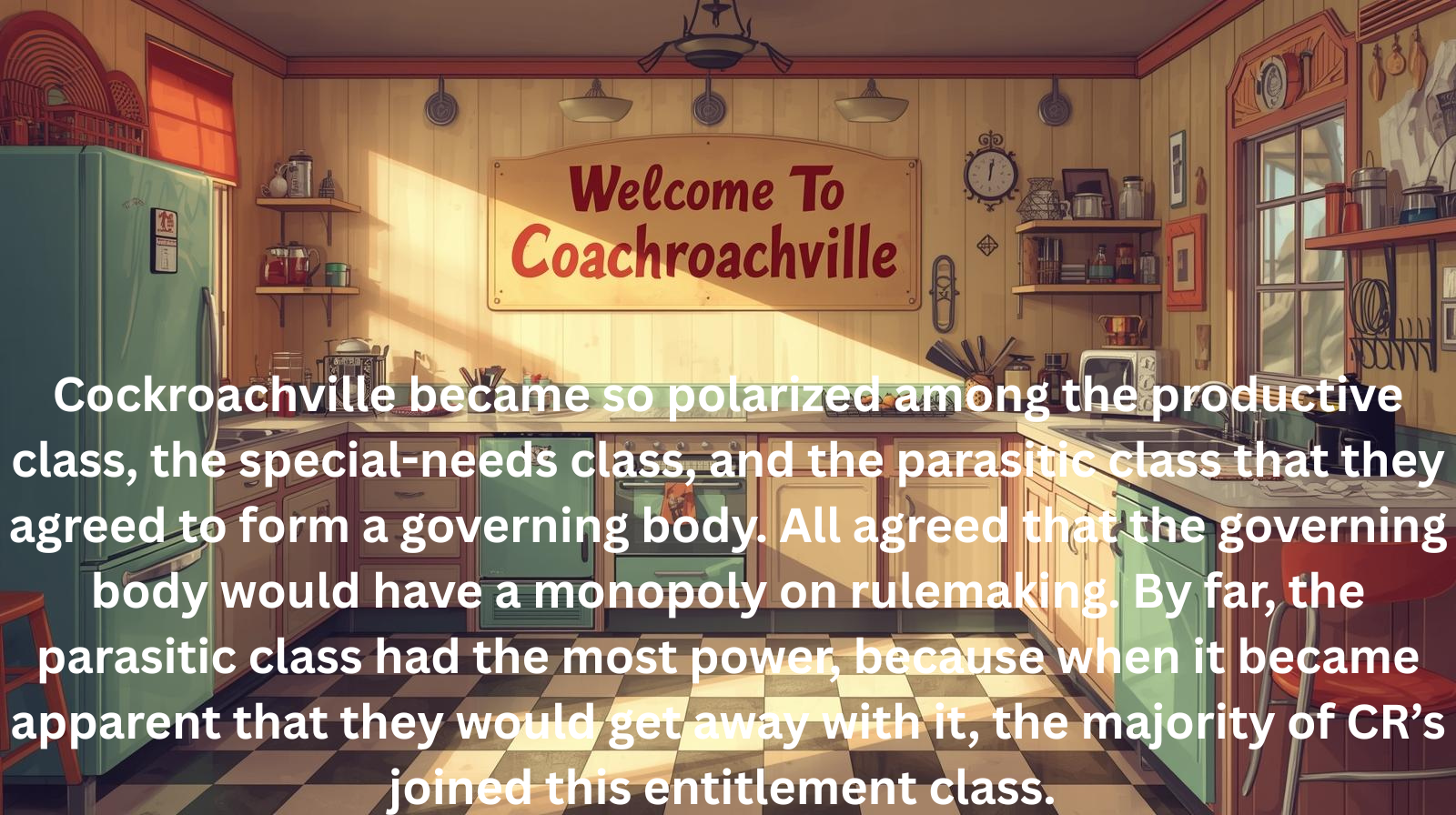
Cockroachville became so polarized among the productive class, the special-needs class, and the parasitic class that they agreed to form a governing body. All agreed that the governing body would have a monopoly on rulemaking.
By far, the parasitic class had the most power, because when it became apparent that they would get away with it, the majority of CR’s joined this entitlement class. They all enjoyed staying at home and watching CR TV all day. They all watched CR TV programs that reinforced their moocher value systems and entitlement status, creating constant demands for more free stuff. They became known as the entitlement class of CR’s. Leisure time, consuming food droplets, complaining, demanding larger portions, and scheming to avoid work were the dominant characteristics.
In many cases, the controlling members of the nonproductive government committee, sometimes referred to as the moocher/parasitic class, would approach members of the governing productive class and promise under-the-table extra free food if the productive members would vote correctly, to enhance the parasitic class’s benefits. It worked!
The governing sell-out class, the parasitic class, and all are beneficiaries of free stuff became known as the “establishment.” They demanded that no changes be made in Cockroachville so that they could continue foraging without corresponding effort. They believe in the “status quo.”
Collectively, the moocher/parasite class of CRs exemplifies how societal systems can enable theft and entitlement, prompting readers to consider the real-world implications of such dynamics and the importance of fairness.
One day, a group of productive CRs decided to wander farther from the house in search of food. They came across a cricket. He was a friendly sort, named Jiminy. He dwelled in “Cricketville.” They shared a bit of discarded corn stock with a few other tasty morsels left behind by some pesky human. They discussed how their societies functioned.
Each of them observed a similar pattern across the productive, special-needs, and parasitic classes. Of course, all the moochers and parasites swore that they were really part of the productive or special needs class. It takes considerable effort to govern and maintain one’s power and elite status.
A few days later, another productive CR was foraging in a pantry. There he met a spider named “Spiderman,” who dwelled in “Spiderville.” Both were trying to collect honey droplets from the lid of a honey jar. They decided to share a few drops during lunch. You may guess that the spider was complaining about always having to hunt and gather for the benefit of other spiders who refused to fend for themselves.
A productive cockroach also had a similar conversation with an “Ant,” who was visiting from “Antville.” Ants have an additional governing body called the Queen.
The parasitic classes of various creatures held a secret meeting to discuss establishing a World Creature Government (WCG).
They declared that they possess the power and monopoly to make all the rules for participating creatures. The underlying assumption was that the WCG could ensure that all the unproductive moochers and parasites would continue to receive unearned benefits with little or no effort. This new WCG would assert a monopoly over the governance of all creatures. Members would receive preferential treatment beyond that afforded to the productive classes. They formed labor unions, bureaucratic committees, and thousands of NGOs (non-Governmental organizations) to further their mooching enterprises.
They had delegated creature committee members to contact other species, such as bees, centipedes, and silverfish, to build their communities in a similar fashion, in which the productive class would be compelled to produce for the benefit of all others.
The moral of the story is that unproductive members of society, such as the parasitic CRs, often gain disproportionate power and benefits, prompting us to question why societal systems allow this and how we might address it.