Summary
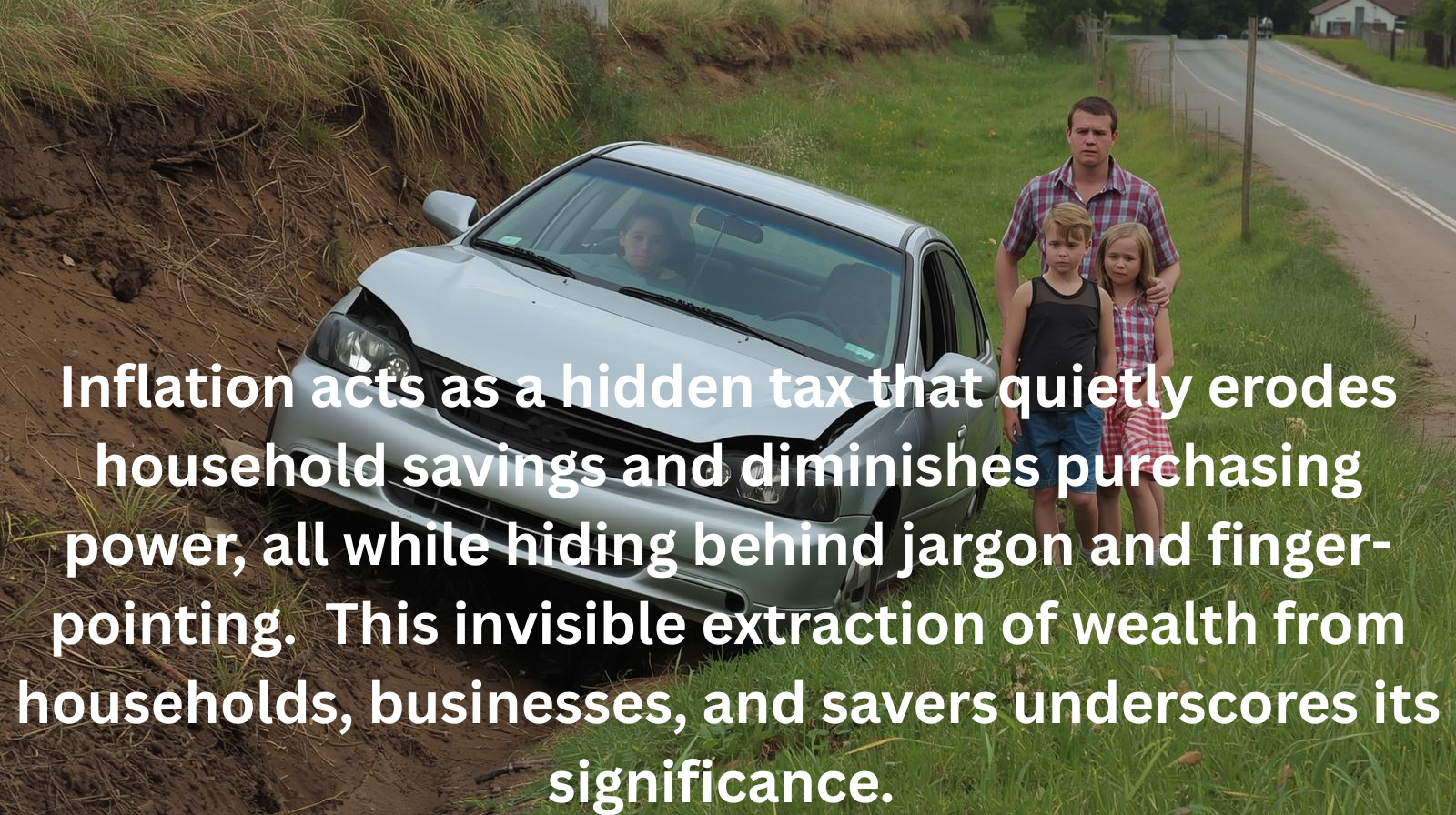
It’s also a powerful political tool. Inflation allows the government to fund almost anything at no cost initially, while shifting the blame for rising prices onto retailers, landlords, or ‘greed.’ As F.A. Hayek warned: “History is essentially a History of inflation, usually inflation engineered by governments for the gain of governments.
How Inflation Warps the Market’s Compass
In healthy markets, prices are signals. When money is destabilized, the signals lie.
“The consequences of inflation are malinvestment, waste, a wanton redistribution of wealth and income… and eventual collapse.” — Henry Hazlitt.
Inflation distorts price signals, making retailers appear to be profiteers when the real culprit is currency debasement. It fools workers with nominal raises that don’t keep up with grocery prices. And it pushes families into higher tax brackets even when their absolute standard of living hasn’t improved—classic bracket creep. Economists across traditions have called this out for a century: John Maynard Keynes wrote that, through inflation, government can.
“confiscate, secretly and unobserved, an important part of the wealth of their citizens.”
Warren Buffett captures the household Impact succinctly: “Inflation swindles the bond investor… it swindles the person who keeps their cash under their mattress, it swindles almost everybody.”
The Fed’s License: An “Elastic Currency”
The Federal Reserve’s charter authorizes it “to furnish an elastic currency.” In practice, that means the power to expand money and credit to accommodate political and financial pressures. Former Fed chair Alan Greenspan described the central task candidly: “The central focus of what we are doing at the Fed is to keep inflation from accelerating – and preferably decelerating.” Whatever the intent, the tool is the same: manipulate money and credit. [
Even central bankers who aim for stability concede inflation’s dangers. Paul Volcker—the man who slew double-digit inflation—called it a “terrible thing,” recalling rates of “14 or 15 percent” early in his tenure.
Debt Monetization: How the Magic Happens
The process is deliberately opaque. Congress runs a deficit, the Treasury issues bonds, financial institutions buy them, and the Fed creates new money electronically to buy those bonds in the open market. The result is fresh purchasing power for the government—and a diluted currency for everyone else. The technical labels—accommodation, QE, balance sheet expansion—mask what Milton Friedman made plain:
“Inflation is taxation without legislation.”
George Bernard Shaw put a sharper point on it: when governments devalue the currency to betray creditors, we “politely call this procedure ‘inflation.’”
Austrian Lens: Why Booms Go Bust
Austrian School economists explain the mechanism of error behind inflationary booms. When central banks push interest rates artificially low, entrepreneurs embark on long, capital-intensive projects that look profitable only under distorted conditions. The boom feels like prosperity, but it’s really misallocation of capital—what Austrians call malinvestment. As Ludwig von Mises emphasized, inflationary credit expansion guarantees a later “readjustment of conditions to the real data of the market,” the painful bust that follows the artificial boom. [
The stakes are not merely technical. For Mises, sound money is a constitutional principle: “an instrument for the protection of civil liberties and a means of limiting government power.”
“Sound money is an instrument for the protection of civil liberties and a means of limiting government power.” — Ludwig von Mises.
And as Hayek warned, inflation is often engineered by governments for their own benefit, encouraging the audience to stay alert to political motives behind economic policies.
What Malinvestment Looks Like in Practice
During easy‑money phases, banks loosen, credit booms, and entire sectors seem to defy gravity. The result is overbuilding, overhiring, and overpromising—projects that only pencil with near-zero rates. When conditions normalize, the scaffolding collapses. That’s why Austrian scholars stress that the boom itself is the problem. As Mises put it, people “rebel against the insight that the disturbing element is to be seen in the malinvestment and overconsumption of the boom period… an artificially induced boom is doomed.”
Academic treatments underscore the exact mechanism: monetary expansion lowers the informational content of prices, increasing the share of investment projects that later prove unprofitable—even if investors try to be cautious.
The Human Cost—and Why It Persists
Inflation corrodes trust. It punishes prudence, rewards speculation, and disorients planning for families and firms alike. As Ronald Reagan memorably said;
“Inflation is as violent as a mugger, as frightening as an armed robber, and as deadly as a hit man.”
So why do we tolerate it? Because it is convenient. Inflation disguises deficits (the real value of debt falls), inflates nominal GDP (politicians can claim “growth”), and redirects blame onto private actors. Or, in Hayek’s terms, it serves “the gain of governments.”
Ray Dalio offers the investor’s distillation: “There are two main drivers of asset class returns—inflation and growth.” If you misread either, you misprice everything.
Conclusion: Name the Tax to Fight It
Inflation is more than an economic phenomenon; it’s a political strategy and a silent tax that reshapes society without a vote, motivating the audience to advocate for transparency and reform.
“Inflation is taxation without legislation.” — Milton Friedman
“History is largely a History of inflation… engineered by governments for the gain of governments.” — F.A. Hayek.