Summary
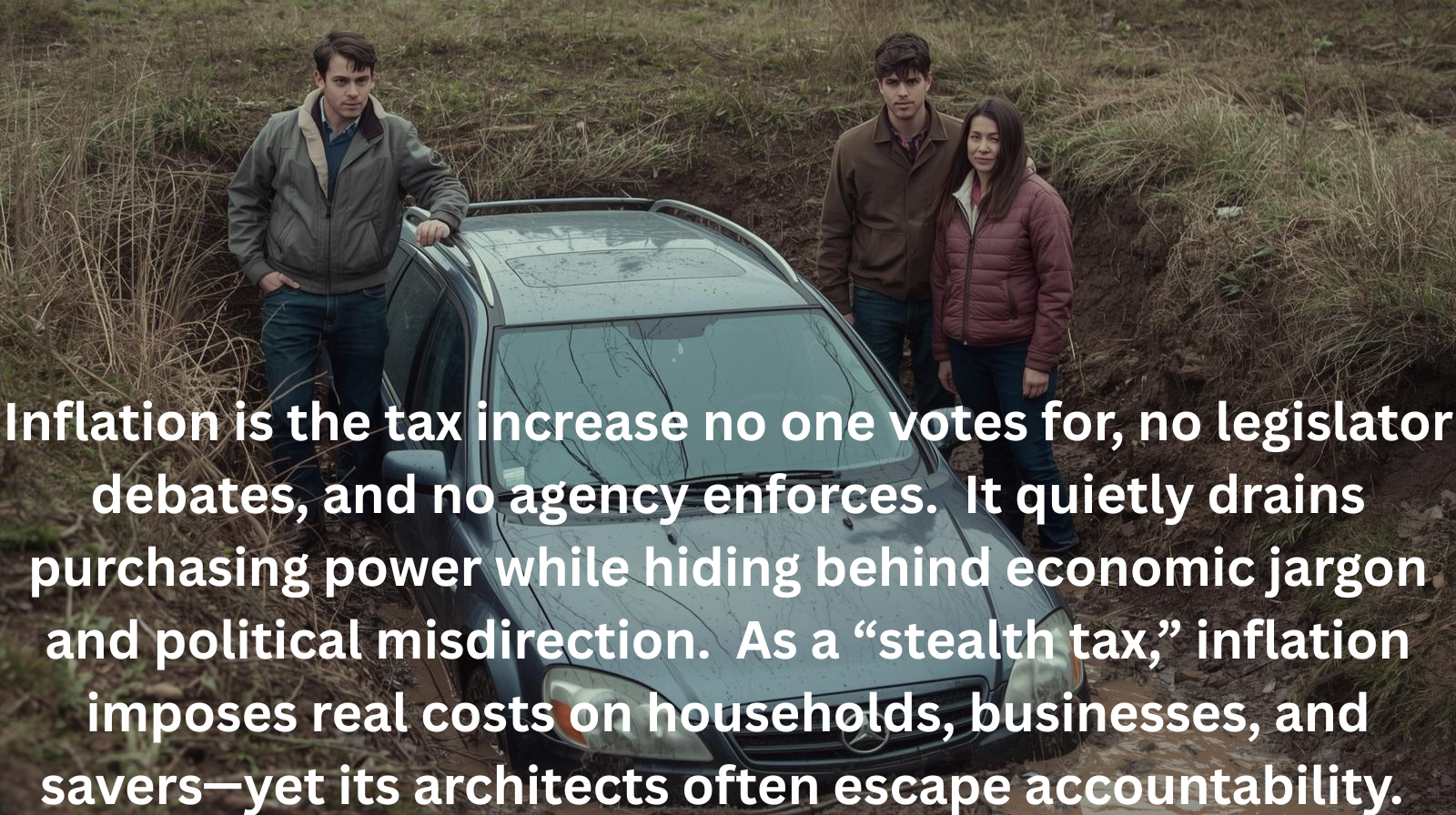
Few public policies deliver so much harm with so little visibility. Inflation allows the government to buy almost anything for nothing, while saddling citizens with the bill. It is the foundation of arrogant government and a persistent threat to long-term prosperity.
The Silent Power of Monetary Inflation
Most Americans assume Congress sets taxes. But the federal government has a second revenue engine: the power to create money. That power resides in the Federal Reserve System—an institution frequently portrayed as a neutral technocracy, yet one that wields the extraordinary authority to expand the money supply at will.
The Fed performs many functions, from regulating banks to influencing interest rates, but its most consequential role is creating money to support government spending and favored market institutions. This monetary expansion does not need a vote, approval, or even public understanding. It simply happens, often quietly, and is usually backed by political leaders who find inflation far easier than fiscal discipline.
Economist Judy Shelton captures the danger well: inflation erodes the foundations of market behavior by falsifying the information prices are supposed to convey. When money itself becomes unstable, every economic signal becomes distorted.
How Inflation Distorts Daily Life
Inflation’s damage extends far beyond rising prices. Its effects ripple through every corner of the economy, impacting retirees losing savings and small businesses struggling to stay afloat, often in ways the public rarely notices.
1. Distorted Price Signals
Prices are supposed to reflect real supply and demand. Inflation muddies that process. When prices rise because money loses value—not because goods are more scarce—consumers mistake retailers for gougers and policymakers blame “corporate greed.” Meanwhile, firms struggle to make rational decisions about investment, wages, and production.
2. Illusory Wage Gains
Workers often celebrate nominal pay raises, unaware that those gains evaporate in the grocery aisle. A 5% raise feels generous until rent climbs 8%, groceries 12%, and insurance 14%. Inflation deceives workers into thinking they are progressing when they are actually falling behind.
3. Hidden Tax Bracket Creep
Inflation shoves families into higher income tax brackets even when their absolute standard of living has not improved. They pay more in taxes for the privilege of treading water. Without inflation-indexing, tax codes become silent accomplices in government revenue extraction.
In each case, inflation shifts wealth from the public to the political system, enabling policymakers to fund programs without direct debate, with minimal transparency and long-term political consequences.
The Fed’s License to Create Money
The Federal Reserve’s charter explicitly empowers it “to furnish an elastic currency.” That phrase sounds benign, even prudent—after all, flexibility is usually good. But an “elastic currency” means one thing: a currency that can be expanded without limit.
Former Fed Chair Ben Bernanke once expressed this power plainly:
“The U.S. government has a technology, called a printing press (or, today, its electronic equivalent), that allows it to produce as many U.S. dollars as it wishes at essentially no cost.”
If a private citizen printed money, it would be called counterfeiting. When the central bank does it, it is called “policy.”
Of course, most officials reject the comparison. They insist inflation is a tool for managing the economy. But the mechanics are strikingly similar: create new money, spend it into circulation, and allow the rest of society to absorb the dilution.
Monetizing the Federal Debt: The Tooth Fairy of Modern Finance
Although phrases like “quantitative easing” or “monetary accommodation” sound sophisticated, the underlying process is straightforward—and remarkably convenient for politicians.
Here is the real sequence:
· Congress spends more money than it collects, creating a deficit.
· To cover the gap, the Treasury issues new government bonds—IOUs promising repayment.
· Banks and financial institutions purchase these bonds.
· The Federal Reserve then creates new money electronically and uses it to buy those bonds from banks in the open market.
· This injects brand-new money into the financial system and indirectly finances government spending.
The public receives no notification that its currency has just been diluted. Yet the government suddenly has hundreds of billions—or trillions—of dollars of new purchasing power.
It is the closest thing to magic in public finance. The government prints IOUs; the Fed prints money. Each enables the other. Taxpayers inherit the inflation.
No wonder the process is cloaked in academic abstraction. If the public understood it clearly, the outcry would be deafening.
Why Inflation Is So Politically Attractive
Inflation persists not because economists misunderstand it, but because politicians find it irresistible.
- It disguises deficits. Rather than raising taxes or cutting spending, inflation erodes the real value of the national debt.
- It creates the illusion of growth. Nominal GDP increases automatically as prices rise, allowing leaders to brag about economic expansion.
- It shifts blame. Instead of pointing to federal spending policies, public anger can be redirected toward businesses, landlords, or “market forces.”
- It rewards indebted institutions. Governments and large borrowers benefit as the real value of their liabilities decreases.
In short, inflation is the ultimate political cheat code: high benefits, low accountability.
The Human Cost: Inflation as a Slow Erosion of Freedom
Inflation may begin as a macroeconomic policy, but it ends as a personal hardship. It corrodes savings, undermines trust, punishes prudence, and rewards speculation. It disorients markets and fosters cynicism about financial institutions. Worst of all, it normalizes government intervention as the inevitable solution to the very problems government policies created.
An economy cannot remain healthy and free when its currency becomes a political tool. Sound money is not just a technical preference—it is a foundation of personal liberty. When inflation becomes chronic, freedom becomes fragile.
Conclusion: The hidden tax of inflation deserves the public’s attention and understanding to prevent further erosion of economic freedom.
Inflation is not just an economic phenomenon. It is a political strategy, a redistribution mechanism, and a silent tax that the public must understand to protect their interests.
Calling inflation what it truly is—a form of ongoing taxation—does not solve the problem. But it can lead to policy reforms that promote fiscal discipline and restore transparency, which is the first step toward meaningful change.