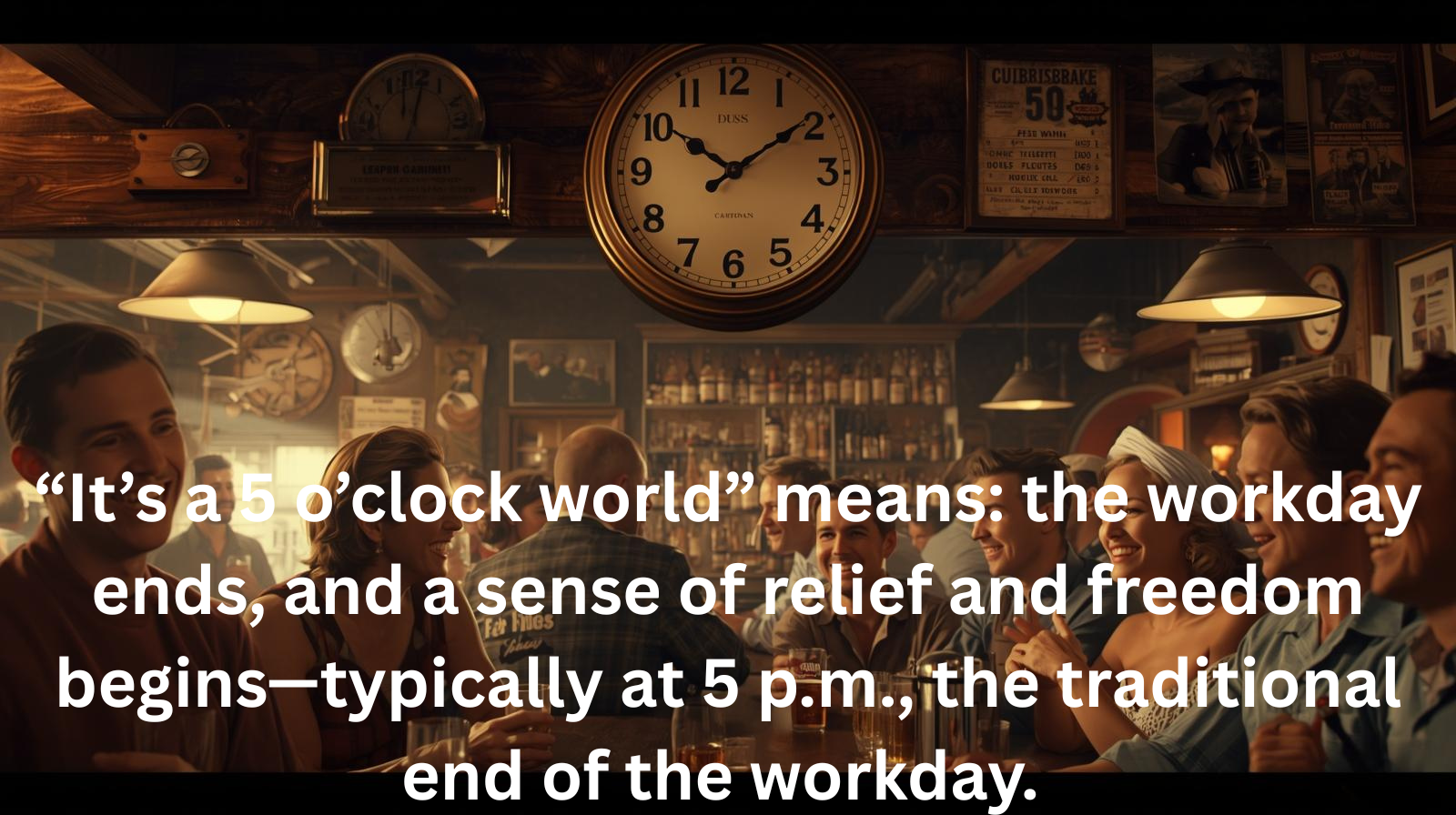
Summary
The idea behind it The phrase points to two “worlds”: • The “5 o’clock world”: the private self that reappears when the whistle blows—time with loved ones, relief, freedom, identity.
“A 5 o’clock world” is the part of life you get back when the job stops owning your time.
Origin: Where did the phrase come from?
It comes from a specific song title and refrain.
The phrase is best traced to “Five O’clock World,” a 1965 song by The Vogues, which captured the universal feeling of leaving work behind and feeling free.
The song’s hook repeats the idea that when the “whistle blows,” a different life begins—an after-hours “world” where “no one owns” the narrator’s time. (That wording is directly reflected in the lyrics; I’m paraphrasing rather than quoting at length.)
Why “five o’clock”?
The image of a whistle at quitting time is a classic mid-20th-century workplace marker—especially in factory and industrial settings—so “5 o’clock” becomes shorthand for freedom after a regimented day.
How widely did it spread?
The song became a major hit—reaching No. 4 on the U.S. Hot 100—and this success helped the phrase spread beyond music into everyday conversations, especially among workers and in pop culture.
The phrase “5 o’clock world” didn’t rise out of folklore—it rode in on a pop hit about working life.
The “real” meaning in one scan
What it signals
- Workday drudgery → after-work release
- A private self (“the real me”) returning at day’s end
- Home/love as the refuge that makes the grind bearable
What it does not mean
It’s easy to confuse this with “It’s five o’clock somewhere,” the drinking-justification phrase. That’s a different idiom with its own meaning and History—day drinking is “okay” because it’s 5 p.m. in some time zone—and it’s popularly associated with a later country hit.
“5 o’clock world” is about clocking out; “five o’clock somewhere” is about pouring one.
Video:
https://www.youtube.com/watch?v=
How people use it today
People use “it’s a 5 o’clock world” (or “my 5 o’clock world”) to mean:
- “I’m stuck in work mode until the day ends.”
- “My real life starts after work.”
- “Quitting time is emotional rescue.”
Because the original lyric anchors it to a whistle and a fixed workday, the phrase can feel “retro”—but it still lands because the work/real-life split hasn’t gone away.
“Origin”
“It’s a 5 o’clock world” comes from The Vogues’ 1965 hit “Five O’clock World,” written by Allen Reynolds. It’s shorthand for the life that begins when the workday ends—when your time becomes your own again.
In a remote-first workplace, “quitting time” doesn’t come with a whistle but with a Slack status change, showing that “it’s a 5 o’clock world” still resonates as a boundary marker for personal time.
Video:
https://www.youtube.com/watch?v=gSIGwAY2JBs
✅ What this does:
- Uses the phrase as a soft boundary, not a dramatic exit.
- Communicates availability rules (“urgent tag”) so the team doesn’t feel abandoned.
- Keeps the vibe human: “I’m clocking out” → “I’m entering my 5 o’clock world.”
In 2026, the “whistle” is your calendar—and your 5 o’clock world is the part of life you refuse to trade for another ping.
Why this usage works (and stays true to the origin)
The phrase comes from the idea popularized by the 1965 hit “Five O’Clock World”—a worker’s split life: workday grind vs. after-hours freedom when the day ends. In the song’s framing, “five o’clock” represents the time when your personal self returns and your time becomes your own again.
Modern translation:
- Then, a whistle blows at quitting time.
- Now: your last meeting ends, your status flips, and you stop responding.
“Let’s respect everyone’s 5 o’clock world—queue non-urgent items for tomorrow.”
These keep the phrase relatable and non-confrontational, while still drawing a line.
Summary
- Meaning: “My real life starts after work.”
- Modern equivalent: calendar ends → status flips → boundaries hold.
- Best use: as a warm boundary + clear “urgent” path.