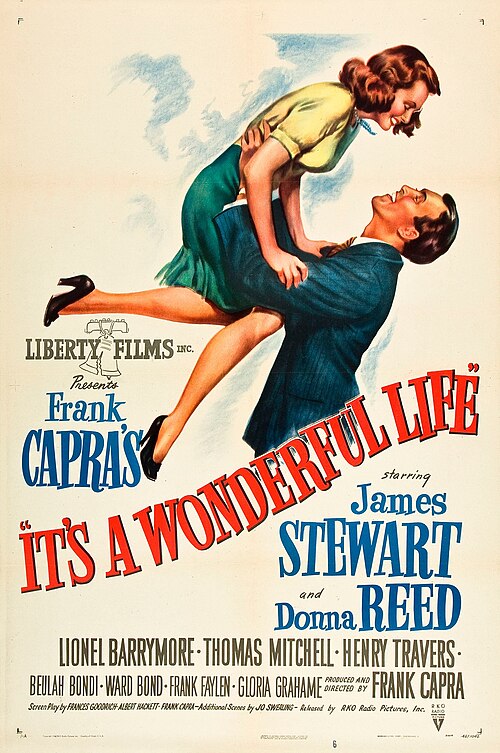
https://en.wikipedia.org/wiki/It’s_a_Wonderful_Life
Book Origins
- The story began as a short story titled “The Greatest Gift” written by Philip Van Doren Stern in 1943.
- Stern couldn’t find a publisher, so he printed about 200 copies and sent them as Christmas cards to friends.
- The story centers on a man who, feeling his life is meaningless, wishes he had never been born—only to be shown what the world would look like without him.
Movie Adaptation
- Director: Frank Capra
- Release Year: 1946
- Stars: James Stewart (George Bailey), Donna Reed (Mary Hatch Bailey), Lionel Barrymore (Mr. Potter)
- The film expands Stern’s short story into a rich narrative about community, sacrifice, and the value of one life.
Plot Summary:
George Bailey dreams of leaving his small town for adventure, but circumstances and his sense of duty keep him home, running the family’s Building & Loan. After a financial crisis and despair, George contemplates suicide on Christmas Eve. His guardian angel, Clarence, intervenes and shows him what life would be like if he had never existed, revealing the profound Impact he has had on others. George realizes his worth and returns home to find his community rallying to support him, fostering a sense of hope and belonging.
Themes
- Self-worth and purpose: Every life touches others in unseen ways.
- Community and generosity: The power of collective goodwill.
- Hope and redemption: Even in despair, meaning can be found.
Legacy
- Initially a box-office disappointment, the film gained cultural prominence after entering the public domain and becoming a TV staple, shaping American holiday traditions.
- Frequently ranked among the greatest films ever made, it has a legacy that inspires pride and admiration.
- The phrase “It’s a Wonderful Life” has become a symbol of gratitude and perspective, fostering a sense of cultural pride and shared History.
1. Written in 1943, this simple tale inspired a film that would become a cultural touchstone, demonstrating storytelling’s power to influence cinema and society.
- Book (Short Story):
- Written in 1943, it is only about 4,000 words long.
- A simple, almost allegorical tale focusing on the concept of one man’s Impact on others.
- Movie:
- Released in 1946, it lasts over two hours.
- Expands the story into a rich narrative with multiple subplots, characters, and emotional arcs.
2. Main Character
- Book:
- The protagonist is named George Pratt, a man who feels his life is meaningless and wishes he had never been born.
- Movie:
- Renamed George Bailey, with a fully developed backstory: childhood dreams, family ties, and years of sacrifice for his community.
3. Setting
- Book:
- Generic small town, minimal description.
- Movie:
- Bedford Falls, a vividly portrayed town that becomes a character, symbolizing community and shared destiny.
4. Plot Differences
- Book:
- George Pratt meets a mysterious stranger who grants his wish to see life as if he had never existed.
- He visits familiar places and realizes how much worse life would be for others without him.
- Ends with George returning home, grateful for his life.
- Movie:
- Adds dramatic tension: financial crisis, Mr. Potter as antagonist, George’s near-suicide on Christmas Eve.
- Introduces Clarence, a quirky guardian angel, adding humor and warmth.
- Includes the famous ending where the town rallies to save George, reinforcing themes of community.
5. Tone and Themes
- Book:
- Quiet, reflective, almost mystical.
- Focuses on existential gratitude and the ripple effect of one life.
- Movie:
- Emotional, dramatic, and heartwarming.
- Explores sacrifice, resilience, and collective goodwill in addition to personal worth.
6. Character Development
- Book:
- Few characters, mostly symbolic.
- Movie:
- Rich ensemble: Mary, Uncle Billy, Mr. Potter, Clarence, and townspeople—all adding depth and conflict.
7. Ending
- Book:
- George realizes his life matters and returns home.
- Movie:
- Climactic celebration: “No man is a failure who has friends,” with the community’s generosity saving George.
Life lessons:
1. Every Life Has value
One of the most powerful messages in It’s a Wonderful Life is that every individual matters. George Bailey spends much of the film feeling trapped and insignificant, believing his life has amounted to nothing. Yet when shown what the world would look like without him, he realizes that his existence shaped countless lives—from saving his brother as a child to helping families achieve homeownership. This lesson reminds us that even small acts of kindness and responsibility can create ripples that change the world in ways we may never see.
2. True Wealth Is Found in Relationships
The film challenges the notion that success is measured by money or status. George never becomes rich or famous, but in his darkest hour, his friends and neighbors rally to support him, proving that love and loyalty are the greatest treasures. The closing line, “No man is a failure who has friends,” captures this truth perfectly. In a society often obsessed with material wealth, the story reminds us that genuine human connections sustain us.
3. Sacrifice Can Be Meaningful
George Bailey repeatedly sacrifices his personal dreams—college, travel, and career ambitions—to help others, inspiring admiration and empathy. • his sacrifices, which keep the Building & Loan alive, teach that meaningful actions often involve hardship but lead to lasting fulfillment and legacy.
4. Gratitude Transforms Perspective
When George sees what life would be like without him, despair turns into gratitude. He realizes that his ordinary life is extraordinary because of the love and Impact woven into it. Gratitude shifts our focus from what we lack to what we have, and that change in perspective can be life-saving. In today’s fast-paced world, this lesson is timeless: appreciating the blessings we already possess can bring peace and joy even in challenging times.
5. Community Matters
The final scene of the film is a celebration of community. Bedford Falls comes together to help George in his hour of need, proving that strong communities thrive on mutual support and shared responsibility. This lesson underscores the importance of building relationships and contributing to the common good. In an era of increasing isolation, It’s a Wonderful Life reminds us that we are stronger together and that kindness and solidarity can overcome even the darkest moments.
The fundamental message of It’s a Wonderful Life is:
Every individual’s life has inherent value and creates a ripple effect of influence on others, often in ways unseen or unappreciated. Even when circumstances feel overwhelming or dreams seem unfulfilled, our relationships, acts of kindness, and sense of community give life its true meaning.
The film emphasizes that self-worth isn’t measured by wealth or status, but by the positive Impact we have on people around us. It also champions hope, resilience, and the power of human connection, reminding us that no one is truly alone when supported by friends and community.
Closing Paragraph:
“It’s a Wonderful Life” endures because it transforms a simple idea into a timeless meditation on human worth and community. While Philip Van Doren Stern’s short story planted the seed, Frank Capra’s film gave it heart, depth, and unforgettable imagery. Its message—that every life touches countless others—resonates across generations, reminding us that even in moments of despair, our existence holds immeasurable value. That universal truth, wrapped in warmth and hope, is why the movie became not just a holiday tradition but a cultural treasure.