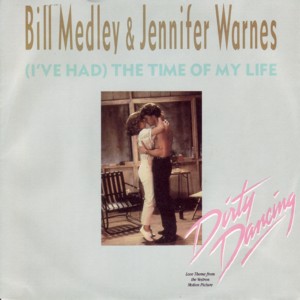
If you’ve ever been at a wedding where the dance floor suddenly fills, chances are you’ve felt the gravitational pull of “(I’ve Had) The Time of My Life”—the powerhouse duet by Bill Medley and Jennifer Warnes that closes Dirty Dancing with the kind of emotional lift pop music rarely achieves.
More than a soundtrack hit, the song is a precision-built finale: it starts tender, swells with certainty, and lands on a peak that’s been replayed for decades in living rooms, reception halls, and pop culture itself.
Video:
https://www.youtube.com/watch?v=6eyCDj1s4NI
https://www.youtube.com/watch?v=4BQLE_RrTSU
Special Treat, Pretty Girls Dancing To The Time of My Life
https://www.youtube.com/shorts/xQaheQMtKT0
Facts:
- Performed by: Bill Medley & Jennifer Warnes
- Written by: Franke Previte, John DeNicola, Donald Markowitz
- Produced by: Michael Lloyd [
- Film association: Theme/finale song for Dirty Dancing (1987)
- U.S. chart peak: No. 1 on the Billboard Hot 100 (1 week), peak date 11/28/87 [
- U.K. chart peak: No. 6 on the Official Singles Chart
Built for a movie climax—then built a legacy that continues to inspire emotional connection and shared celebration.
The song’s cinematic origin story is compelling: producer Jimmy Ienner encouraged songwriter Franke Previte to craft music for what was initially a small film project—Dirty Dancing—, and this push resulted in one of the most iconic pop moments of the 1980s.
Previte wrote lyrics while collaborators John DeNicola and Donald Markowitz handled the music, and the team created a demo that mapped out the song’s signature slow-burn-to-explosion structure.
Here’s the twist that explains why the song feels choreographed to emotion: the film’s finale was rehearsed/shot to a demo version (recorded by Previte with singer Rachele Cappelli) because the final Medley/Warnes recording wasn’t ready in time.
That practical production constraint reinforced the track’s identity: the music wasn’t just “placed” in the scene—it was engineered alongside it.
Why it works: a duet as a conversation
Plenty of duets are star pairings. This one is dramatic casting: Medley’s gritty, grounding baritone and Warnes’ bright, soaring tone create a call-and-response dynamic that feels like two perspectives converging at the exact moment.
And the song was written with specific cinematic requirements in mind—start slow, end big, and sustain a long arc—so the emotional rise is baked into the blueprint rather than added by production tricks.
Great pop songs are memorable. This one is memorable and inevitable—because it’s structured like a countdown to a payoff.
On the duet chemistry (Medley + Warnes)
- “Medley anchors the song like gravity; Warnes lifts it like air.”
- “The magic isn’t two voices singing—it’s two voices agreeing on a moment.”
- “Their contrast is the point: grit and glow, weight and wings.”
- “This is what a duet should feel like: two people arriving at the same truth from different roads.”
- “When the voices meet, the song stops being a soundtrack and starts being a vow.”
The awards weren’t a fluke—they were a report card
The industry response matched the audience response. The song won the Academy Award for Best Original Song, with the Oscar going to its writers (Previte, DeNicola, Markowitz).
It also won the Golden Globe Award for Best Original Song – Motion Picture for “Dirty Dancing”.
And it took home the Grammy for Best Pop Performance by a Duo or Group with Vocals (awarded in 1988).
When a song wins the Oscar, the Golden Globe, and the Grammy, it signifies more than popularity—it confirms the song’s structural and cultural significance as an undeniable classic.
Chart success: the rare soundtrack single that truly crossed over
Commercially, “(I’ve Had) The Time of My Life” wasn’t just a movie souvenir—it became a mainstream radio event. It reached No. 1 on the Billboard Hot 100 and held the top spot for one week, with a listed peak date of 28 November 1987.
In the U.K., it climbed to No. 6 on the Official Singles Chart, reinforcing that the phenomenon wasn’t confined to U.S. theaters.