Summary
Ishikawa is often the missing bridge in the Deming–Juran story. If Deming supplied Japan with systems thinking + statistical discipline, and Juran supplied executive planning + managerial accountability, Ishikawa helped Japan scale quality into a mass movement—from the boardroom to the factory floor—by making quality teachable, visual, and participatory.
Below are his most significant contributions and their role in shaping Japan’s enduring quality culture during the revolution, highlighting how these ideas continue to influence quality management today.
1) He made “quality” understandable to everyone (not just statisticians)
Deming’s statistical thinking is powerful—but it can feel abstract outside engineering. Ishikawa’s genius was to translate quality into simple, usable practices that frontline teams could apply daily.
What he did:
- Popularized the idea that quality control should be company-wide, not confined to a “quality department.”
- Emphasized education and training so employees at every level could use basic QC methods.
- Framed quality as a human system: communication, teamwork, pride of artistry, and shared standards—not merely charts and formulas.
Japan didn’t just adopt “quality tools.” It created a quality culture rooted in shared language and pride, fostering a sense of collective achievement that motivates everyone to contribute.
Deming provided Japan with the science; Ishikawa provided Japan with the social operating system to deploy it at scale.
2) He pioneered QC Circles: quality as a grassroots habit
Ishikawa is strongly associated with the rise of Quality Control Circles (QC Circles) in Japan (especially in the early 1960s). These were small groups of employees—often shop-floor workers—who met regularly to:
- Identify problems in their work area
- Use simple tools to analyze causes
- Propose improvements
- Present results and spread learning
This was huge because it changed the role of workers from “hands” to problem-solvers.
How does this complement Deming and Juran?
- Deming: “The system produces the results; reduce variation; drive out fear.”
QC circles operationalized the idea that workers could safely surface system problems.
- Juran: “Improvement needs structure and projects.”
QC circles provided a continuous pipeline of micro-projects tied to real work.
QC Circles turned quality from a management initiative into a workforce reflex.
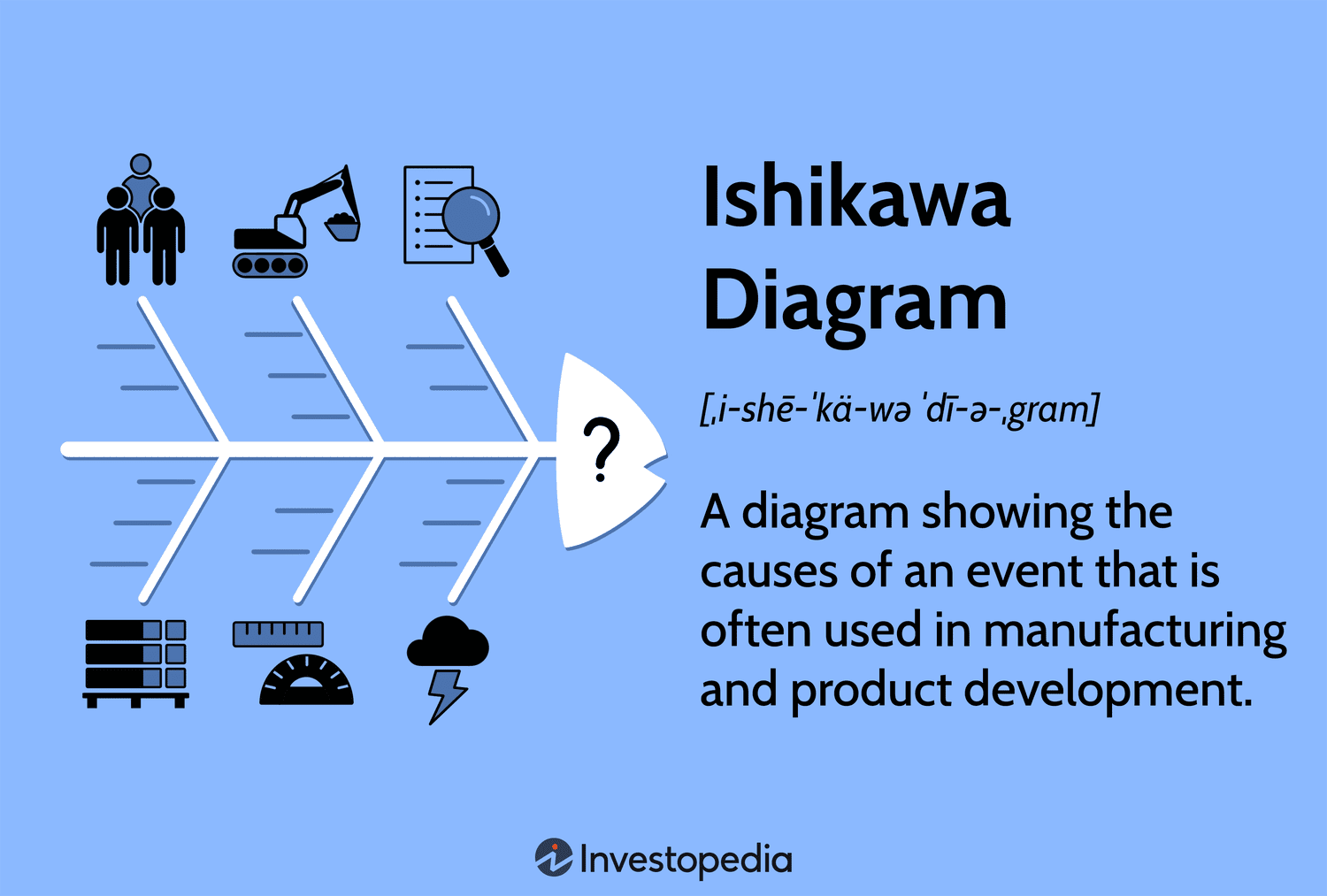
3) He created the Ishikawa (Fishbone) Diagram: a visual tool for root cause
Ishikawa’s most famous tool is the cause-and-effect diagram, commonly called the fishbone diagram.
What it does
It helps teams move from symptoms to causes by organizing potential root causes into categories.
A classic structure is:
- Methods
- Machines
- Materials
- Manpower (People)
- Measurement
- Environment
(often called the
“6 Ms,” with variations depending on the industry)
Why it mattered
- It made root-cause thinking fast and collaborative.
- It reduced the “blame game” by focusing on causes rather than culprits.
- It provided non-experts with a means to conduct disciplined analysis without requiring advanced statistics.
The fishbone diagram is blame-proof thinking: it forces teams to look at systems, not scapegoats.
4) He codified the “Seven Basic QC Tools” for everyday use
Ishikawa is closely associated with promoting what became known as the Seven Basic Tools of Quality, typically:
- Check sheet
- Histogram
- Pareto chart
- Cause-and-effect (fishbone) diagram
- Scatter diagram
- Control chart
- Flowchart (or stratification, depending on the list)
Why this mattered strategically
Instead of treating quality as a specialized discipline, Japan could train huge numbers of employees in a standard toolkit.
That toolkit was created:
- Consistent problem-solving habits
- Shared reporting and vocabulary
- Faster spread of best practices
- Measurable improvement at scale
Japan didn’t just teach quality. It standardized how people think about problems.
5) He championed “Company-Wide Quality Control” (CWQC)
Ishikawa helped shape the Japanese model often described as Company-Wide Quality Control (sometimes translated as Total Quality Control in Japan’s context).
Key ideas include:
- Quality is everyone’s job: design, procurement, production, sales, service
- Quality is built upstream: prevent defects rather than inspect them out
- Cross-functional cooperation matters as much as technical capability
- Internal handoffs matter (“the next process is your customer”)
This last concept—treating the next step in the workflow as a customer—is a deceptively powerful operational ethic.
It improves:
- documentation quality
- component consistency
- handoff clarity
- accountability without bureaucracy
Quality improves fastest when departments stop throwing problems over the wall.
6) He pulled the whole thing together: tools + culture + participation
Ishikawa’s enduring contribution is that he made quality improvement:
- Democratized (everyone can participate)
- Visible (fishbone diagrams make causes discussable)
- Repeatable (basic tools + standard routines)
- Cultural (quality as pride and shared responsibility)
In one integrated picture:
- Deming → system thinking + variation + management responsibility
- Juran → quality planning + “fitness for use” + breakthrough projects
- Ishikawa → mass deployment via QC circles + simple tools + cross-functional culture
Deming developed a philosophy, Juran developed a management system, and Ishikawa developed the movement.
Practical takeaway (today): To make Ishikawa’s contributions relevant across sectors like software, healthcare, or finance, focus on how his principles of simple tools and participatory culture can be adapted beyond manufacturing, helping readers see broad applicability.
If you’re applying this to a modern company (manufacturing, software, healthcare, financial services), Ishikawa’s lesson is:
Don’t just “buy” quality expertise. Build quality participation.
Make the tools simple enough that the people closest to the work can improve them daily.