Summary
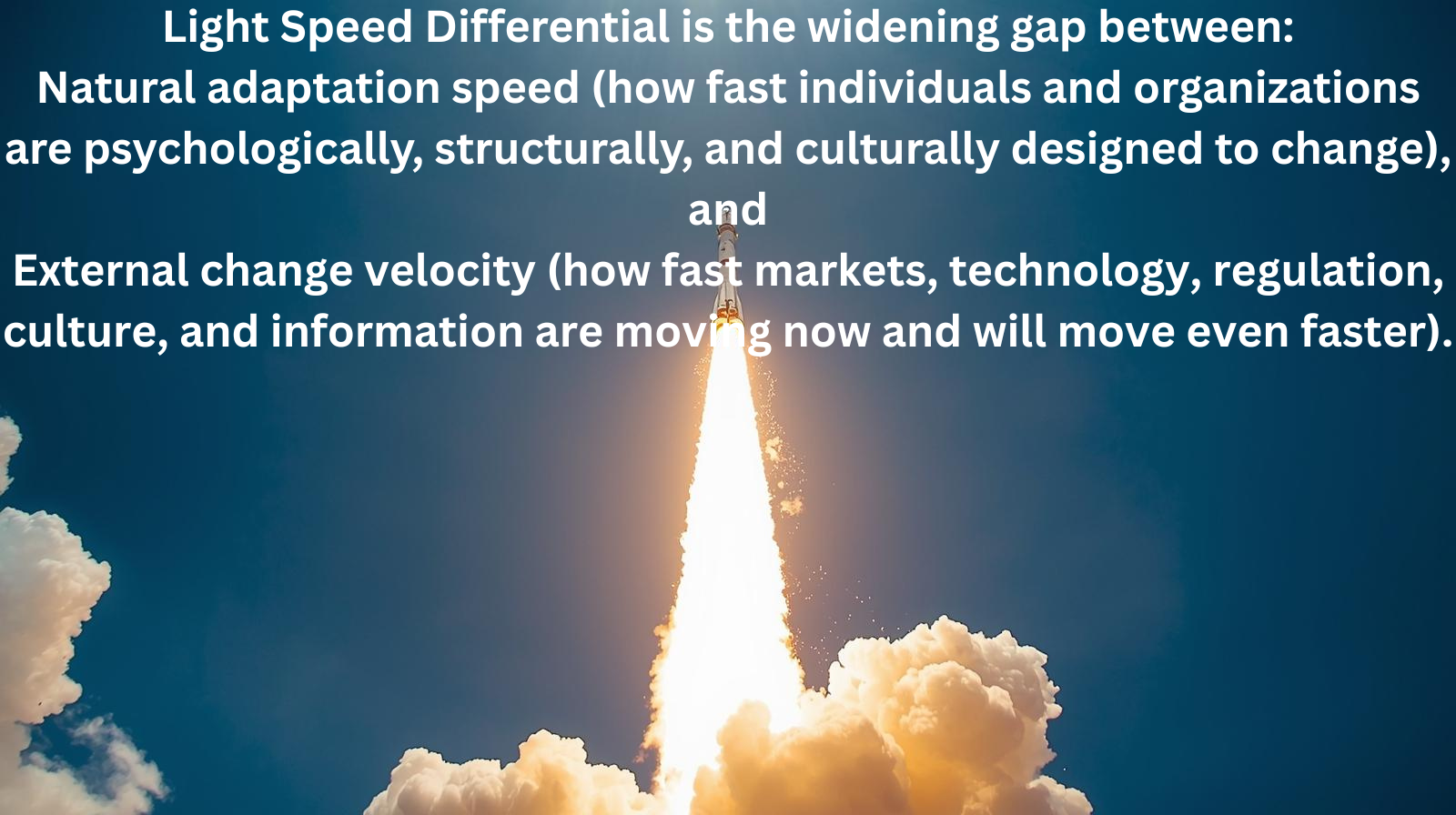
Light Speed Differential is the widening gap between: • Natural adaptation speed (how fast individuals and organizations are psychologically, structurally, and culturally designed to change), and • External change velocity (how fast markets, technology, regulation, culture, and information now move- and get even faster).
It is a diagnostic lens—a way to understand why capable people and institutions struggle in hyper-fast changing environments.
The question is no longer whether change will accelerate.
The question is whether one’s internal rate of adaptation can keep pace with reality.
Reducing the Light Speed Differential: How Individuals and Organizations Close the Gap
The Light Speed Differential cannot be slowed down or eliminated. The change environment continues to accelerate. Technology, regulation, culture, and competition will not slow down to match human comfort.
The only viable strategy is to narrow the gap from within—by increasing adaptive capacity without destroying people, culture, or mission.
This is not about moving faster.
It is about absorbing speed without breaking.
1. Replace Planning Certainty with Learning Velocity
Traditional systems try to predict the future. Lightspeed systems try to learn faster than the future arrives.
What to Change
- Stop optimizing perfect plans
- Stop delaying decisions for “complete information.”
- Stop treating mistakes as failures
What to Build Instead
- Short feedback loops
- Small, reversible decisions
- Continuous testing in real conditions
Rule:
If learning lags change, the gap widens.
Practical Application
- Weekly learning reviews instead of quarterly strategy reviews
- Pilot projects instead of full rollouts
- Metrics that measure time‑to‑learning, not just outcomes
2. Radically Simplify the North Star
In management, the North Star is a singular, high-level, guiding principle or metric that aligns an entire organization toward a shared, long-term purpose. It functions as a compass, helping teams prioritize actions, reduce distractions, and focus on delivering sustainable customer value over short-term gains.
Speed destroys alignment.
Only clarify Velocity.
As change accelerates, organizations often add complexity to maintain a sense of control—more employees, more meetings, more rules, more layers. This makes the differential worse.
What to Do
- Reduce mission statements to one sentence
- Define 3–5 non-negotiables
- Treat everything as provisional
Rule:
When everything is predetermined, nothing moves fast enough.
Why It Works
A simple North Star allows decentralized action without constant coordination. People can move independently without drifting.
3. Modularize Structure, Roles, and Decisions
Large, interdependent systems fail catastrophically at high speeds. Modular systems bend.
What Modularity Means
- Projects can fail without killing the whole organization
- Teams can pivot without waiting for enterprise-wide approval
- Roles are flexible rather than fixed
Practical Moves
- Smaller teams with end-to-end ownership
- Clear interfaces between departments
- Independent project timelines
Rule:
If a single delay halts everything, everything is too rigid for light speed.
4. Push Authority to the Edge—With Guardrails
Lightspeed environments punish centralized decision-making. By the time approval travels up and back down, reality has changed.
The Shift
- From permission‑based authority → principle‑based authority
- From “ask first” → “act within boundaries.”
Guardrails Matter
Decentralization without guardrails creates chaos. Guardrails provide safety without slowing execution.
Examples:
- Budget thresholds
- Ethical boundaries
- Mission alignment tests
Rule:
Speed requires trust—but trust must be structured.
5. Normalize Continuous Psychological Safety
The fastest systems fail first when people feel unsafe to act.
Fear slows learning.
Punishment increases hesitation.
Hesitation widens the differential.
What Psychological Safety Enables
- Early error detection
- Honest signal reporting
- Faster correction cycles
What Leaders Must Do
- Publicly reward intelligent risk
- Separate learning failures from negligence
- Model adaptability at the top
Rule:
If people wait for certainty, the system falls behind reality.
6. Redefine Stability Itself
In normal growth environments, Stability means lack of change.
In lightspeed environments, Stability means full speed ahead with continuous recalibration.
New Definition of Stability
- Direction stays fixed
- Methods stay fluid
- Identity stays grounded
Organizations that cling to old definitions of stability collapse under the pressure of speed.
Rule:
Stability is not standing still—it is staying intact while moving.
7. Reduce Cognitive Load, Not Just Workload
Burnout is not caused by speed alone.
It is caused by speed plus ambiguity.
How to Reduce Cognitive Load
- Fewer priorities
- Clear decision ownership
- Visible scoreboards
People can handle intensity. They cannot handle confusion at scale.
Rule:
Clarity is the neutralizer to burnout in fast systems.
8. Train for Adaptation, Not Mastery
Mastery assumes a stable environment. Lightspeed environments invalidate mastery faster than people can achieve it.
The Shift
- From “become an expert” → “become adaptive.”
- From credential accumulation → learning agility
What This Looks Like
- Cross-training instead of silo specialization
- Learning sprints instead of long certification paths
- Continuous skill refresh instead of static roles
Rule:
Under lightspeed conditions, adaptability outperforms expertise.
9. Accept Permanent Discomfort—But Limit Damage
The Light Speed Differential can be reduced, but not eliminated. Leaders must design systems that tolerate discomfort without converting it into damage.
This means:
-
Accepting uncertainty
- Planning for revision
- Treating discomfort as information, not failure
Rule:
The goal is not comfort. The goal is resilience.
The Meta‑Principle
You do not reduce the Light Speed Differential by chasing speed. You reduce it by increasing your capacity to learn, adapt, and realign faster than conditions change.
“The future doesn’t punish those who are wrong. It punishes those who are slow to learn they’re wrong.”
Reducing the Light Speed Differential is not a productivity tactic.
It is a survival discipline—for individuals, organizations, and institutions operating in a world that no longer waits.
Individual Adaptation in a Light Speed World: Concepts That Actually Work
Most advice about rapid change tells people to “be resilient” or “learn faster.” That language is insufficient. Individuals do not fail in lightspeed environments because they lack effort or intelligence. They fail because their internal operating system was designed for a slower world.
Below are core adaptation concepts that help individuals narrow the Light Speed Differential without harming themselves.
1. Identity Elasticity (Not Reinvention)
The most dangerous belief in a hyper-rapid environment is:
“I am what I do.”
When roles, tools, and industries change faster than identities can stabilize, rigid self‑definitions collapse.
The Shift
- From fixed identity → elastic identity
- From “this is who I am” → “this is how I currently contribute.”
Elastic identity allows continuity without stagnation.
People who survive light‑speed change don’t reinvent themselves constantly—they stretch without snapping.
Practical Practice
Define yourself by capabilities and values, not titles:
- Problem solver, not “loan officer.”
- Builder, not “developer.”
- Teacher, not “Manager.”
2. Micro‑Adaptation Over Life Redesign
Hyper-rapid change creates pressure to overhaul everything. That impulse backfires.
The Principle
Large redesigns increase cognitive load.
Micro-adaptations reduce friction and compound forward momentum.
Examples
- One new tool per month, not five
- One experimental habit per quarter
- One skill upgrade at a time
Under lightspeed conditions, small, continuous changes outperform dramatic Reinvention.
3. Optionality as a Life Strategy
Certainty is no longer a stable currency.
Optionality is.
What Optionality Means
- Multiple skills that overlap
- Multiple income or value streams
- Multiple ways to deploy experience
This is not a distraction—it is risk dispersion.
Optionality turns volatility from a threat into leverage.
Practical Question
“If this disappeared tomorrow, what else could I do quickly?”
If the answer is “nothing,” the gap is widening.
4. Fast Sense‑Making (Not Fast Decisions)
Speed is often misinterpreted as decisiveness. In reality, sense-making speed matters more than decision speed.
Sense‑Making Is:
- Pattern recognition
- Context framing
- Meaning extraction
People who fail under speed often decide fast on misread signals.
Those who see clearly can afford to move quickly.
Practical Habit
- Weekly reflection: “What changed this week that I didn’t expect?”
- Monthly pattern review: “What’s repeating that I ignored?”
5. Skill Half-Life Awareness
Every skill now has a half-life—the time it takes for its value to decline by 50%.
The problem is not learning.
The problem is learning obsolete things too deeply.
The Shift
- From mastery mindset → refresh mindset
- From “be the expert” → “stay relevant.”
In a fast world, relevance beats mastery.
Practical Filter
Before deep learning, ask:
- “Is this skill likely to compound?”
- “Does it transfer across contexts?”
6. Cognitive Load Budgeting
Burnout is not caused by speed alone.
It is caused by speed, ambiguity, and overcommitment.
Light‑Speed Rule
You must budget attention the way you budget money.
Practical Guardrails
- Fewer simultaneous priorities
- Hard limits on context switching
- Clear “stop doing” lists
You cannot outrun overload. You must design against it.
7. Psychological Safety With Yourself
Researchers discuss psychological safety at work.
Few talk about internal psychological safety.
In high-speed environments, self-criticism amplifies stress more rapidly than external pressure.
Internal Safety Means:
- Treating confusion as data, not failure
- Allowing temporary incompetence
- Separating self-worth from pace of adaptation
You cannot adapt if you are constantly punishing yourself for learning.
8. Temporal Reframing: Shorter Horizons, Longer Arc
Individuals break when they attempt to plan for the long term in a short-cycle world.
The Reframe
- Short planning horizon (weeks/months)
- Long purpose horizon (years/decades)
Clarity of direction matters more than clarity of route.
This prevents anxiety while preserving meaning.
9. Personal OODA Loops
Individuals who thrive unconsciously run fast Observe–Orient–Decide–Act cycles.
Personal OODA Example
- Observe: “This tool/market behavior changed.”
- Orient: “This affects my role because…”
- Decide: “I’ll test one adjustment.”
- Act: “I try it this week.”
Fast learners don’t wait for certainty—they run loops.
10. Permanent Beginner’s Advantage
Experts protect reputation.
Beginners protect learning.
In hyper-rapid environments, a beginner’s humility is an asset.
The Shift
- From “I should know this” → “I can learn this.”
- From defensiveness → curiosity
The future belongs to those who are unembarrassed to learn.
11. Energy Management Over Time Management
Time cannot be expanded.
Energy can be protected and renewed.
Light‑Speed Reality
Cognitive fatigue widens the Light Speed Differential more rapidly than time constraints.
Practical Focus
- Sleep as a strategic asset
- Recovery as performance infrastructure
- Rhythm over intensity
Speed without recovery is borrowed performance—with interest.
12. Meaning Anchors in a Moving World
When everything means nothing.
People who adapt well under speed anchor to:
- Service
- Craft
- Faith
- Contribution
- Stewardship
Meaning is what prevents speed from becoming chaos.
Closing:
“You do not adapt to light‑speed change by becoming faster. You adapt by becoming more fluid, more aware, more focused actions, and less attached to static versions of ourselves.”
The Light Speed Differential is not just an organizational problem.
It is an identity, cognition, and design problem at the individual level.
Those who master these concepts do not merely survive acceleration—they remain coherent inside it.