Summary
Ever walk into a high-stakes room so ready that nothing could rattle you? That feeling—calm, confident, purposeful—is the essence of being loaded for bear. It’s more than a colorful idiom. It’s a mindset: the deliberate choice to prepare for the most formidable challenge and operate as if the stakes are real, the terrain is uneven, and the “bear” might charge, making you feel empowered and in control.
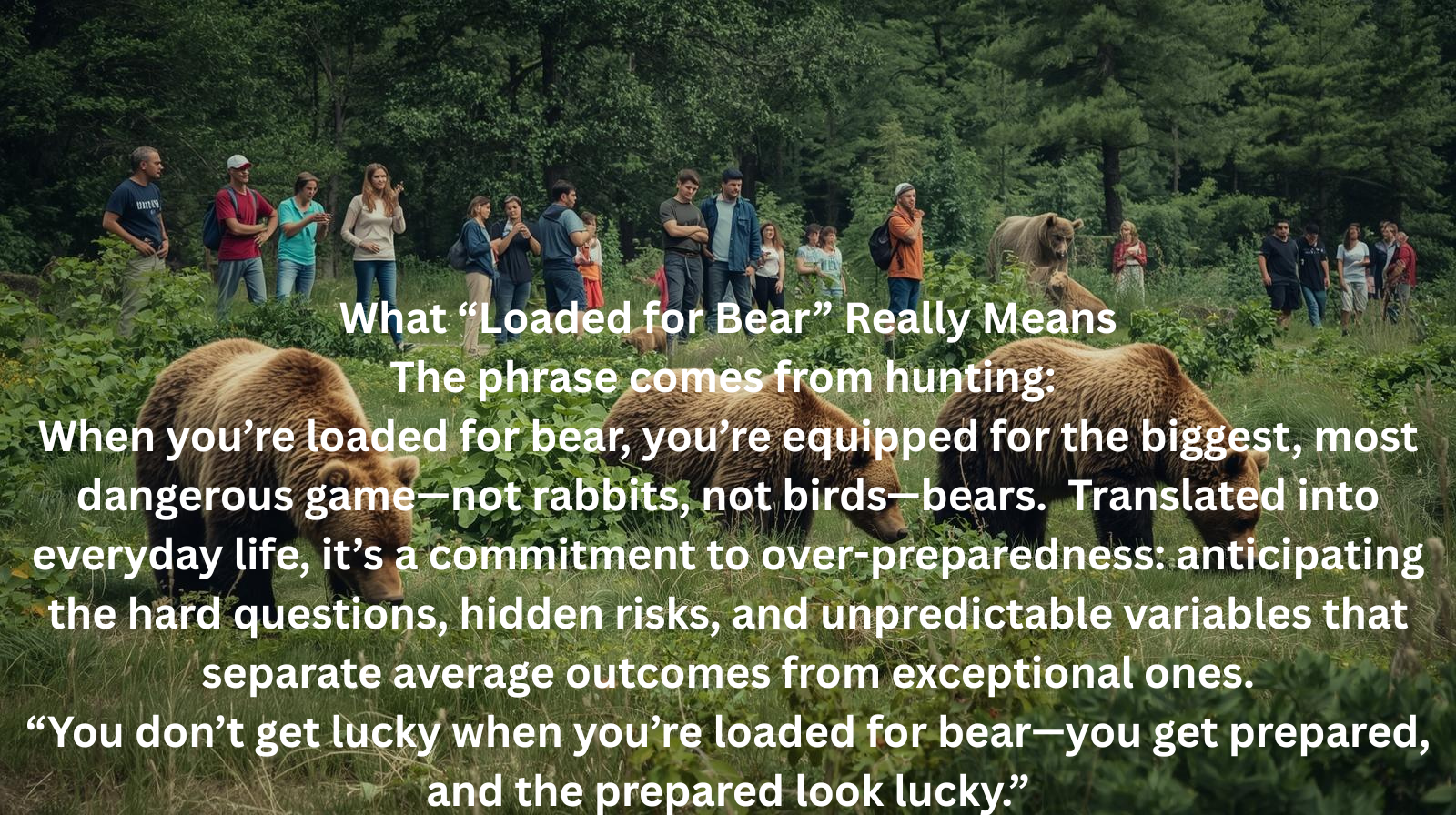
The phrase comes from hunting:
When you’re loaded for bear, you’re equipped for the biggest, most dangerous game—not rabbits, not birds—bears. Translated into everyday life, it’s a commitment to over-preparedness: anticipating the hard questions, hidden risks, and unpredictable variables that separate average outcomes from exceptional ones.
“You don’t get lucky when you’re loaded for bear—you get prepared, and the prepared look lucky.”
Why Over-Preparedness Wins
It’s tempting to treat preparation as a checkbox. Do the reading, make the slides, rehearse the pitch—done. But overpreparation shifts your mindset from reactive to confident, fostering resilience and a proactive approach that prepares you for worst-case scenarios.
- In negotiations, being loaded for bear means you know the numbers cold, the other party’s incentives, and the alternatives on the table. You walk in with a strong BATNA (Best Alternative to a Negotiated Agreement), pre-drafted term options, and proof points ready to share. When pressure mounts, credibility beats charisma.
- In leadership, it’s the difference between reacting to crises and orchestrating contingencies. Leaders who plan for the bear—regulatory shifts, supply chain shocks, capital constraints—make faster decisions and retain stakeholder trust when turbulence hits.
“Preparation isn’t the opposite of risk; it’s the antidote to surprise.”
Real-Life Success Story #1: Netflix’s Pivot
When Netflix faced the looming threat of Blockbuster and the decline of DVD rentals, they didn’t just prepare for incremental change—they prepared for streaming dominance. Years before broadband was mainstream, Netflix invested in licensing deals, compression technology, and predictive algorithms. Their foresight instilled pride and a sense of achievement, demonstrating how anticipation can lead to industry leadership.
Loaded for Bear in Everyday Life applies beyond boardrooms or battlefields. Whether managing personal finances or handling unexpected challenges, adopting this mindset helps you stay prepared and in control when the stakes are high.
You don’t need a boardroom or a battlefield to live this way. The mindset applies anywhere the stakes are real.
- Sports: Think of Serena Williams. Her dominance wasn’t just talent—it was preparation. She studied opponents, rehearsed pressure points, and trained for endurance beyond match length. When finals stretched into mental warfare, she didn’t flinch. She was loaded for bear.
- Personal finance: During the 2008 financial crisis, households with emergency funds and diversified income streams weathered the storm far better than those living paycheck to paycheck. They didn’t predict the crash—but they prepared for volatility. That’s the essence of readiness: fostering security and resilience in uncertain times.
“If you’re ready for the worst, the worst rarely owns you.”
Prepared vs. Paranoid
Overpreparedness has a rival: paralysis.
The aim is decisive readiness, not endless contingency planning that postpones action. How do you keep sharp without spinning your wheels?
· Set thresholds. Decide in advance which data and scenarios will trigger action; focus on the most impactful risks to optimize your preparedness efforts.
· Time‑box preparation. Give yourself a disciplined window—prepare deeply, then ship.
· Practice stress. Simulate real constraints: limited budgets, tight deadlines, skeptical audiences. Rehearsed friction builds resilience.
· Review outcomes. After the action, conduct a short post-mortem: What surprised you? What saved you? Where did preparation pay off—and where did fear masquerade as prudence?
“Preparation fuels action; paranoia delays it.”
The Loaded‑for‑Bear Playbook
Here’s a practical framework you can adapt for any situation-pitching investors, launching a startup, or managing a team-that makes over-preparedness actionable and scalable for any stage of your business or life.
1) Define the Bear
Write down the worst credible version of the challenge:
- The most skeptical decision-maker in the room.
- The most challenging question you could be asked.
- The constraint you hope doesn’t show up—but could.
Naming the bear neutralizes fear and focuses preparation on realities, not ghosts.
2) Build the Evidence Stack
Gather data, documents, and proofs that withstand scrutiny:
- Key metrics, sources, and benchmarks.
- Case studies and failure analyses.
- Comparables and third-party validation.
Why it matters: When the stakes rise, documentation is persuasion.
3) Craft the Contingency Tree
Map A, B, and C routes to your goal:
- If X fails, pivot to Y.
- If capital tightens, scale, scope, or sequencing.
- If timelines slip, adjust milestones but protect the mission.
Optionality converts obstacles into detours.
4) Pre-wire the Room
Identify the people and pressure points:
- Allies, skeptics, and swing votes.
- What each person values—and what they fear.
- Pre-meeting outreach to seed context and reduce surprise.
Why it matters: Decisions are human. Pre-wiring turns cold rooms warm.
5) Rehearse the Heat
Run red‑team drills and devil’s‑advocate sessions:
- Invite colleagues to attack your plan.
- Record practice sessions; tighten your answers.
- Build one-page briefs with crisp logic and shareable visuals.
Why it matters: Pressure testing in private prevents failure in public.
“Confidence isn’t a mood; it’s a byproduct of reps and receipts.”
Case Snapshot: The Meeting That Didn’t Go Sideways
A founder walked into a diligent meeting where the mood was cool, and the questions were colder. He didn’t start with a deck; he began with evidence. He had a unit economics one-pager, customer cohorts with retention curves, and sensitivity tables showing outcomes under conservative assumptions. He welcomed the hardest questions first. When an investor challenged pricing, the founder produced comparables and elasticity tests. When someone pushed on churn, he had segmented data and recovery initiatives. The tone changed—not because he dazzled, but because he respected the bear.
“Respect the bear, and the bear respects you.”
The Mindset Shift
Being loaded with a bear is a discipline and a stance:
- Discipline: Do the work no one sees—research, rehearsals, documentation.
- Stance: Choose courage over comfort. Confront the hardest version of reality and go anyway.
You don’t control the weather, the market, or the mood of a room. But you control your readiness, your options, and your composure.
“You can’t guarantee outcomes, but you can guarantee preparation.”
Takeaway
When the stakes are high, do not show up average. Show up loaded for bear—with facts, contingency plans, and phrases that stick. Cut the filler, embrace the hard questions, and design for skimming so your message lands quickly and clearly. Preparation won’t eliminate uncertainty, but it will tilt the odds. And when the bear appears—as it inevitably does—you won’t flinch.
“In a world that rewards speed, preparation is the quiet advantage that wins out.”