Introduction
Language shapes persuasion, and few idioms illustrate weakness as vividly as “not a leg to stand on.” Common in everyday speech and legal argument alike, this phrase signals a position devoid of support—whether factual, legal, or logical. For lawyers, understanding its origin, meaning, and strategic use can enhance clarity and rhetorical Impact in briefs, oral arguments, and client communications.
Origin and Evolution
The idiom dates back to the 18th century and is rooted in the physical impossibility of standing without legs. Early usage appeared in legal and debate contexts, describing arguments lacking foundation. Over time, it became a staple in English idiom, symbolizing vulnerability and collapse—just as a person without legs cannot stand, an argument without evidence cannot prevail.
Meaning in Legal Context
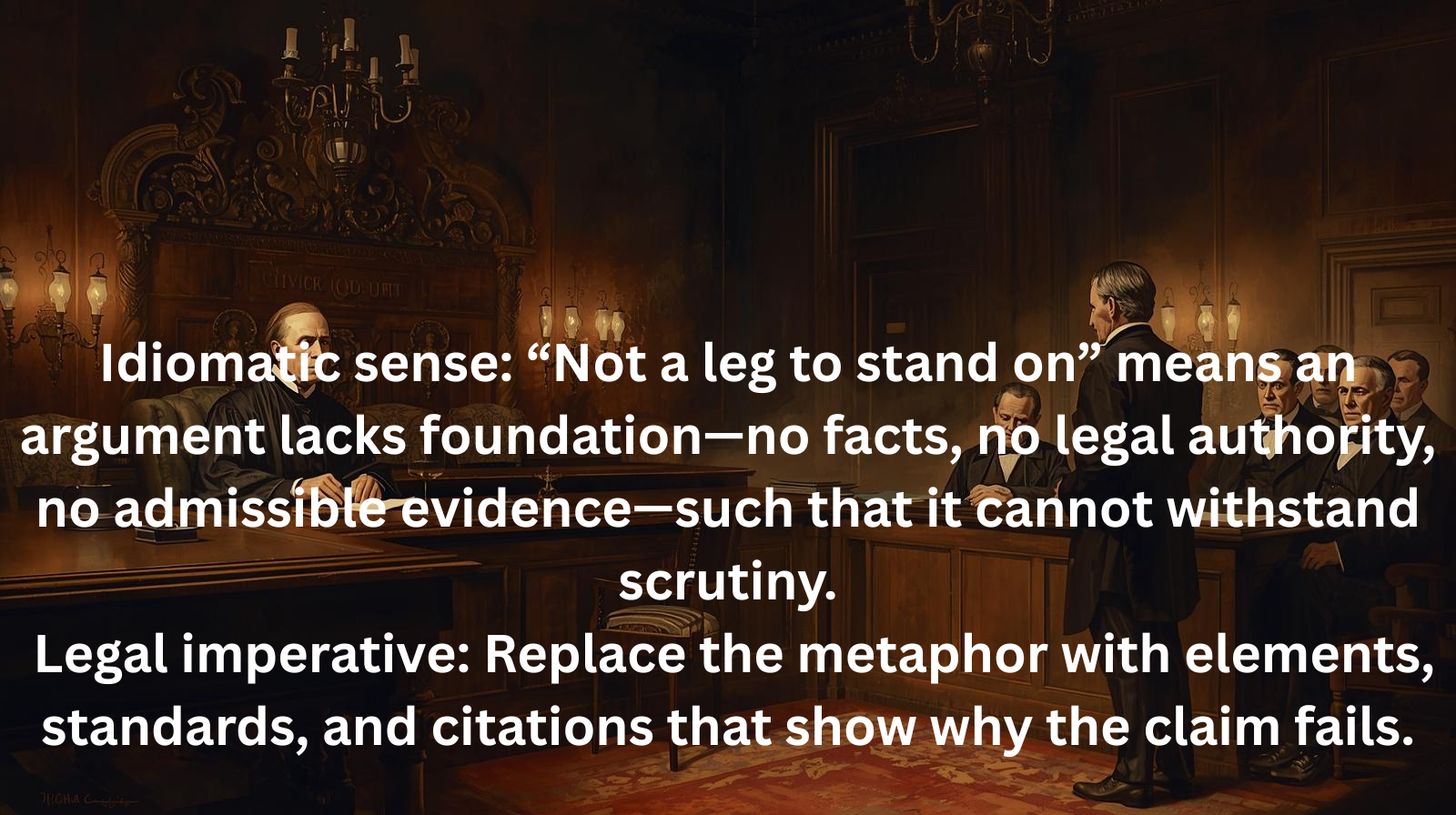
In Law, “not a leg to stand on” conveys that a claim or defense is unsupported by facts, statutes, or precedent. It is often used to underscore fatal deficiencies in pleadings, evidentiary showings, or doctrinal arguments.
Examples
-
“The plaintiff’s lawsuit was dismissed because they had no leg to stand on without proof of damages.”
-
“The defense argued self-defense, but with no witnesses or forensic evidence, they had no leg to stand on.”
-
“Since the agreement was never signed, the company had no leg to stand on in enforcing its terms.”
Usage in Court Arguments
While informal, the idiom appears frequently in oral arguments, motions, and even judicial opinions for emphasis:
- Oral Argument:
“Your Honor, the plaintiff’s theory of liability has no leg to stand on because the statute clearly bars recovery under these circumstances.”
- Motion to Dismiss:
“Defendant respectfully submits that Plaintiff’s complaint has no leg to stand on, as it fails to allege any facts constituting a cause of action under applicable Law.”
- Judicial Commentary:
“Given the absence of contractual privity and the lack of evidence of damages, the appellant’s argument has no leg to stand on.”
Strategic Considerations
- Anchor to Authority: Pair the idiom with citations to statutes, precedent, or record evidence.
- Calibrate Tone: Courts value precision; avoid hyperbole or sarcasm.
- Know Your Forum: Idioms are more effective in oral advocacy and client-facing communications than in appellate briefs.
- Translate to Doctrine: After using the idiom, articulate the legal standard:
“Therefore, under Rule 12(b)(6), the claim fails for lack of causation allegations.”
Related Idioms for Legal Rhetoric
- Dead in the water: No chance of success.
- House of cards: Fragile argument likely to collapse.
- Thin ice: Risky or unstable position.
Support the deployment of idioms with substantive analysis to reinforce professionalism and demonstrate thorough legal reasoning to the audience.
Conclusion
The idiom “not a leg to stand on” remains a powerful rhetorical tool for signaling weakness in legal arguments. When used judiciously—anchored to authority and translated into doctrinal terms—it can sharpen advocacy without sacrificing professionalism. In Law, as in life, arguments need legs. Without them, they fall.
Not alleged facts sufficient to establish causation, and controlling precedent forecloses liability under these circumstances.”