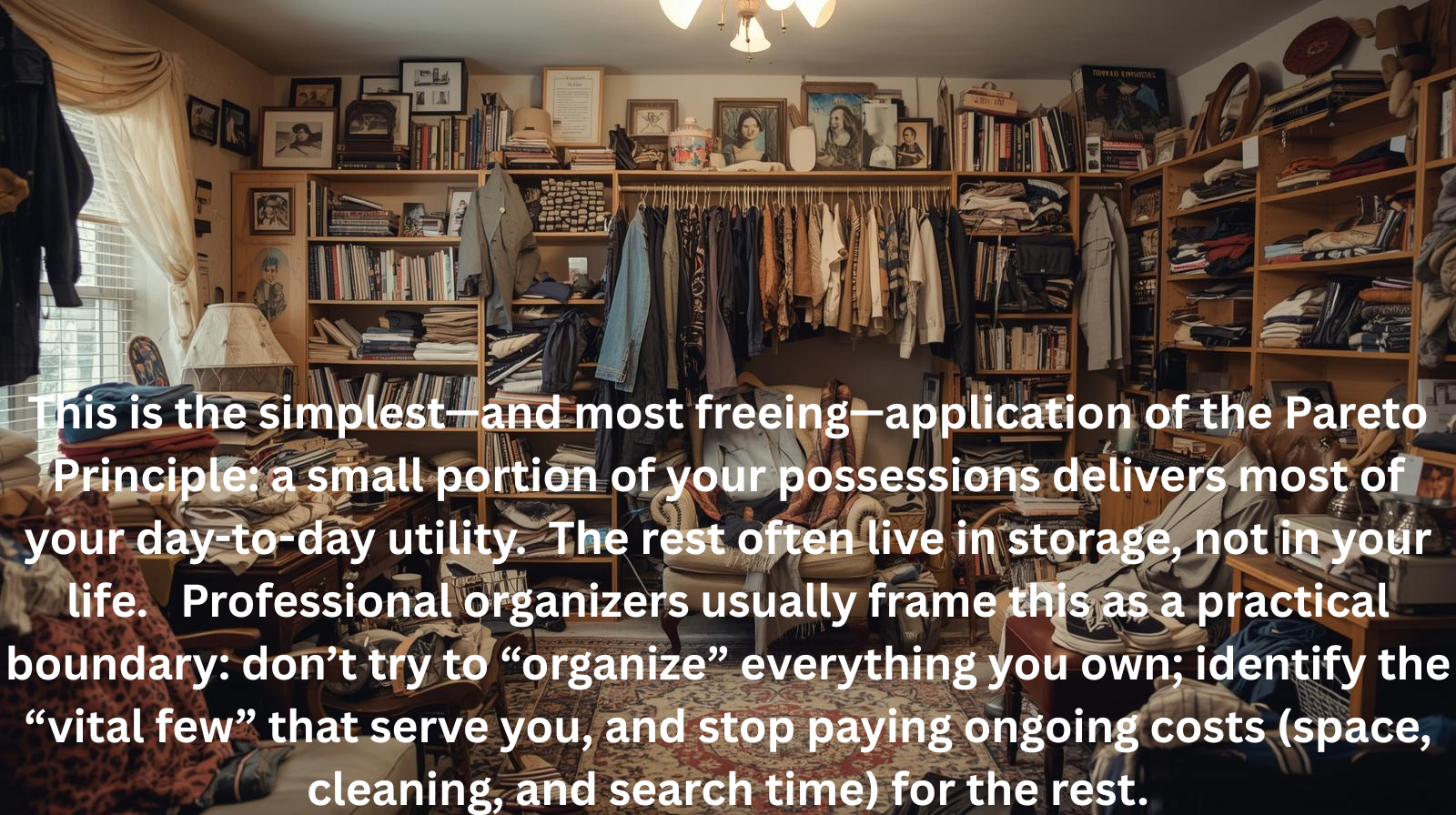
1) We use 20% of our stuff 80% of the time, showing that we can reclaim control by focusing on what truly matters in our daily lives.
This is the simplest—and most freeing—application of the Pareto Principle: a small portion of your possessions delivers most of your day-to-day utility. The rest often live in storage, not in your life. Professional organizers usually frame this as a practical boundary: don’t try to “organize” everything you own; identify the “vital few” that serve you, and stop paying ongoing costs (space, cleaning, and search time) for the rest.
What it means in practice:
- Your “daily drivers” should be the easiest to reach.
- The rarely used items must justify their rent (space and maintenance), or they should be removed.
If we have to dig for it, we don’t truly own it—we store it.
2) We wear 20% of our clothes 80% of the time
The wardrobe version of the 80/20 principle shows up as a habit: people repeatedly reach for a small set of outfits that are comfortable, dependable, and “low-decision.” Many decluttering guides cite this pattern because it reflects real behavior-most closets are stocked for a fantasy life, not the life you actually live, which can lead to unnecessary clutter.
Why does it happen?
- Decision fatigue: too many choices push you toward the easiest known win.
- Reliability bias: you repeat what fits well, feels good, and works for your day.
Takeaway: Build a closet around what you wear. Treat the rest as inventory you’re paying to store.
A packed closet can still be a “nothing to wear” closet—because only a small slice works.
3) We wear 20% of our shoes 80% of the time
Shoes are a perfect example of “visible abundance, invisible usage.” People tend to rotate through a small set that matches their lifestyle and comfort needs—work shoes, daily casual shoes, workout shoes—while the rest are event-specific, impulse buys, or “aspirational.” In other words: a few pairs do the heavy lifting.
Even in sports medicine and footwear guidance, “rotation” is discussed as a purposeful subset you actually use rather than the entire collection—because function, comfort, and context drive what you wear repeatedly.
takeaway:
- Keep your “core rotation” visible and accessible.
- Store special-occasion shoes away from daily zones—or release them if the “occasion” never arrives.
If your shoes aren’t serving your feet—or your life—they’re serving your closet.
4) “20% of our staff have value, while 80% have none.” (Reframe this—without insulting people)
This point is emotionally charged—and it’s worth refining for a magazine audience. The healthy version of this idea is not that most people are “worthless,” but that many workplaces show skewed output: a small portion of contributions can drive a large portion of measurable results. Research on “star performers” suggests that individual performance often follows a power-law distribution, with a few people contributing disproportionately.
But here’s the editorial correction:
- Joseph Juran—who popularized Pareto thinking in quality—preferred “the vital few and the useful many,” specifically to avoid devaluing everyone else.
- Forced “top 20%” ranking systems can backfire, increasing resentment and turnover among high performers who feel arbitrarily underrecognized.
In many organizations, a small share of activities and outcomes carry an outsized share of Impact—so leaders should identify high-leverage roles and remove friction, rather than label people as low value. This approach helps focus efforts on what truly drives results, aligning with the 80/20 principle for better efficiency.
Pareto thinking isn’t permission to dismiss people—it’s a tool to focus leadership where it matters most.
5) 20% of your stuff is desirable, while 80% is ready for the dump
This is the decluttering “truth bomb,” and it lands because most households confuse storage capacity with value. Lifestyle and home publications increasingly recommend an “80/20 organizing” approach: fill only 80% of shelves and drawers, leaving 20% empty so your home can absorb daily life without collapsing into clutter. [
Translation:
- The goal isn’t to cram more in.
- The goal is to create breathing room—physical and mental.
How to apply it safely (without going extreme):
- Identify your essential 20% (the items you use weekly).
- “Quarantine box” the questionable 80%: if you don’t retrieve it in 60–90 days, donate it.
Space isn’t wasted space—it’s what makes a home usable.
6) Why do we live year after year keeping things with no value?
Because “value” isn’t just practical—it’s psychological.
Three forces keep the 80% in place:
· Decision fatigue: Every item requires a micro-decision (keep, toss, relocate). Research shows repeated choosing can deplete self-control and persistence, leading to procrastination and paralysis.
· Stress cues: Clutter can turn a home into a landscape of unfinished tasks. Research linking “stressful home” descriptions (including clutter/unfinished projects) with cortisol patterns suggests the house can become a chronic stress signal rather than a recovery zone.
· Identity and attachment: Some objects aren’t kept for use—they’re kept for the story they represent (“just in case,” “someday,” “I used to be…,” “I might become…”). That’s why decluttering can feel like grief.
Friendly insight:
People don’t keep clutter because they love a mess. They keep it because they don’t have the cognitive or emotional bandwidth to decide—and because the objects have symbolic weight.
Most clutter isn’t stored for today—it’s stored for an imagined future.
7) Why don’t we get rid of the 80% and free ourselves from the enclosure called our cage?
Because we try to do it like a moral project—“I should be better”—instead of a design project—“My environment should require fewer decisions.” The 80/20 rule is liberating when it becomes a system, not a judgment.
A practical, low-drama way out:
- Protect your essential 20% first. Put daily-use items where they’re easiest to reach.
- Create space buffers (20% empty). This prevents re-cluttering and makes tidying doable.
- Reduce visual noise. Visual clutter competes with attention and increases cognitive load; your home should lower friction, not increase it.
The “cage” isn’t your house.
The cage is the constant background pressure of unfinished decisions.
Decluttering is not about having less—it’s about needing less mental energy to live your life.
Summary
- 80/20 is a lens: most results come from a small set of inputs.
- Stuff: a small portion gets the most use; the rest incurs maintenance costs.
- Clothes/shoes: a slight “core rotation” dominates daily wear.
- Work: performance can be skewed, but don’t devalue “the useful many.”
- The trap: decision fatigue + stress cues keep clutter in place.
- The exit: build systems, keep 20% space empty, reduce decisions.