Summary
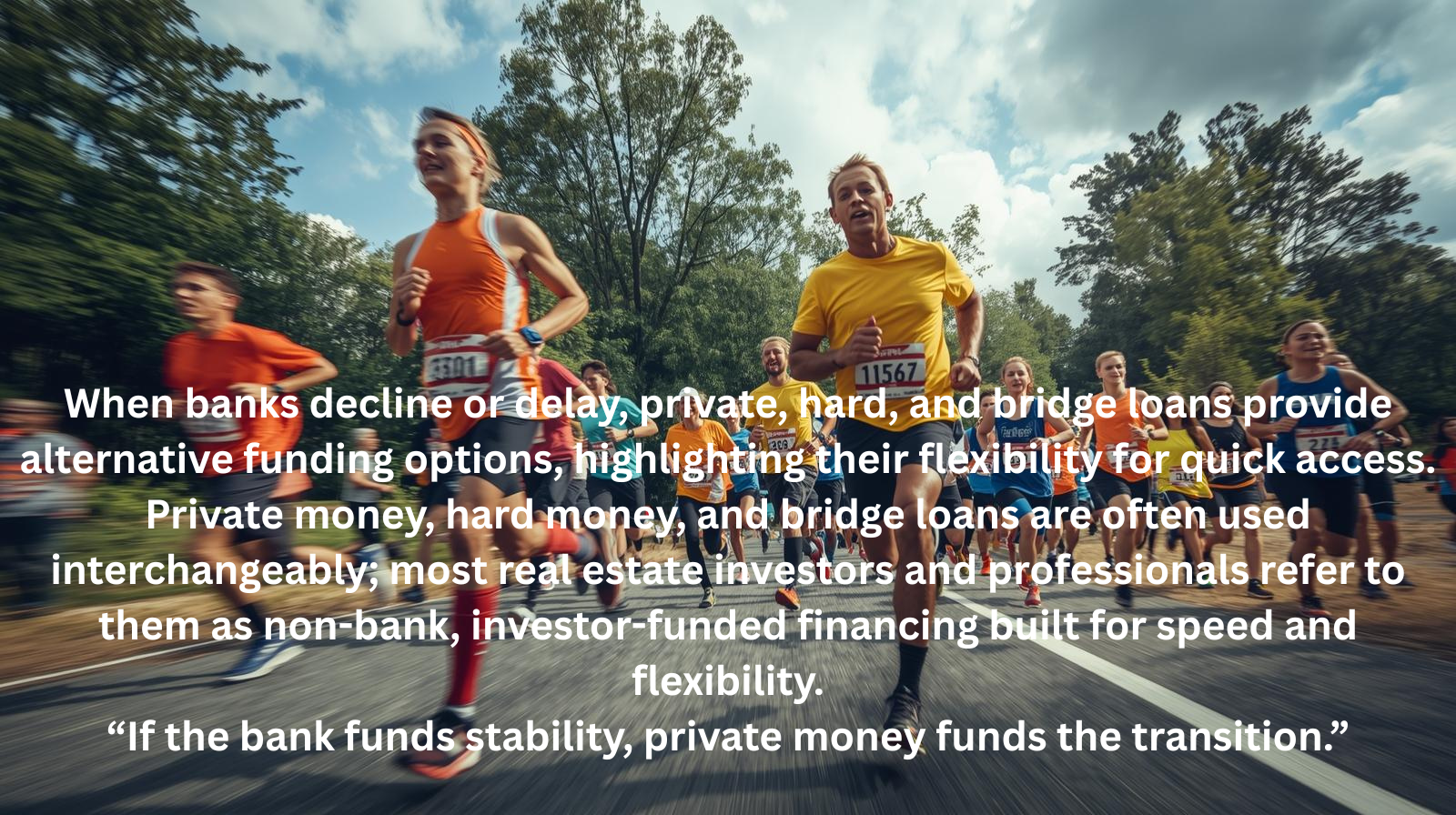
Private money, hard money, and bridge loans are often used interchangeably; most real estate investors and professionals refer to them as non-bank, investor-funded financing built for speed and flexibility.
“If the bank funds stability, private money funds the transition.”
What They Have in Common
All three typically refer to alternative lending outside traditional banks and institutional lenders, funded by:
- One or more private investors, or
- A pool of investor capital managed by a sponsoring entity
If the loan is funded through a pooled vehicle, there’s usually a Sponsor/Manager who runs the fund, sets guidelines, and oversees underwriting and servicing.
“It’s not ‘easy money’—it’s faster money with different rules.”
Definitions
- Private Money: Describes the source of funds (private investors or private capital), not necessarily the loan structure.
- Hard Money: Typically, asset-based lending approval depends more on property collateral and equity than on tax returns. Often short-term and priced higher for speed and risk.
- Bridge Loan: Describes the purpose—short-term financing that “bridges” you to a better outcome, such as sale, refinance, stabilization, repairs, or lease-up, giving you clarity on your next steps.
“Private money is who funds it. The bridge is why you use it.”
Why Borrowers Use These Loans
Private money lending can be a practical option when banks decline or stall—especially when the property or situation is in motion, such as:
- Incomplete construction or renovation
- High vacancy or unstable cash flow
- Time-sensitive closings or payoffs
- A plan to stabilize first, then refinance into cheaper long-term debt
“Banks want ‘finished.’ Private money helps you get there.”
Real-World Examples: When “Private Money / Hard Money / Bridge” Shows Up
“These loans aren’t about being cheap. They’re about being possible—fast.”
Example 1: The “Bank Said No Because It’s Ugly” Rehab Purchase (Hard Money)
Scenario: Investor buys a distressed SFR with broken systems and won’t pass conventional condition guidelines.
Why banks fail: Property condition + appraisal/repair requirements.
How private money wins: The lender underwrites the asset, equity, and rehab plan.
Typical structure:
- Purchase: $350,000
- Rehab budget: $75,000
- As-is value: $360,000
- As-completed (ARV): $500,000
- Loan: 80% of purchase + rehab draws
- Term: 12 months, interest-only
Fact:
“The bank wanted it fixed before lending. Private money lent so I could fix it.”
Example 2: The “Close in 10 Days or Lose the Deal” Competitive Offer (Bridge)
Scenario: Seller demands a quick close; buyer’s conventional lender can’t hit the deadline.
Why banks fail: Underwriting timeline + appraisal scheduling.
How private money wins: Funds fast with simplified approvals, then the Borrower refinances later.
Typical structure:
- Purchase: $1,200,000
- Down payment: 30%
- Bridge loan: 70% LTV
- Close: 7–14 days
- Exit: Refinance into a bank/agency in 60–120 days after seasoning and documentation
Fact:
“A low rate is worthless if it shows up after the seller picks someone else.”
Example 3: Multifamily Value-Add with an Occupancy Dip (Bridge → Refi)
Scenario: 24-unit building at 72% occupancy due to bad management and unit turns.
Why the bank fails: DSCR/NOI doesn’t qualify at the current occupancy; the bank wants stabilized operations.
How private money wins: Lender funds the transition, expecting stabilization.
Typical structure:
- Purchase: $3.8M
- Loan: 65–70% LTV
- Term: 18–24 months
- Rehab/capex: unit turns + roof/HVAC + exterior
- Plan: Increase occupancy to 90%+, raise rents, then refinance into permanent debt
Fact:
“Banks fund stabilized apartments. Private money funds the messy middle.”
Example 4: Retail Strip Center with a Lease Rollover Problem (Bridge)
Scenario: Small strip center where the anchor tenant’s lease expires in 9 months.
Why banks fail: Tenant rollover risk; underwriting hates uncertainty.
How private money wins: Loan bridges lease renewal/lease-up.
Typical structure:
- Property: 15,000 SF neighborhood strip
- Current NOI: depressed due to vacancy/rollover
- Bridge: 12–24 months
- Lender focus: location, replacement tenants, leasing plan, reserves
- Exit: refinance once leases are signed and cash flow stabilizes
Fact:
“When the rent roll is changing, bank underwriting freezes.”
Example 5: Construction Completion After Budget Overruns (Private Money)
Scenario: Borrower is 80% complete but has run out of capital; the contractor won’t finish without funds.
Why banks fail: The project isn’t complete; the bank won’t refinance a partially finished asset.
How private money wins: Funds completion based on as-is + as-completed value.
Typical structure:
- Remaining cost to complete: $220,000
- As-is value: $900,000
- As-completed value: $1,300,000
- Loan: enough to finish + reserves
- Exit: refinance into conventional once completed and permitted
Fact:
“The last 20% of construction is where deals go to die—unless the money can move.”
Example 6: Business Owner with Real Income but “Bad Tax Returns” (Bank-Statement Loan / Private Money)
Scenario: Self-employed Borrower writes off aggressively; tax returns show low net income.
Why banks fail: Conventional underwriting based on tax return income.
How private money wins: Uses 3–6 months’ bank statements to support the ability to pay (or asset-based approval).
Typical structure:
- Loan purpose: refinance + consolidate business debt
- Documentation: bank statements + credit + property equity
- Term: 12–36 months
- Exit: improve credit/documentation and refinance into a bank loan later
Fact:
“The bank underwrote my tax returns. Private money underwrote my deposits.”
Example 7: Consumer Debt Consolidation With Strong Equity (Private Money)
Scenario: Borrower has heavy credit card debt and high monthly obligations, but owns a home with equity.
Why banks fail: DTI too high / credit score too low.
How private money wins: Consolidates debts to reduce monthly burn and buy time to rebuild.
Typical structure:
- Home value: $800,000
- Existing first mortgage: $430,000
- New private 2nd: $120,000
- Goal: lower monthly payments, stop late payments, stabilize credit
- Exit: refinance into a bank second or cash-out once credit improves
Fact:
“Sometimes the win isn’t the rate—it’s breathing room.”
Example 8: Raw Land / Entitlement Funding (Private Money)
Scenario: Borrower owns land but needs money for engineering, plans, studies, and fees to get entitlements.
Why banks fail: Raw land risk + lack of cash flow.
How private money wins: Funds the “pre-development” phase using land equity.
Typical structure:
- Land value: $1.5M
- Loan: 40–55% LTV
- Use of funds: environmental, engineering, architecture, applications, carrying costs
- Exit: payoff with construction loan or sale to developer once entitled
Fact:
“Banks don’t love dirt. Private money funds the path to a buildable deal.”
Example 9: Inherited Property—Need Cash Before Sale or Rental (Private Money)
Scenario: The estate needs funds to pay legal costs, repair the property, and distribute proceeds to heirs.
Why banks fail: Title/ownership transition and timing; income/doc complexities.
How private money wins: Short-term loan secured by property equity until sale or refinance.
Typical structure:
- Loan purpose: repairs + distributions + carrying costs
- Term: 6–12 months
- Exit: sale on open market or rental refinance
Fact:
“Estates don’t run on bank timelines. They run on court deadlines.”
“What Do We Call This?” (Quick Language Map)
- Private Money = who funds it (private investors / pooled capital)
- Hard Money = how it’s underwritten (asset/equity driven)
- Bridge Loan = why it’s used (short-term path to refinance/sale/stabilization)
“Private money is the source. Hard money is the style. Bridge is the mission.”
“These loans can save deals. They can also punish wishful thinking.”
“If you can’t explain your exit in one sentence, you’re not ready for bridge debt.”
Private Money vs. Hard Money vs. Bridge Loans (Same Bucket, Different Labels)
When a bank says “no” or “not yet,” these are the loans that still get deals funded.
Private money, hard money, and bridge loans are often used interchangeably—because in the real world, they all mean non-bank capital designed for speed and flexibility.
QUOTE: “If the bank funds stability, private money funds the transition.”
Definitions
- Private Money = who funds it (private investors or pooled capital)
- Hard Money = how it’s underwritten (asset/equity driven)
- Bridge Loan = why it’s used (short-term path to refinance, sale, or stabilization)
QUOTE: “Private money is the source. Hard money is the style. Bridge is the mission.”
✅ The One-Line Test
If the Borrower says, “I need speed.” → Bridge / Private money
If the Borrower says: “The property is rough.” → Hard money (asset-based)
If the Borrower says: “Bank said no.” → Private money (alternative capital)
Real-World Examples (What These Loans Actually Solve)
QUOTE: “These loans aren’t about being cheap. They’re about being possible—fast.”
Example 1: The “Bank Said No Because It’s Ugly” Rehab Purchase (Hard Money)
Scenario: Investor buys a distressed SFR with broken systems; the property won’t pass conventional condition rules.
Why banks fail: Condition + appraisal/repair requirements.
Why private wins: Underwrites asset + equity + rehab plan, not perfection.
Typical structure:
- Purchase: $350,000
- Rehab: $75,000 (draws)
- ARV: $500,000
- Term: 12 months, interest-only
QUOTE: “The bank wanted it fixed before lending. Private money lent so I could fix it.”
🔥 What to Watch (Rehab Loans)
- Draw schedule (how fast you get reimbursed)
- Holdbacks (how much the lender keeps until work is verified)
- Timeline risk (permits + contractor delays = extension fees)
Example 2: “Close in 10 Days or Lose the Deal” (Bridge)
Scenario: Seller demands a quick close; conventional lender can’t hit the deadline.
Why banks fail: Underwriting + appraisal timing.
Why private wins: Funds fast, then Borrower refinances later.
Typical structure:
- Purchase: $1,200,000
- Bridge loan: ~70% LTV
- Close: 7–14 days
- Exit: refinance in 60–120 days
QUOTE: “A low rate is worthless if it shows up after the seller picks someone else.”
✅ When Speed Creates Money
- Faster close can win price reductions
- A stronger offer can reduce seller credits or contingencies
- Certainty can beat higher offers with weak execution
Example 3: Multifamily Value-Add With an Occupancy Dip (Bridge → Refi)
Scenario: 24-unit at 72% occupancy due to mismanagement and unit turns.
Why the bank fails: DSCR/NOI doesn’t qualify at the current occupancy.
Why private wins: Funds the messy middle while you stabilize.
Typical structure:
- Purchase: $3.8M
- Loan: 65–70% LTV
- Term: 18–24 months
- Plan: renovate units → raise occupancy → raise NOI → refinance
QUOTE: “Banks fund stabilized apartments. Private money funds the messy middle.”
🧱 The Multifamily “Reality Checklist.”
- Occupancy dips before it improves during unit turns
- Insurance + taxes move (NOI is not static)
- T‑12 is History; value-add is execution
Example 4: Retail Strip Center With Lease Rollover Risk (Bridge)
Scenario: Anchor lease expires soon; rollover could trigger vacancy and NOI disruption.
Why banks fail: Uncertainty around income.
Why private wins: Bridges you through lease renewal/lease-up.
Typical structure:
- Bridge: 12–24 months
- Lender focus: tenant plan + reserves + location fundamentals
- Exit: refinance once leases are signed and cash flow stabilizes
QUOTE: “When the rent roll is changing, bank underwriting freezes.”
✅ Leasing Risk = Timeline Risk
Bridge debt works best when your leasing plan is specific:
target tenants • broker engagement • TI/LC budget • realistic lease-up timeframe
Example 5: Construction Completion After Budget Overruns (Private Money)
Scenario: Project is 80% complete; Borrower has run out of capital.
Why banks fail: Lender won’t refinance a partially completed asset.
Why private wins: Funds completion using as-is + as-completed value logic.
Typical structure:
- Remaining cost to complete: $220,000
- As-is value: $900,000
- As-completed value: $1,300,000
- Exit: refinance once completed and permitted
QUOTE: “The last 20% of construction is where deals go to die—unless the money can move.”
Example 6: Self-Employed Borrower With Real Deposits, Ugly Tax Returns (Bank-Statement / Private Money)
Scenario: Strong deposits, but tax returns show low net income due to write-offs.
Why banks fail: Conventional underwriting based on tax return income.
Why private wins: Follows bank statements + equity.
Typical structure:
- Docs: 3–6 months bank statements
- Term: 12–36 months
- Exit: refinance into bank terms after credit/docs improve
QUOTE: “The bank underwrote my tax returns. Private money underwrote my deposits.”
Example 7: Debt Consolidation With Strong Equity (Private Money)
Scenario: High monthly obligations; Borrower has equity, but credit/DTI is strained.
Why banks fail: DTI/score tightening.
Why private wins: Creates breathing room and a path back to conventional.
Typical structure:
- Home value: $800,000
- First: $430,000
- New private second: $120,000
- Goal: reduce monthly burn, stop late payments, stabilize credit
QUOTE: “Sometimes the win isn’t the rate—it’s breathing room.”
Example 8: Raw Land / Entitlement Funding (Private Money)
Scenario: Borrower needs funds for engineering, reports, and fees to secure land entitlement.
Why banks fail: Raw land risk + no income.
Why private wins: Funds the “before” stage using land equity.
Typical structure:
- Loan: 40–55% LTV
- Use: studies, plans, fees, carrying costs
- Exit: construction loan or sale after entitlements
QUOTE: “Banks don’t love dirt. Private money funds the path to a buildable deal.”
⭐ 5 Facts
- “The cheapest loan is the one that funds.”
- “A soft yes is a slow no.”
- “Speed is leverage.”
- “Close first. Optimize later.”
- “Bridge debt is a tool—not a lifestyle.”
Warning
Private money is powerful, but it’s not forgiving. If you take short-term financing without a clear exit, the “bridge” can turn into a squeeze—fast.
QUOTE: “Private money won’t hurt you. A bad exit plan will.”
⚠️ Don’t Take Private Money Unless You Can Answer These
- What’s my exit? (refi, sale, stabilization timeline)
- What could delay it? (permits, lease-up, insurance, DSCR/NOI, appraisal)
- What’s Plan B if the timeline slips? (extensions, reserves, collateral)
…an