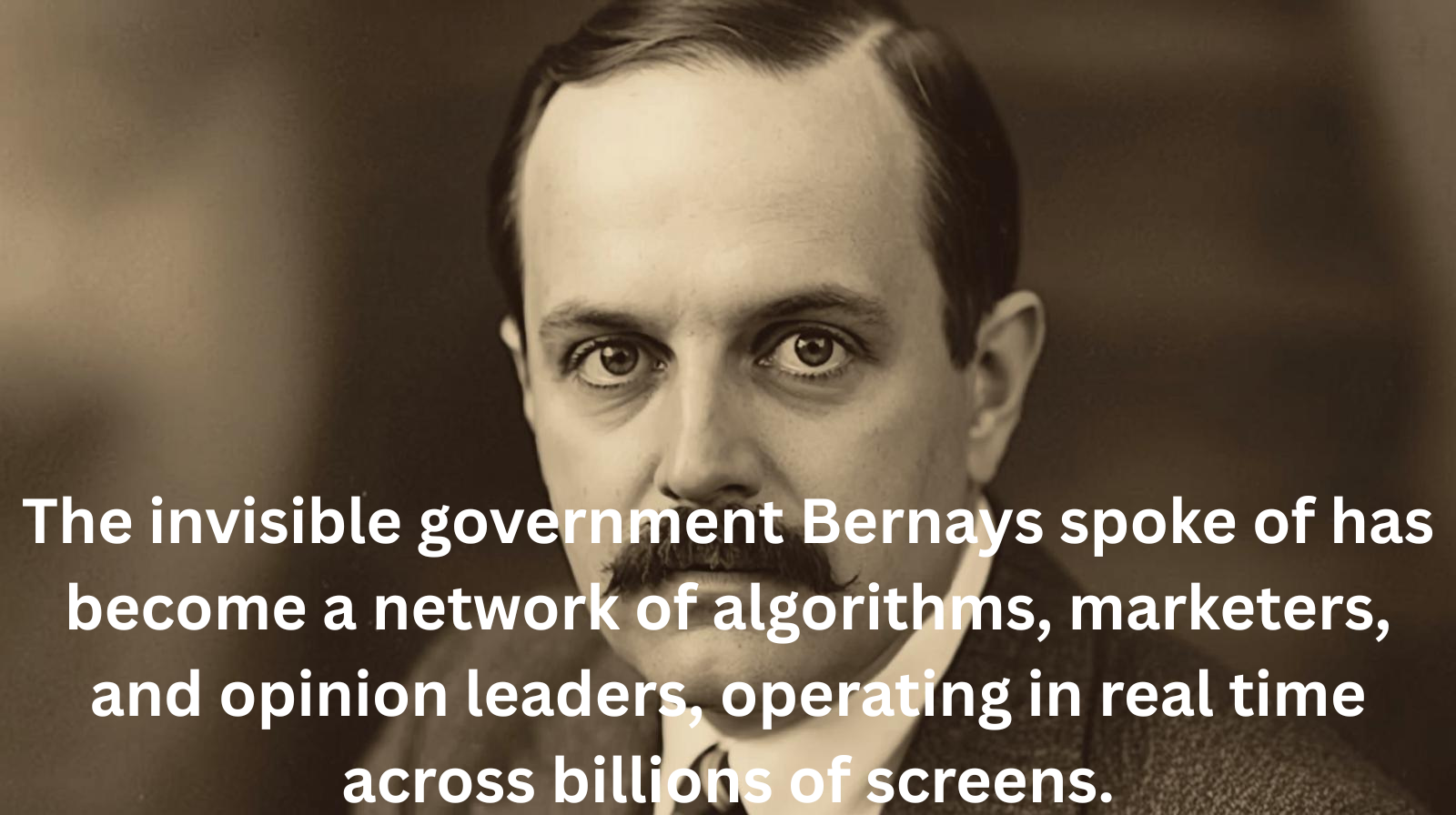
Quote from Edward Bernays, 1928
“The conscious and intelligent manipulation of the organized habits and opinions of the masses is an important element in a democratic society. Those who manipulate this unseen mechanism of society constitute an invisible government which is the true ruling power of our country. …We are governed, our minds are molded, our tastes formed, our ideas suggested, largely by men we have never heard of. This is a logical consequence of the way our democratic society is organized. A vast number of human beings must cooperate in this manner if they are to live together as a smoothly functioning society. …In almost every act of our daily lives, whether in the sphere of politics or business, in our social conduct or our ethical thinking, we are dominated by the relatively small number of persons…who understand the mental processes and social patterns of the masses. It is they who pull the wires which control the public mind.”
Today, we live in a reservoir of continuous Propaganda, false illusions, media manipulations, and false flags designed to control our every movement. Most of us recognize this fact, but in 1928, it was innovative.
Core Idea of Bernays’ Quote
Bernays emphasizes that, in a modern democratic society, public opinion is not entirely spontaneous; it is shaped by a small group of individuals who understand psychology and social behavior. Recognizing this influence can help the audience see their own role in a larger social process and feel more connected to the topic.
Key Points
- Manipulation as a Necessity: Bernays believed that organizing public opinion was essential for a functioning democracy because society is too complex for everyone to make fully informed decisions. This can inspire the audience to think critically about the role of influence in their own lives.
- Invisible Government: A small elite—advertisers, PR professionals, media executives—guides public thought behind the scenes.
- Mechanisms of Control: This influence occurs through media, advertising, and cultural norms, shaping tastes, ideas, and behaviors.
- Ethical debate: Bernays viewed this influence as logical and beneficial, but critics argue it can undermine democratic choice and accountability. This ongoing discussion encourages the audience to consider their own ethical stance and responsibility in media influence.
Historical Impact
- Bernays is widely regarded as the father of public relations.
- His ideas influenced advertising, political campaigns, and corporate branding throughout the 20th century.
- The book Propaganda (1928) remains cited in discussions of media influence, consumer psychology, and political communication.
Summary of Edward Bernays’ Propaganda (1928)
Core Premise
Bernays argues that organized efforts shape public opinion in a democratic society, and that this manipulation—what he calls Propaganda—is both inevitable and necessary for social order.
Key Themes & Chapters
1. The Invisible Government
- Society is too complex for individuals to make fully informed decisions on every issue.
- A small group of people—business leaders, politicians, media professionals—act as “invisible governors” who influence public opinion.
- This is not inherently sinister; Bernays sees it as a practical necessity for democracy.
2. The Engineering of Consent
- Propaganda is the conscious and intelligent manipulation of public opinion.
- Those who understand psychology and social behavior can guide the masses toward desired actions.
- Bernays frames this as a science that combines sociology, psychology, and communication.
3. Business and Public Relations
- Corporations must shape public perception to succeed.
- Public relations is not just advertising—it’s about creating favorable attitudes toward products, industries, and even ideas.
- Example: Linking bacon and eggs to the concept of a “hearty American breakfast.”
4. Propaganda in Politics
- Political campaigns rely on emotional appeals, symbols, and media influence.
- Leaders must “manufacture consent” to gain support for policies.
- Bernays acknowledges ethical concerns but argues that they are unavoidable in mass democracy.
5. Propaganda in Social Life
- Fashion, art, education, and even personal habits are influenced by organized persuasion.
- Cultural trends often originate from deliberate campaigns by designers, educators, and opinion leaders.
6. Ethical Considerations
- Bernays insists Propaganda can be used for good or ill.
- It is the responsibility of practitioners to use it ethically.
- He warns that demagogues or special interests can abuse Propaganda.
Modern Relevance
- Bernays’ ideas laid the foundation for public relations, advertising, and political communication.
- His concept of “engineering consent” is echoed in today’s social media algorithms, influencer marketing, and political spin.
Edward Bernays defines Propaganda as:
“The conscious and intelligent manipulation of the organized habits and opinions of the masses.”
In his view, Propaganda is a systematic effort to influence public opinion and behavior through psychological, communication, and social science methods. Recognizing this can empower the audience to evaluate influence tactics in their daily lives critically.
Key Elements of His Definition
- Conscious and Intelligent: It’s deliberate and strategic, not accidental.
- Manipulation: Involves shaping perceptions and attitudes.
- Organized Habits and Opinions: Targets collective patterns, rather than individuals.
- Purpose: To align public behavior with desired outcomes—whether in politics, business, or social life.
Bernays’ ideas from Propaganda are deeply embedded in modern communication strategies—often under different names, such as public relations, marketing, and influence management—raising questions about transparency and the need for critical media literacy.
Here’s how his view is used today:
1. Public Relations & Corporate Branding
- Companies use strategic storytelling and image management to shape public perception.
- Example: Tech firms framing themselves as “innovators improving lives” rather than just selling products.
2. Political Campaigns
- Political consultants apply Bernays’ principles to manufacture consent through emotional appeals, symbolism, and media framing.
- Example: Slogans such as “Hope” or “Make America Great Again” distill complex ideas into persuasive narratives.
3. Advertising & Consumer Psychology
- Brands leverage behavioral science to influence buying habits—connecting products to identity, status, or lifestyle.
- Example: Luxury brands associating products with success and exclusivity.
4. Social Media Algorithms
- Platforms amplify content that triggers emotional engagement, shaping opinions at scale.
- Influencers serve as modern “opinion leaders,” shaping trends and consumer choices—precisely what Bernays predicted.
5. Crisis Management
- Organizations use controlled messaging to protect their reputation during scandals, steering public opinion through selective disclosure and framing.
6. Government & Policy Messaging
- Public health campaigns (e.g., anti-smoking, vaccination drives) use Bernays-style persuasion—appealing to authority, social norms, and emotional triggers.
Conclusion: From Propaganda to Algorithmic Persuasion
Edward Bernays’ vision of Propaganda as the “conscious and intelligent manipulation of the organized habits and opinions of the masses” was revolutionary in 1928. Nearly a century later, his ideas have not only endured—they have evolved into something far more sophisticated and pervasive. What Bernays described as a necessary mechanism for organizing a democratic society now operates at a scale and speed he could scarcely imagine.
Today, the engineering of consent is powered by data analytics, behavioral science, and algorithmic targeting. Social media platforms amplify emotional content, influence and shape cultural norms, and brands craft narratives that blur the line between information and persuasion. Political campaigns deploy micro-targeted ads to sway voters, while corporations use neuromarketing to trigger subconscious desires. The invisible government Bernays spoke of has become a network of algorithms, marketers, and opinion leaders, operating in real time across billions of screens.
This evolution raises profound ethical questions. Bernays believed Propaganda could serve the public good if used responsibly. But in an era of deepfakes, disinformation, and algorithmic bias, the stakes are higher than ever. The challenge is not whether persuasion exists always, but whether transparency, accountability, and informed choice can survive in a world where influence is omnipresent and often invisible.
Understanding Bernays’ principles is no longer academic—it is essential. For leaders, policymakers, and citizens alike, recognizing the mechanics of modern Propaganda is the first step toward reclaiming autonomy in a society where consent is engineered, and perception is power.