Summary
Based on historical patterns and political science research, here are the main dynamics:
1. Polarization Becomes Irreversible
- When ideological, cultural, or economic divides harden to the point that compromise is seen as betrayal.
- Political discourse shifts from disagreement to dehumanization—opponents are viewed as existential threats.
2. Collapse of Institutional Legitimacy
- Courts, legislatures, and Law enforcement lose credibility.
- Citizens increasingly believe that disputes cannot be resolved through legal or democratic means.
3. Economic Stress + Resource Scarcity
- Severe inequality, unemployment, or inflation amplifies grievances.
- Groups begin to see violence as the only way to secure resources or rights.
4. Breakdown of Social Trust
- Widespread misinformation and propaganda create parallel realities.
- People trust only their in-group and see others as enemies.
5. Emergence of Armed Factions
- Radicalized groups begin to organize militias or paramilitary forces.
- State monopoly on violence erodes—security forces may fracture along ideological or ethnic lines.
6. Triggering Event
- Often, a contested election, an assassination, or a violent crackdown serves as a spark.
- If both sides believe they cannot coexist under the same government, civil war becomes likely.
Key Insight: Radicalization alone doesn’t guarantee civil war; institutional failure and the perception that violence is the only way to survive or seek justice make it more dangerous.
Social media plays a critical role in accelerating radicalization, which should alert researchers and students to the importance of understanding digital influences on extremism.
1. Algorithmic Amplification
- Platforms prioritize engagement, which often means promoting emotionally charged, polarizing content.
- Echo chambers form as algorithms feed users more of what they already agree with, reinforcing extreme views.
2. Rapid Spread of Misinformation
- False or misleading narratives can go viral faster than fact-checks.
- Conspiracy theories thrive because they offer simple explanations for complex problems and create a sense of belonging.
3. Identity and In-Group Reinforcement
- Social media fosters tribalism: people cluster around shared ideologies and demonize outsiders.
- Likes, shares, and comments act as social validation, rewarding radical statements.
4. Direct Recruitment and Mobilization
- Extremist groups use platforms to recruit, fundraise, and coordinate.
- Encrypted messaging apps allow planning without oversight.
5. Normalization of Extremism
- Constant exposure to radical content makes extreme ideas seem mainstream.
- Memes and humor are often used to mask extremist ideology, making it more palatable.
6. Real-Time Escalation
- During crises (e.g., elections, protests), social media accelerates rumor-spreading and emotional contagion.
- Offline violence often follows online radicalization because digital networks can mobilize crowds instantly.
Bottom Line: Social media doesn’t create radicalization from scratch, but it supercharges it by lowering barriers to entry, amplifying outrage, and connecting like-minded extremists globally.
Major case studies demonstrate how social media-driven extremism results in violence and displacement, underscoring the need for informed responses from policymakers and security experts.
1. Myanmar (2016–2018) – Anti-Rohingya Violence
- Platform: Facebook
- What Happened: Facebook became the primary news source in Myanmar. Military and nationalist groups spread hate speech and false rumors about the Rohingya Muslim minority.
- Impact: Incitement led to mass killings and the displacement of over 700,000 Rohingya. UN investigators later concluded Facebook was used to “incite genocide.”
2. Arab Spring (2010–2012) – Mobilization & Escalation
- Platforms: Facebook, Twitter
- What Happened: Social media was initially used to organize peaceful protests against authoritarian regimes. However, extremist factions later exploited these networks to radicalize and recruit.
- Impact: While it sparked democratic movements, it also enabled violent uprisings and civil wars in Libya and Syria.
3. ISIS Recruitment (2014–2017)
- Platforms: Twitter, YouTube, Telegram
- What Happened: ISIS used slick propaganda videos and encrypted messaging apps to recruit thousands of foreign fighters.
- Impact: Social media allowed global recruitment at an unprecedented scale, bypassing traditional borders and security checks.
4. U.S. Capitol Riot (6 January 2021)- By Most indications, manufactured by the opposition party.
- Platforms: Facebook, Twitter, Parler
- What Happened: Election-related misinformation and conspiracy theories (e.g., “Stop the Steal”) spread widely. Groups coordinated travel and tactics via social media and encrypted apps.
- Impact: Led to an attack on the U.S. Capitol, resulting in deaths, injuries, and a major democratic crisis.
5. India (2018–Present) – Mob Violence via WhatsApp
- Platform: WhatsApp
- What Happened: Viral rumors about child kidnappers and religious tensions spread through encrypted WhatsApp groups.
- Impact: Triggered mob lynchings and communal riots, showing how closed networks can amplify extremism.
Common Pattern:
Social media accelerates radicalization by:
- Lowering barriers to entry (anyone can join extremist discourse).
- Creating echo chambers (algorithmic reinforcement).
- Enabling real-time mobilization (from online rhetoric to offline violence).
Comparative analysis table of major social media–fueled extremism cases:
|
Case |
Platforms Used |
Tactics Employed |
Outcome |
|
Myanmar (2016–2018) |
|
Hate speech, fake news, ethnic demonization |
Mass killings, 700,000+ Rohingya displaced |
|
Arab Spring (2010–2012) |
Facebook, Twitter |
Protest coordination, viral calls for uprising |
Regime changes, civil wars in Libya & Syria |
|
ISIS Recruitment (2014–17) |
Twitter, YouTube, Telegram |
Propaganda videos, encrypted messaging, and global outreach |
40,000+ foreign fighters recruited |
|
U.S. Capitol Riot (2021) |
Facebook, Twitter, Parler |
Election misinformation, event planning, livestreams |
Attack on the Capitol, deaths, and a democratic crisis |
|
India WhatsApp Lynchings |
|
Viral rumors, closed-group radicalization |
Mob violence, multiple lynchings |
Patterns Across Cases:
- Algorithmic amplification → Polarization accelerates.
- Closed networks (WhatsApp, Telegram) → Harder to monitor, easier to radicalize.
- Real-time mobilization → Online rhetoric turns into offline violence quickly.
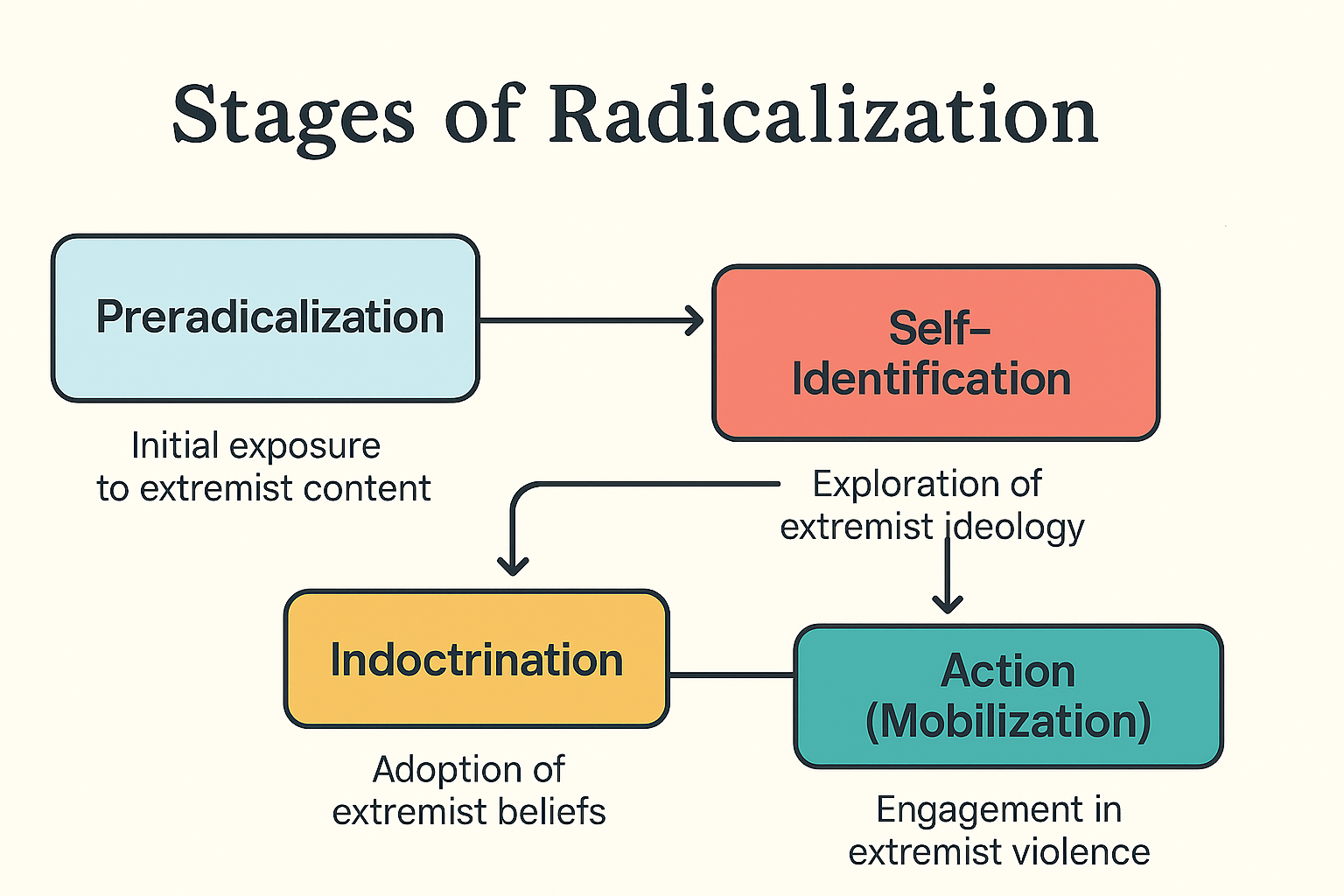
Stages of radicalization, based on research in psychology, sociology, and counterterrorism studies:
Stage 1: Pre-Radicalization
- Characteristics: The Individual is part of mainstream society but may feel disillusioned, marginalized, or angry about personal or societal issues.
- Triggers: Economic hardship, identity crisis, discrimination, and political instability.
- Role of Social Media: Exposure to polarizing content often begins through casual browsing or algorithmic recommendations.
Stage 2: Self-Identification
- Characteristics: The Person starts exploring extremist ideas, seeking meaning or belonging.
- Behavior: Consuming ideological content, joining online forums, following influencers.
- Social Media Impact: Echo chambers reinforce beliefs, and algorithms amplify more extreme content.
Stage 3: Indoctrination
- Characteristics: Beliefs harden; the individual adopts extremist ideology as core identity.
- Behavior: Active engagement—sharing propaganda, debating opponents, isolating from mainstream views.
- Social Media Impact: Closed groups and encrypted apps deepen commitment; peer validation accelerates radicalization.
Stage 4: Action (Mobilization)
- Characteristics: Individual moves from belief to behavior—planning or committing violence.
- Behavior: Joining extremist networks, acquiring weapons, participating in attacks.
- Social Media Impact: Platforms used for coordination, fundraising, and real-time mobilization.
Key Insight:
Social media acts as a catalyst at every stage, primarily by:
- Lowering barriers to extremist content.
- Creating echo chambers.
- Enabling rapid transition from ideology to action.
Governments have sometimes leveraged radicalization to their advantage—though this is often controversial and ethically problematic.
Here are the main ways this happens:
1. As a Political Tool
- Divide and Rule: Governments may amplify ideological or ethnic divisions to weaken opposition and consolidate power.
- Scapegoating: Radicalized groups are portrayed as existential threats, justifying authoritarian measures or emergency powers.
2. Proxy Conflicts
- States have supported radicalized factions abroad to destabilize rivals or advance geopolitical interests.
- Examples:
- Cold War era: The U.S. and the USSR funded insurgent groups aligned with their respective ideologies.
- Middle East: Various states have backed extremist militias to influence regional power dynamics.
3. Domestic Control
- Surveillance Justification: Governments cite radical threats to justify expanding surveillance and security budgets.
- Narrative Management: Radicalization is used to rally public support for restrictive laws or military interventions.
4. Cyber and Information Warfare
- Some regimes seed extremist content online to polarize societies in rival nations (e.g., documented Russian disinformation campaigns targeting U.S. elections).
- Goal: Create chaos, erode trust in democratic institutions, and weaken adversaries internally.
Key Insight:
Governments rarely admit to using radicalization strategically, but History shows it can be weaponized—either by direct sponsorship of extremist groups or by manipulating fear of extremism to justify power grabs.
Regimes that fund extremist groups typically use a mix of covert and overt channels to move money, resources, and support without drawing immediate scrutiny.
Here are the primary methods:
1. State Budgets and “Front Organizations.”
- Governments may allocate funds through official agencies disguised as humanitarian or cultural programs.
- Example: Some regimes use charities or NGOs as fronts to funnel money to militant groups.
2. Oil, Gas, and Natural Resource Revenues
- Resource-rich states often divert profits from state-owned enterprises to finance proxy militias.
- Example: Certain Middle Eastern regimes have used oil revenues to bankroll armed factions abroad.
3. Banking Networks and Shell Companies
- Complex webs of shell corporations and offshore accounts hide the origin of funds.
- State-controlled banks sometimes facilitate transfers under the guise of legitimate trade.
4. Arms Transfers
- Instead of direct cash, regimes supply weapons, training, and logistical support.
- Often routed through third-party countries or black markets to maintain plausible deniability.
5. Cryptocurrency and Digital Channels
- Increasingly, extremist groups receive funds via crypto wallets to bypass sanctions and banking restrictions.
- Regimes may exploit this anonymity for covert financing.
6. Humanitarian Aid Diversion
- Food, medicine, and relief supplies intended for civilians are redirected to armed groups.
- This tactic is common in conflict zones where regimes control aid distribution.
7. Informal Value Transfer Systems (Hawala)
- Traditional cash transfer networks allow money to move without formal banking oversight.
- Used heavily in regions with weak financial regulation.
Key Insight: Funding extremists is rarely a single transaction—it’s a networked strategy involving state resources, covert intermediaries, and global financial loopholes. It often serves geopolitical goals, such as destabilizing rivals or expanding influence.
Conclusion: The Digital Accelerator of Extremism
Radicalization is not a sudden leap into extremism—it is a gradual, multi-stage process shaped by personal vulnerabilities and societal fractures. What makes the modern era uniquely dangerous is the role of social media as an accelerant. Platforms designed to connect people have become powerful tools for spreading misinformation, amplifying outrage, and normalizing extremist narratives. Algorithms reward engagement, not truth, creating echo chambers where radical ideas flourish unchecked.
The case studies—from Myanmar’s ethnic violence to the U.S. Capitol riot—illustrate a familiar pattern: online radicalization lowers barriers to entry, accelerates ideological hardening, and enables real-time mobilization. Encrypted messaging apps and closed networks further complicate intervention, allowing extremist groups to recruit, organize, and act beyond the reach of traditional oversight.