When you inspect a property that shares a driveway, parking, or allows vehicles and pedestrians to flow freely between contiguous parcels, treat it as a bright, flashing due diligence signal. The “it’s always been that way” handshake between neighbors is not a risk-control system—a recorded, attorney-drafted agreement is. Reciprocal access and reciprocal parking agreements (often documented in a Reciprocal Easement Agreement, or REA) define who can use what, when, and under what conditions—and they address mundane but critical issues such as maintenance, repairs, restrictions, and enforcement. Without them, today’s convenience becomes tomorrow’s litigation.
This is also one of the easiest ways to demonstrate technical credibility with a Borrower or client: a single, well-timed question about reciprocal access/parking can surface title and operational landmines and signal that you understand “property plumbing,” not just price.
Why reciprocal agreements matter (and why “informal” is expensive)
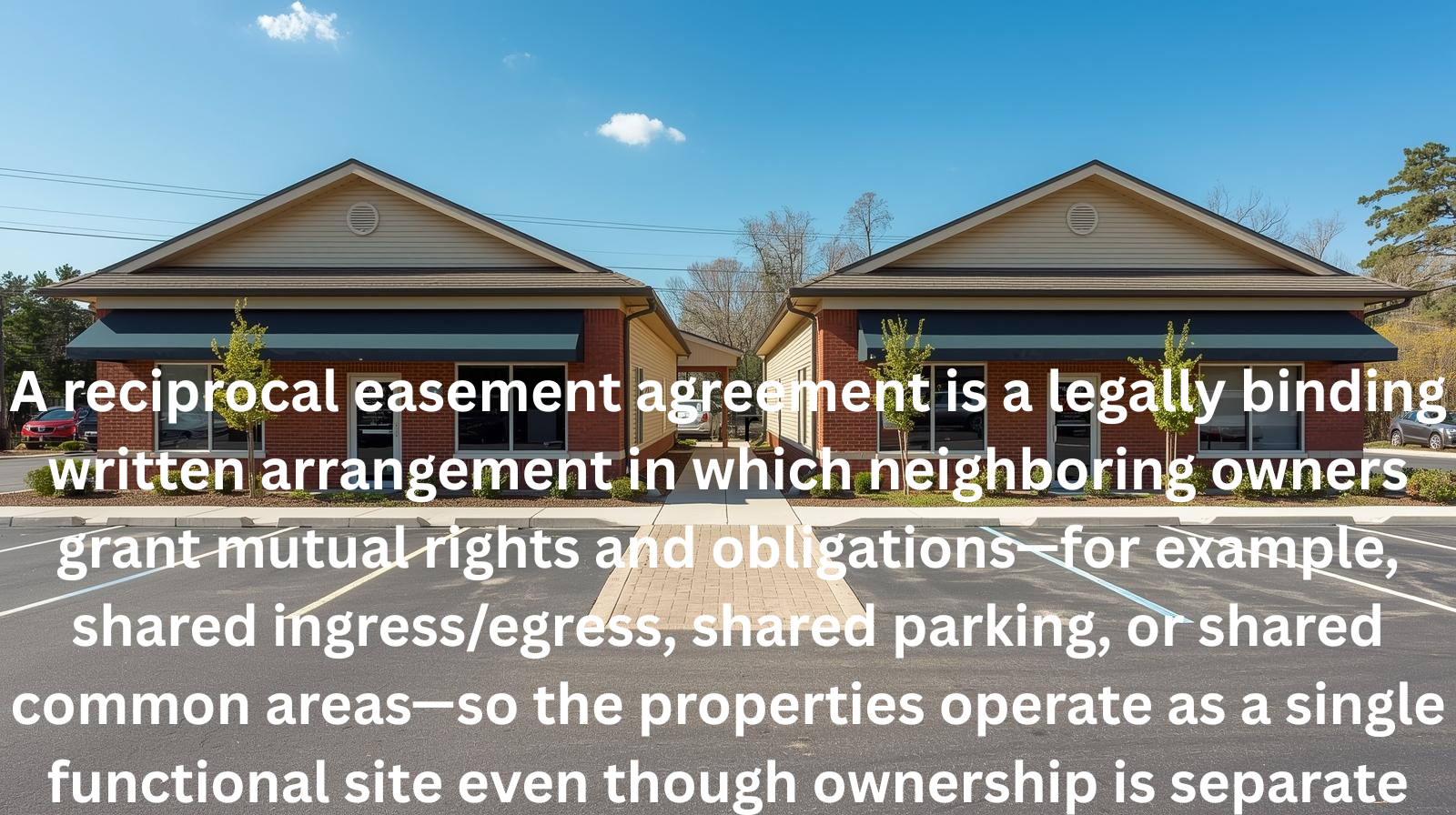
A reciprocal easement agreement is a legally binding written arrangement in which neighboring owners grant mutual rights and obligations—for example, shared ingress/egress, shared parking, or shared common areas—so the properties operate as a single functional site even though ownership is separate. The key features are mutuality and enforceability: each party grants a benefit and accepts a burden.
These agreements are standard in shopping centers, office complexes, mixed-use campuses, and anywhere parcels are adjacent yet operationally integrated (e.g., shared parking lots, shared entrance drives, cross-access between parcels).
Confirming the recording status of agreements helps inspectors and lenders feel capable and in control, ensuring access rights are legally binding and reducing uncertainty about future disputes.
The classic failure mode: “shared use” with no recorded paper
You’ll see this constantly:
- A shared driveway that straddles a property line.
- A cross-connection between parking lots where customers/tenants routinely drive from Parcel A to Parcel B.
- An informal understanding that “Tenant overflow parks next door on weekends.”
- A property that depends on neighbor land for turning radii, truck access, or fire lane circulation.
If there is no recorded agreement, the legal right may be unclear, and informal understandings-such as a “screenshot agreement” or a scribbled memo-are often unenforceable, increasing legal risk. Explicitly highlighting that informal arrangements lack enforceability helps inspectors recognize potential disputes and underscores the importance of documented, recorded agreements for risk mitigation.
Having a written, recorded, and professionally drafted agreement for access or parking provides reassurance to inspectors and lenders, reinforcing confidence in thorough risk assessment and in the stability of property value.
What a good agreement typically covers (the “must-have” clauses)
A well-constructed REA or reciprocal access/parking agreement usually addresses:
1) Ingress/Egress scope
Defines where and how vehicles/pedestrians may cross, including drive aisles, curb cuts, internal roadways, turning movements, loading areas, and any hours-of-use limitations.
Specifies who can park where; sometimes it allocates a minimum number of spaces to each parcel, sets rules for reserved/employee/customer parking, and addresses “parking-intensive” uses.
3) Maintenance and repair
Assigns responsibility and cost-sharing for pavement, striping, lighting, drainage, signage, and snow/ice (where applicable). Maintenance allocation is one of the most common triggers for neighbor disputes when left undefined.
4) Restrictions and controls
In commercial centers, REAs often regulate signage, permitted uses, operating hours, and design standards to ensure the overall project remains functional and protects anchor tenants.
5) Insurance and indemnity
Defines each party’s insurance requirements and mutual indemnities—especially important where customer traffic flows across parcels.
6) Enforcement and remedies
Good REAs include enforcement mechanisms (notice/cure, default remedies, and, in some cases, attorneys’ fees).
How this ties to underwriting, title, and surveys (and why your question is “pro-level”)
Title and lending risk
In many lending contexts, an acceptable title condition includes mutual easement agreements for joint driveways or similar shared arrangements—as long as future owners have “unlimited and unrestricted use” and the impediment does not materially affect marketability. That’s why lenders and secondary-market rules pay attention to easements and survey exceptions.
Survey and “what you can see on the ground.”
Title insurers and lenders often rely on an ALTA/NSPS Land Title Survey to identify boundary matters, easements, rights-of-way, and encroachments—precisely the issues that arise with shared driveways and parking—understanding how reciprocal agreements influence survey results and title exceptions helps inspectors evaluate legal risks and supports a thorough risk assessment.
Title policy exceptions are where problems hide.
Standard title policies often exclude certain matters, such as unrecorded easements or conditions that would be revealed by a survey/inspection. Shared driveways and “habitual” access paths are classic examples of risks that can sit in the gap between “what’s recorded” and “what’s used.”
Translation: your question—“Do you have a recorded reciprocal access/parking agreement?”—isn’t just smart; it is aligned with how professionals manage marketability, collateral risk, and title defensibility.
The Borrower question (use this on-site)
When you observe shared circulation or shared parking, ask something like:
“I’m seeing shared access/parking with the adjacent parcel. Do you have a recorded reciprocal access agreement or reciprocal parking agreement (REA), and can you share the recorded instrument and exhibit(s)?”
Follow-ups that separate pros from amateurs:
- “Is it recorded, and does it run with the land?”
- “What does it say about maintenance cost allocation and repair authority?”
- “Are there use restrictions (parking ratios, prohibited uses, hours) that affect your operations or future tenants?”
- “Does the title commitment list it as an exception? Does the ALTA survey depict it correctly?”
Red flags you should treat as underwriting/valuation issues
· No written agreement (or “we have an understanding”).
· Not recorded (won’t bind successors).
· Vague diagrams / no legal description / no exhibits (easement area is unclear).
· No maintenance allocation (inevitable dispute).
· One-sided rights (neighbor can block, gate, or revoke).
· Operational dependency (site function requires neighbor land for truck turning, fire access, customer circulation).
· Title policy still has a broad survey exception or unclear easement exceptions—suggests diligence gaps.
Best practice: what “good” looks like
For the client/Borrower
- A properly drafted and recorded REA (or reciprocal access/parking easement) with:
- clear easement description and map/exhibits,
- explicit maintenance and cost-sharing,
- insurance/indemnity,
- enforcement procedure.
For you (inspection/underwriting/appraisal)
· Verify alignment across three items:
· Recorded document (county records/title commitment exceptions)
· ALTA/NSPS survey depiction (easement areas, drive aisles, encroachments)
· Site reality (actual striping, gates, signage, access points)
If any one of these doesn’t match the other two, you’ve found a diligence gap.
RECIPROCAL ACCESS / PARKING DUE DILIGENCE CHECK
□ Shared driveway or cross-access observed on site
□ Borrower confirms the existence of a recorded REA or easement agreement
□ Obtain recorded instrument + legal□ Obtain recorded instrument + legal description + exhibits/site plan
□ Confirm agreement “runs with the land” (binds successors)
□ Confirm scope: ingress/egress + pedestrian + delivery + fire access
□ Confirm parking rights/allocation + restrictions
□ Confirm maintenance/repair cost-sharing + decision authority
□ Confirm insurance/indemnity provisions
□ Confirm enforcement mechanism + remedies
□ Cross-check title commitment Schedule B exceptions
□ Cross-check ALTA/NSPS survey shows easement/encroachments correctly
Closing
In short, when a property’s value and functionality depend on shared driveways or shared parking, handshakes and scribbles don’t count as risk management—a properly drafted and recorded reciprocal easement agreement does. These documents spell out the who/what/when of access, parking rights, maintenance, and remedies, and they protect the property’s marketability for future owners, not just today’s neighbor relationship. Asking about them during your inspection isn’t nitpicking; it’s what disciplined professionals do to prevent predictable disputes and preserve collateral integrity.