I. Everyday Myths (Cultural Misconceptions)
Research shows the illusory truth effect helps explain why popular myths endure for decades.
Examples of categories include:
- Brain‑usage myths (e.g., the false belief that humans use only a small fraction of their brains).
- Animal‑behavior myths (e.g., misconceptions about animal memory or behavior). [
- Common health myths are repeatedly circulated socially (e.g., false general claims about vitamins or everyday remedies).
These myths persist because repetition increases familiarity, and familiarity is perceived as truth, thereby demonstrating how the illusory truth effect operates across diverse categories of falsehood.
II. Neutral Trivia Used in Controlled Experiments
These are nonpolitical, innocuous statements that researchers include in studies to measure how repetition affects truth judgments.
The seminal 1977 study used repeated trivia items such as:
- Historical claims about events or dates
- Geographic statements
- Scientific “factoid‑style” statements
Researchers found confidence in the truth of repeated items increased—from an average belief rating of 4.2 → 4.6 → 4.7 across three sessions—even though some repeated items were false.
These trivia statements underpin modern research on the illusory truth effect.
III. Advertising and Marketing Repetition
Repeated commercial messaging can cause consumers to believe claims that lack evidence.
Examples of categories include:
- Repeated slogans implying exaggerated product capabilities
- Health-related product claims that become believable through sheer familiarity
- Brand myths reinforced by constant exposure
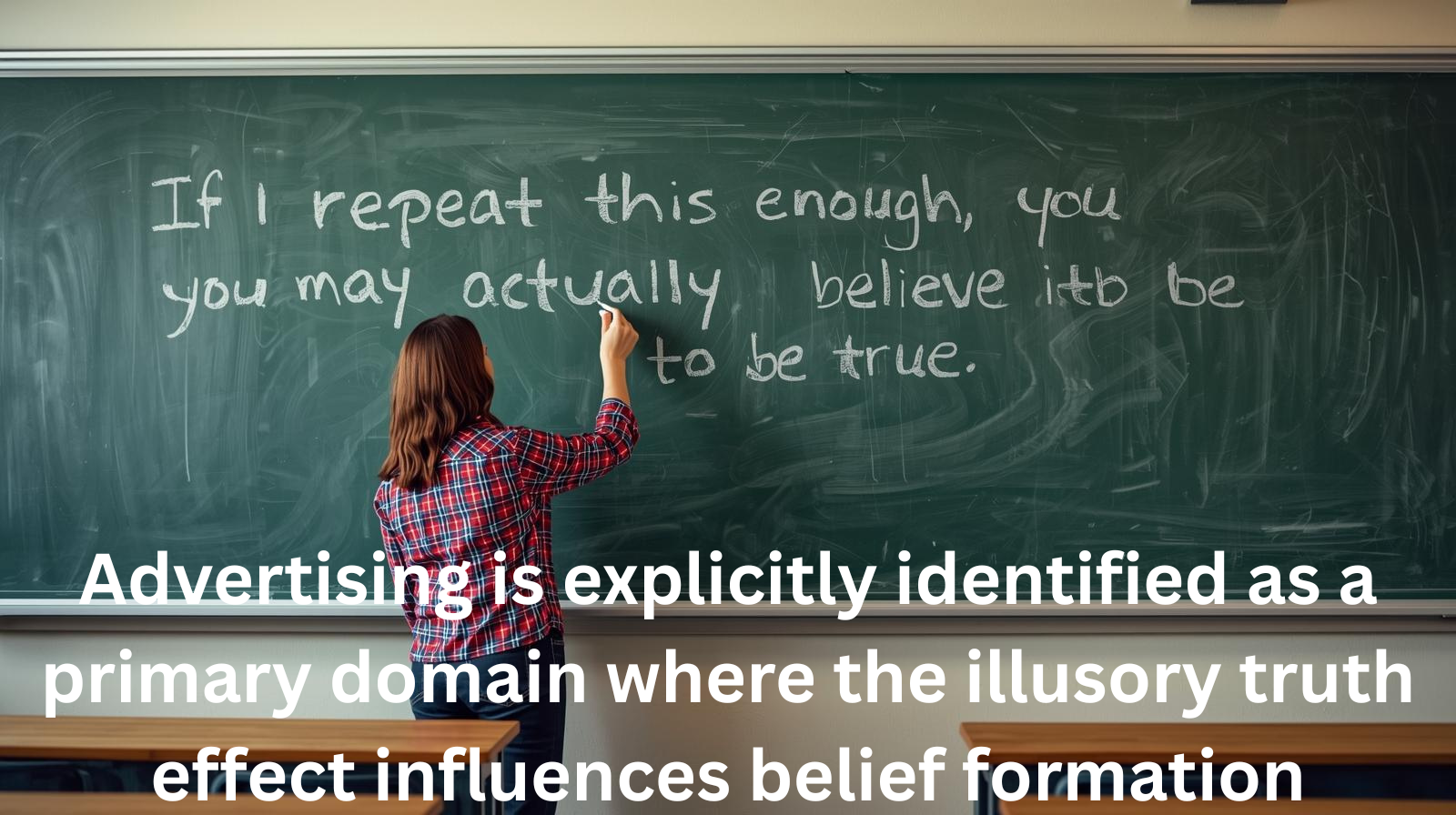
Advertising is explicitly identified as a primary domain where the illusory truth effect influences belief formation.
IV. Social Media Misinformation Patterns
These are categories of falsehoods spread widely online—not the content of the misinformation itself.
Repeated exposure to online misinformation leads users to internalize falsehoods and even form false memories.
Categories include:
- Repeated misleading claims about public events
- Repeated conspiracy narratives across multiple accounts
- Fabricated headlines circulated by different pages
- Misattributed quotes reposted widely
Britannica explains that repeated exposure to such false information leads users to remember the core message, but forget the context (including warnings or debunkings). [
V. Political Propaganda Techniques
Psychology Today documents that the illusory truth effect is actively exploited in political communication.
Categories include:
- Repeated ideological slogans
- Repeated attacks on opponents
- Narratives circulated consistently across aligned media
- Claims repeated by multiple partisan voices to create a perceived consensus
These patterns use familiarity to manipulate belief.
VI. Fake News Patterns
Britannica notes that repeated exposure to fake news stories leads audiences to accept misinformation, especially when paired with misattribution (forgetting the false origin).
Standard fake‑news formats include:
- Sensational headlines repeated across social platforms
- Fabricated “breaking news” alerts are shared frequently
- False cause-and-effect claims are repeated in many posts
Here, repetition, not evidence, drives perceived truth.
Summary Table
|
Category |
Type of Falsehood |
Why It Works |
Source |
|
Cultural Myths |
Brain‑usage myths, animal myths, health myths |
Familiarity → fluency → belief |
|
|
Experimental Trivia |
Neutral statements repeated in studies |
Repetition increases confidence ratings |
|
|
Advertising Claims |
Repeated product slogans and exaggerations |
Repetition influences consumer belief |
|
|
Social Media Patterns |
Repeated misleading or fabricated narratives |
Repetition forms false memories |
|
|
Political Propaganda |
Repeated ideological slogans/narratives |
Familiarity used to manipulate belief |
|
|
Fake News |
Repeated false headlines & stories |
People remember the message, not the false context |