Summary
An Article and Complete List of Their Scores
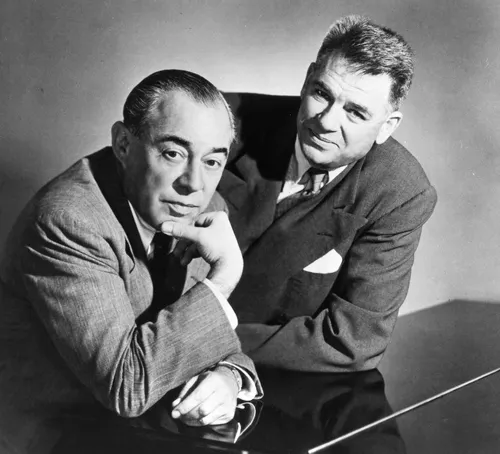
Richard Rodgers and Oscar Hammerstein II are among the most influential creative partnerships in the History of American musical theater, shaping the genre’s development and inspiring generations of composers and lyricists.
Their collaborations established a new benchmark for the genre, emphasizing narrative-driven songwriting, fully realized characters, and socially conscious themes. From rural Americana to the South Pacific during wartime to the hills of Austria, their works consistently explored issues of love, prejudice, courage, and personal transformation.
A new structural approach drove their Impact: instead of treating songs as entertainment breaks, Rodgers and Hammerstein embedded music directly into the plot’s emotional and dramatic fabric, influencing virtually every prominent musical theater composer who followed, including Stephen Sondheim, Andrew Lloyd Webber, and Lin-Manuel Miranda.
Their legacy extends beyond Broadway. Their film adaptations became cultural institutions, their cast albums broke sales records, and their catalog continues to be performed worldwide, from community theaters to major revivals. Collectively, their works garnered dozens of awards, including Pulitzer Prizes, Tony Awards, and Academy Awards.
Though Hammerstein passed away in 1960 and Rodgers in 1979, the Rodgers & Hammerstein estate continues to license their works, ensuring new generations experience the musicals that helped define American storytelling through song. Their influence remains unmatched — not only for their artistic achievements but also for their belief that musical theater could explore profound human truths while still captivating large audiences.
Major Rodgers & Hammerstein Stage Scores
Below is a list of their principal collaborative works, including Broadway openings:
1. Oklahoma! (1943)
Their groundbreaking first collaboration, titled initially Away We Go! before its out‑of‑town shift.
2. Carousel (1945)
A darker, emotionally complex musical based on Ferenc Molnár’s Liliom.
3. Allegro (1947)
An experimental, concept-driven show — one of the earliest examples of a “meta‑musical.”
4. South Pacific (1949)
Winner of the Pulitzer Prize for Drama; known for its candid confrontation of racial prejudice.
5. The King and I (1951)
A study of cultural collision, based on Margaret Landon’s Anna and the King of Siam.
6. Me and Juliet (1953)
A backstage musical exploring life inside the theater.
7. Pipe Dream (1955)
Based on John Steinbeck’s Sweet Thursday.
8. Cinderella (1957, written for television)
Their only musical was written first for TV and later adapted for the stage.
9. Flower Drum Song (1958)
Explores Chinese-American identity in San Francisco.
10. The Sound of Music (1959)
Their final-stage collaboration is enormously influential and endlessly revisited.
Film Scores and Adaptations
Original Film Projects
- State Fair (1945) — Their only musical written directly for film (later adapted for the stage).
Major Film Adaptations of Their Stage Works
- Oklahoma! (1955)
- Carousel (1956)
- The King and I (1956)
- South Pacific (1958)
- Flower Drum Song (1961)
- The Sound of Music (1965)
- Cinderella (1957, 1965, 1997 television versions)
Summary
Stage Musicals
- Oklahoma!
- Carousel
- Allegro
- South Pacific
- The King and I
- Me and Juliet
- Pipe Dream
- Cinderella
- Flower Drum Song
- The Sound of Music
Film/TV
- State Fair (film)
- Cinderella (TV)