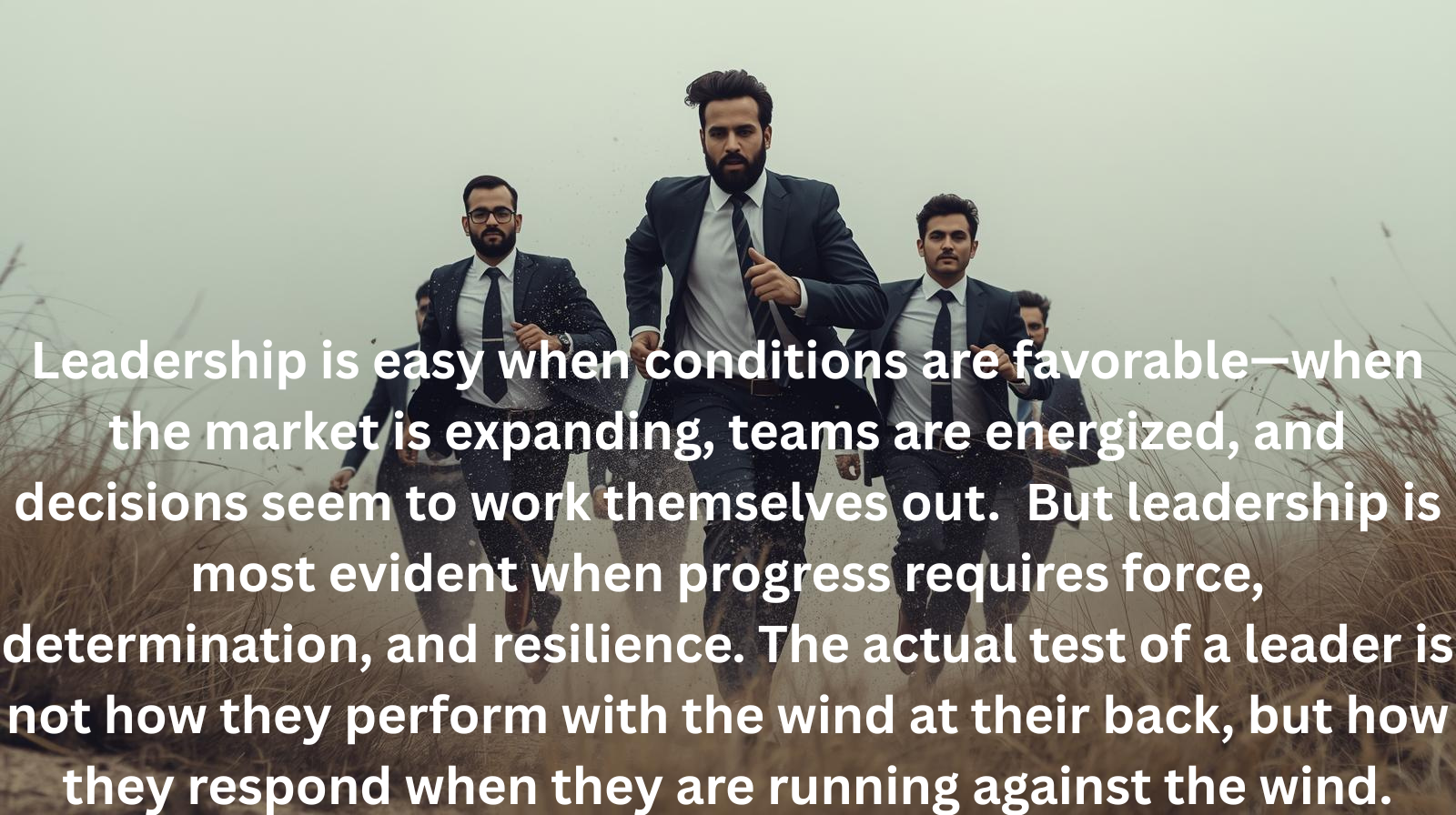
Leadership is easy when conditions are favorable—when the market is expanding, teams are energized, and decisions seem to work themselves out. But leadership is most evident when progress requires force, determination, and resilience. The actual test of a leader is not how they perform with the wind at their back, but how they respond when they are running against the wind.
Recognize that adversity is not an interruption to leadership; it is leadership itself, inspiring the audience to see challenges as opportunities to demonstrate resilience and purpose.
Headwinds Expose Real Leadership Capacity
When conditions shift—economically, organizationally, or operationally—leaders feel the drag immediately. Targets become harder to hit. Talent becomes harder to retain. Strategies that once produced predictable results now yield friction.
These headwinds do something invaluable:
They separate leadership from position.
- Titles do not generate momentum.
- Authority does not eliminate resistance.
- Hierarchies do not create clarity in uncertainty.
When the environment pushes back, leaders can develop resilience by practicing adaptive communication and steady decision-making, ensuring progress despite headwinds.
Resistance Sharpens Decision-Making
Running into a headwind forces leaders to question everything they believed was “essential.” What once seemed urgent suddenly falls away. What once seemed strategic becomes revealed as merely comfortable.
Effective leaders respond to resistance by:
1. Tightening Focus
A headwind forces a ruthless prioritization mindset. Non-essential initiatives fade; core mission rises.
2. Accelerating Learning
When assumptions fail, experimentation becomes a necessity, not a luxury. Leaders who stay curious—not defensive—find solutions faster.
3. Making Decisions with Imperfect Information
In adversity, clarity rarely comes first. Leaders must make forward-moving decisions even when the picture is incomplete.
4. Communicating More, Not Less
Uncertainty creates a narrative vacuum. Strong leaders fill it early and often—with honesty, direction, and steadiness.
The Psychology of Leadership Under Pressure
Resistance affects teams emotionally long before it affects them operationally. Doubt spreads quickly. People watch leadership body language more closely when conditions worsen.
A leader running confidently against the wind models:
- Composure under pressure
- Optimism grounded in reality
- Consistency of message and behavior
- Visible personal discipline
Employees can spot fear, indecision, and confusion without a single word being spoken. Likewise, they can immediately feel a sense of conviction and steadiness. Leadership psychology sets the emotional temperature for the entire organization.
Momentum is More Important Than Speed
During challenging periods, leaders often feel inadequate because progress slows. But a leader’s responsibility is not always to accelerate—it is to ensure forward motion.
Even little progress:
- Builds team confidence
- Reinforces belief in the strategy
- Prevents organizational paralysis
- Creates a compounding advantage over competitors who stall
A leader running into the wind knows the truth:
Survival through resistance positions the team for future dominance, encouraging patience and strategic focus during tough times.
Leading Through Headwinds Creates Durable Strength
When adversity eventually lifts—and it always does—leaders and teams that endured the headwind carry new capabilities:
- Lean systems
- Sharper strategy
- Greater trust
- Higher tolerance for ambiguity
- Unshakeable team cohesion
These qualities cannot be purchased or trained in calm conditions. They are forged.
Many organizations realize their long-term competitive advantage only after the storm has passed and they look back on what they were forced to become.
When the Wind Shifts, Leaders Who Endured Accelerate
Every challenging cycle eventually turns. Markets recover. Operational tensions ease. Teams renew. The same external forces that once hindered progress begin to support it.
And that is when leaders who keep running gain extraordinary acceleration.
Not because they ran fastest—but because they never stopped running at all.
In leadership, advantage is not created by the wind.
The response creates it.