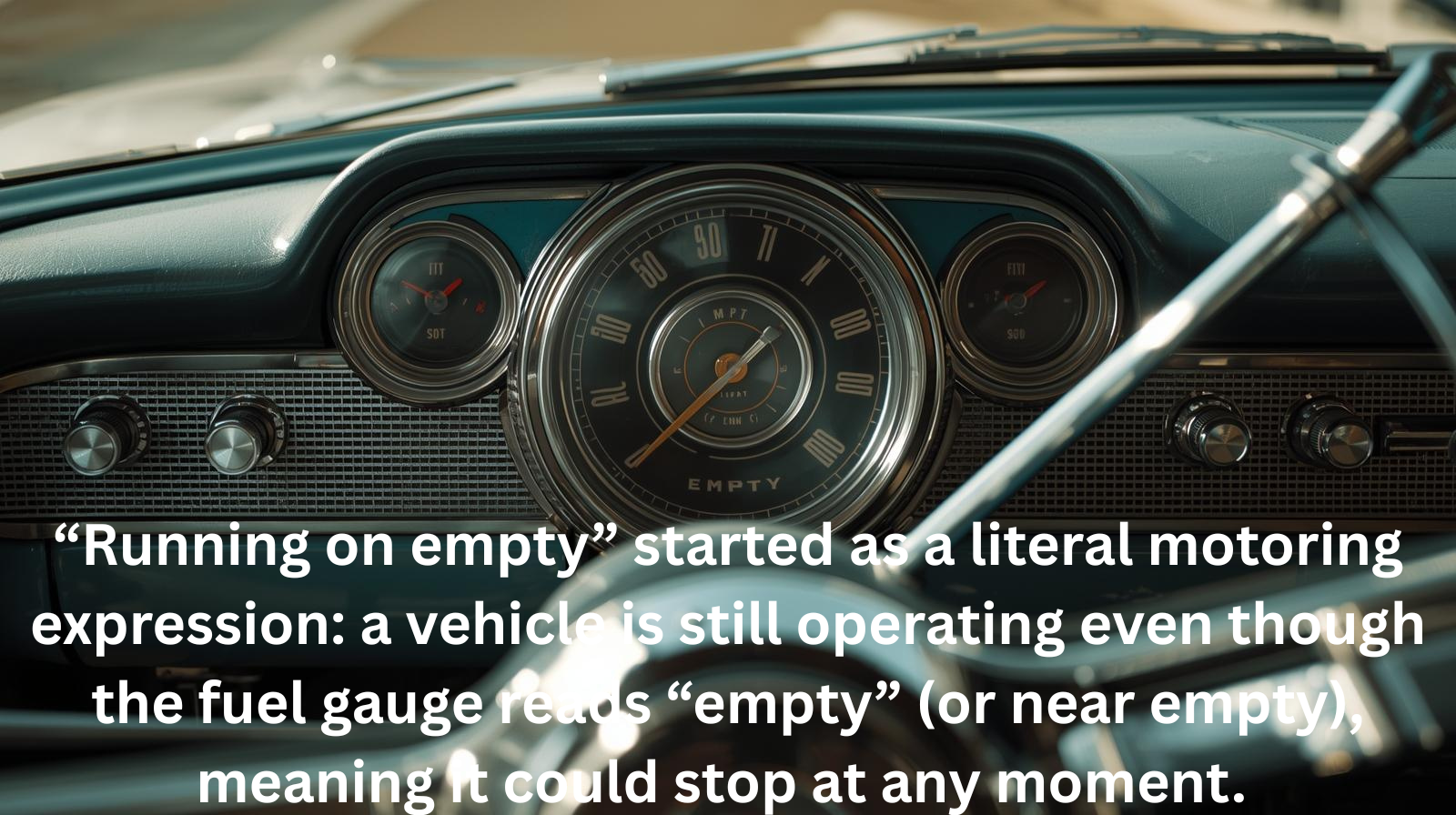
1) Literal root: the fuel-gauge image
In its most direct sense, the phrase refers to an engine or vehicle that has almost no fuel left.
That concrete picture—needle hovering at E while the car is still moving—creates the central metaphor.
2) How it became an idiom (figurative meaning)
From that automotive scenario, the phrase extended to express feelings of exhaustion, depletion, or low morale, resonating with personal and organizational struggles.
Dictionaries and idiom references explicitly frame it as a metaphorical “low fuel” condition—operating close to breakdown without replenishment.
3) When it entered common usage (timeframe)
Multiple idiom references describe it as a 20th-century Americanism, commonly placed in the second half of the 1900s.
4) What boosted its popularity: Jackson Browne (1978)
While the metaphor makes intuitive sense on its own, many sources note that the phrase gained broader currency through Jackson Browne’s hit “Runnin’ on Empty” (1978), which helped cement the expression in everyday language.
In one sentence
“Running on empty” derives from the image of a car nearly out of gas and has since evolved into an idiom for pushing on with depleted resources, with major popularization in the late 1970s through Jackson Browne’s song.
Examples (literal vs. figurative)
- Literal: “The engine was running on empty—find a gas station.”
- Figurative: “After weeks of deadlines, the team is running on empty.”
1) Stage One: Literal motoring phrase (mid-late 20th century)
At its core, “running on empty” begins as a plainspoken driving image: a vehicle continues to operate even though the fuel gauge is at “empty” (or near it), implying you’re close to stalling.
Even modern dictionary definitions retain this literal sense (“engine or vehicle having almost no fuel left”), indicating that the phrase’s anchor has never disappeared.
What’s happening linguistically: this is a concrete source domain (fuel/engine) that’s easy to visualize and emotionally “portable.”
2) Stage Two: Early figurative leap—resources beyond gasoline
From the driving context, the phrase quickly broadened into an idiom meaning operating with dangerously low reserves—not just fuel, but energy, money, morale, or capacity.
Idiom references explicitly characterize it as a 20th-century Americanism, often dated to the second half of the 1900s, which aligns with the era when car culture and fuel gauges became everyday experiences for a mass population.
Key semantic shift: the “tank” becomes a generalized metaphor for any finite reserve (stamina, cash, patience, ideas).
3) Stage Three: Pop-culture acceleration—Jackson Browne (late 1970s)
Video:
https://www.youtube.com/watch?v=IKnnh8VDULs
https://www.youtube.com/watch?v=zdHg4QEmBvk
While the metaphor works without pop culture, multiple sources note the phrase gained major currency through Jackson Browne’s “Running on Empty”—recorded/issued around 1977–1978 and a notable hit.
Music journalism recounts Browne describing a literal inspiration—driving around with very little gas—then turning that into a broader statement about life on the road and depletion.
Cultural effect: after a widely heard song, an expression often becomes quotable shorthand, easier to reuse outside its original context.
4) Stage Four: Broadening into distinct “tracks” of meaning (late 20th century → today)
Over time, “running on empty” settled into a few common figurative lanes. These aren’t separate definitions so much as stable, repeated usage patterns.
A) The burnout/exhaustion lane (people)
Many dictionaries now define (or illustrate) it as continuing to work or function with almost no personal energy left—a near-synonym to being depleted, drained, or at the end of your rope.
Cambridge’s phrasing is especially clear: “to continue to work and be active when you have no energy left.”
Modern leadership/wellbeing writing uses “running on empty” as an accessible label for overwork, overwhelm, and burnout dynamics, thereby reinforcing the phrase in workplace and self-care contexts.
B) The money/capacity lane (organizations)
The phrase also evolved into a way to describe organizations or projects with diminishing resources (financial, personnel, momentum).
Even Cambridge includes institutional examples (e.g., budgets/treasuries) that show “empty” mapping neatly onto financial reserves.
C) The ideas/innovation lane (“running out of new ideas”)
A particularly interesting development: “running on empty” can mean not just low energy, but creative exhaustion—an individual or organization has no new ideas or is less effective than before.
This meaning is explicitly captured in Cambridge’s “mainly US and Australian English” note: a person/organization “has no new ideas or is not as effective as they were before.”
Why this happened: once “fuel” becomes “resources,” it’s natural for “resources” to include creative novelty and strategic imagination, not just time or money.
5) What’s changed (and what hasn’t)
What hasn’t changed
- The phrase still implies continued motion despite impending failure—the sense of “you can keep going, but not for long.” The automotive imagery remains the metaphor’s intuitive “engine.”
What has changed (expanded)
- Scope: from cars → humans → organizations, budgets, campaigns, and systems.
- Type of “fuel”: from gasoline → energy, money, morale, ideas, effectiveness.
- Today,” running on empty” powerfully captures feelings of burnout and overwhelm, helping readers feel understood in their modern life and work struggles.
6) How people use it today (practical nuance)
If you want the phrase to land precisely, match it to the lane:
- Personal depletion: “I’m running on empty” (suggests fatigue + still pushing).
- Organizational strain: “The team/project is running on empty” (resources/morale).
- Stale performance/ideas: “The organization is running on empty” (no new ideas; less effective).