Summary
California’s Housing crisis often delays projects due to complex procedures. By leaning into SB-4’s ‘Not a project’ status, Free Sacred Trinity Church (FSTC) can feel more confident and in control of a faster path forward.
SB-4: The Three Words That Change Everything for Faith-Based Housing Developer Must Confront
Why SB-4’s “Not a Project” Status Gives Free Sacred Trinity Church a Stronger Hand
California’s Housing crisis often delays projects due to complex procedures. By leaning into SB-4’s ‘Not a project’ status, Free Sacred Trinity Church (FSTC) can feel more confident and in control of a faster path forward.
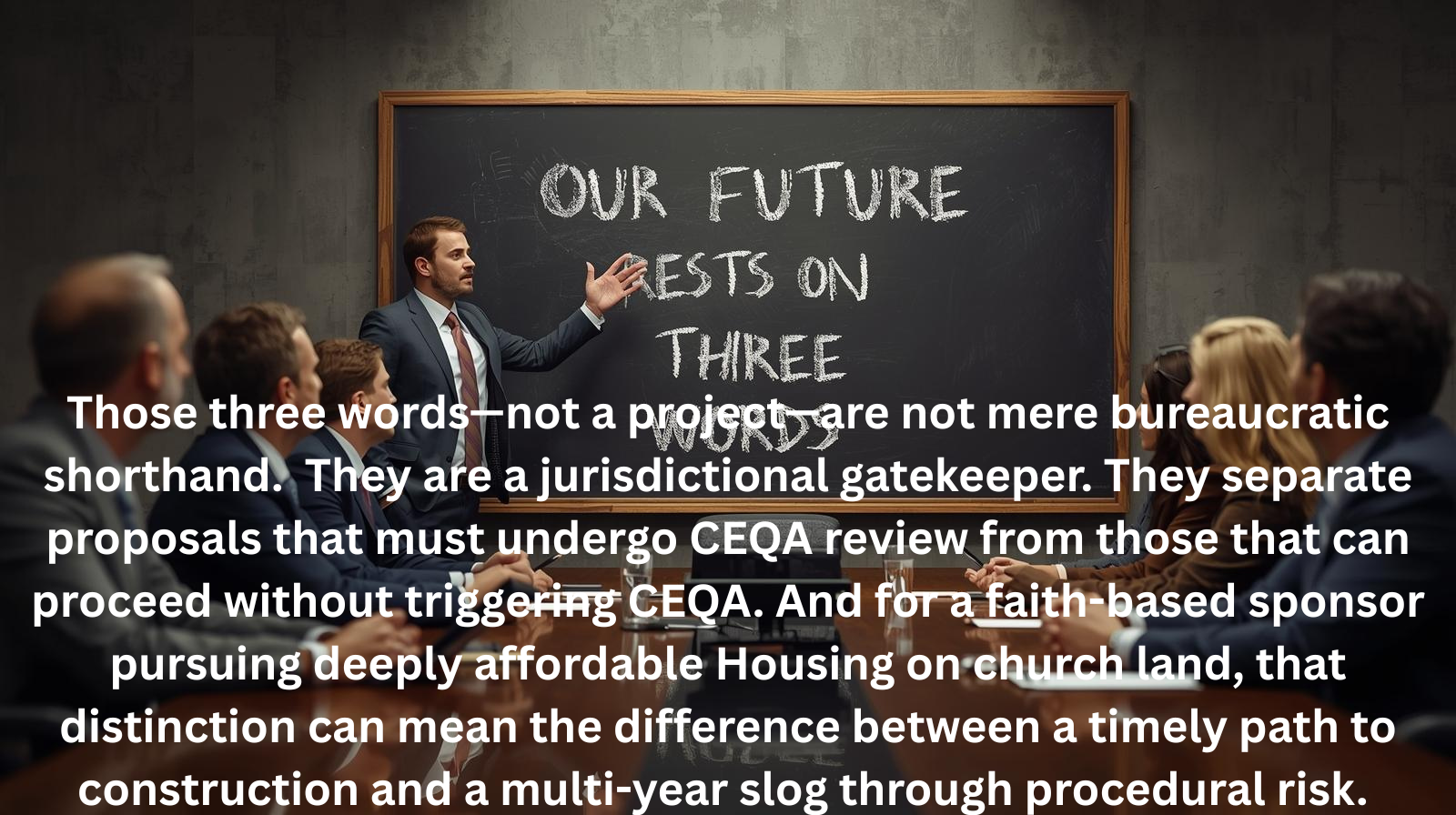
Those three words—not a project—are not mere bureaucratic shorthand. They are a jurisdictional gatekeeper. They separate proposals that must undergo CEQA review from those that can proceed without triggering CEQA. And for a faith-based sponsor pursuing deeply affordable Housing on church land, that distinction can mean the difference between a timely path to construction and a multi-year slog through procedural risk.
What SANDAG Quietly Clarified—And Why FSTC Should Amplify It
SANDAG’s Housing Processing Comparison Chart (April 2024) shows regional backing, helping FSTC feel supported and aligned with broader Housing efforts.
But in the CEQA column, SB-4 is uniquely described: “Not a project for purposes of CEQA.” Most other Housing streamlining entries are labeled “Exempt” or “Not Exempt,” which are fundamentally different categories.
This is the key advocacy message for FSTC:
SB 4 is not just an exemption strategy. It is a CEQA non-applicability strategy—an “outside-CEQA” lane, not a special carve-out inside it.
CEQA’s First Question: Is It Even a “Project”?
CEQA does not apply to everything. It applies when a public agency proposes to carry out or approve an activity that meets CEQA’s definition of a “project,” generally an action with potential for direct or reasonably foreseeable indirect physical change, tied to agency undertaking, funding, or discretionary approvals.
CEQA’s Guidelines make that “project” definition the threshold gate. If an activity is not a project, CEQA procedures—initial studies, EIR debates, and exemption filings—do not even begin.
Understanding that ‘Not a project’ is categorically different from ‘exempt’ helps FSTC feel more assured and strategic, reducing uncertainty about their process.
“Exempt” vs. “Not a Project”: The Difference That Shapes Risk
Most Housing streamlining statutes reduce discretion or accelerate timelines. However, they typically still operate in a world where the proposal is treated as a CEQA project, and the proponent or agency relies on an exemption determination.
An “exempt” project is still a CEQA project. It is simply a project the agency believes falls within a statutory or categorical exemption category, documented under CEQA procedures.
By contrast, “not a project” means CEQA does not attach at all—because the underlying approval is treated as outside CEQA’s project definition or expressly treated as such for CEQA purposes in the applicable statute.
Shareable quote for FSTC’s messaging:
“An exemption is a shield inside CEQA. ‘Not a project’ is the argument that CEQA never enters the room.”
This framing is exactly how FSTC should position its entitlement posture: not as a party seeking a favorable CEQA ruling, but as a party relying on a legislative pathway where CEQA review is not triggered.
SB-4 Was Built for Sites Like FSTC’s
SB 4—described in practitioner summaries as the Affordable Housing on Faith and Higher Education Lands Act of 2023—creates a streamlined approval lane for qualifying affordable Housing on land owned by religious institutions or eligible higher education institutions as of a specified date, if the proposal satisfies objective criteria and affordability requirements.
SANDAG’s chart summarizes the SB 4 lane as:
- Ministerial processing (a major procedural shift away from discretionary review) [
- A CEQA status of “Not a project for purposes of CEQA.”
- Strong affordability requirements (with limited, specified flexibility)
- Defined processing timelines and expectations for local jurisdictions [
For FSTC, this is not just a compliance box to check. It aligns with local government priorities for streamlined approvals, demonstrating that the project supports statewide Housing policy, is designed for church sites, and benefits from a faster legislative approval lane, which can ease concerns about oversight and control.
Paperwork and Process: Why “Not a Project” Is Cleaner Than “Exempt”
In CEQA practice, exemptions often still require documentation to protect the approval. The CEQA Guidelines describe a Notice of Exemption (NOE)—a filing that may be used when an agency finds a project exempt, including project description, location, exemption citation, and reasons. [
And the timelines matter. CEQA provides unusually short statutes of limitation when notices are properly filed—35 days after filing a Notice of Exemption is a commonly cited trigger under the CEQA Guidelines’ limitations discussion.
Here is the advocacy-forward point for FSTC:
If your strategy depends on an exemption, you are still fighting on CEQA turf—filing notices, managing posting requirements, and defending the exemption theory.
But if SB 4 places your approval in the “not a project” territory, the CEQA procedural framework is not the core battleground.
Translation for non-lawyers:
- Exempt = “We’re inside CEQA, but we qualify for a carve-out.”
- Not a project = “CEQA doesn’t apply to this approval pathway.”
That difference is why your original conclusion is persuasive: FSTC’s posture is stronger when it can truthfully claim CEQA non-applicability rather than merely an exemption.
How FSTC Should Use This Advantage (Without Overreaching)
A sophisticated advocacy strategy does two things at once: it makes a clear claim, and it shows disciplined respect for the remaining rules.
1) Make eligibility the headline
SB-4’s benefits are triggered by compliance with SB 4’s objective criteria, which means FSTC’s first job is to build an application record that reads like a checklist: ownership timing, site constraints, and affordability commitments presented with precision.
Advocacy line:
“We are not asking for special treatment; we are submitting a fully qualifying SB 4 application that the Legislature directed to be processed in a streamlined, ministerial manner.”
2) Quote SANDAG’s chart—because agencies already trust it
The SANDAG chart is designed as an agency reference tool. FSTC can responsibly cite the SB-4 line to reduce confusion and prevent inadvertent drift into CEQA-based processing habits.
3) Separate CEQA from other legitimate reviews
Even if CEQA is not triggered, SB-4 is still a structured process with objective standards, timelines, and requirements. FSTC should be explicit: “No CEQA” does not mean “no standards.”
This approach strengthens credibility and defuses the most common political critique—that streamlining equals “no oversight.”
The Strongest Closing Argument for a Faith-Based Sponsor
FSTC’s most compelling position is values-based and procedural:
· The project serves an urgent public need—deeply affordable Housing—on land that is uniquely suited for community-serving use. The Legislature created SB 4 specifically to unlock this category of sites through streamlined approval.
· Regional processing guidance recognizes SB 4’s special procedural posture: “Not a project for purposes of CEQA.”
“For FSTC, SB 4 is more than a Housing statute—it’s a permission structure. It turns church land into a Housing opportunity, and it does so by moving the approval out of CEQA’s shadow and into a defined, ministerial lane.”