Meaning of “Scallywag”
1. Modern, General Meaning
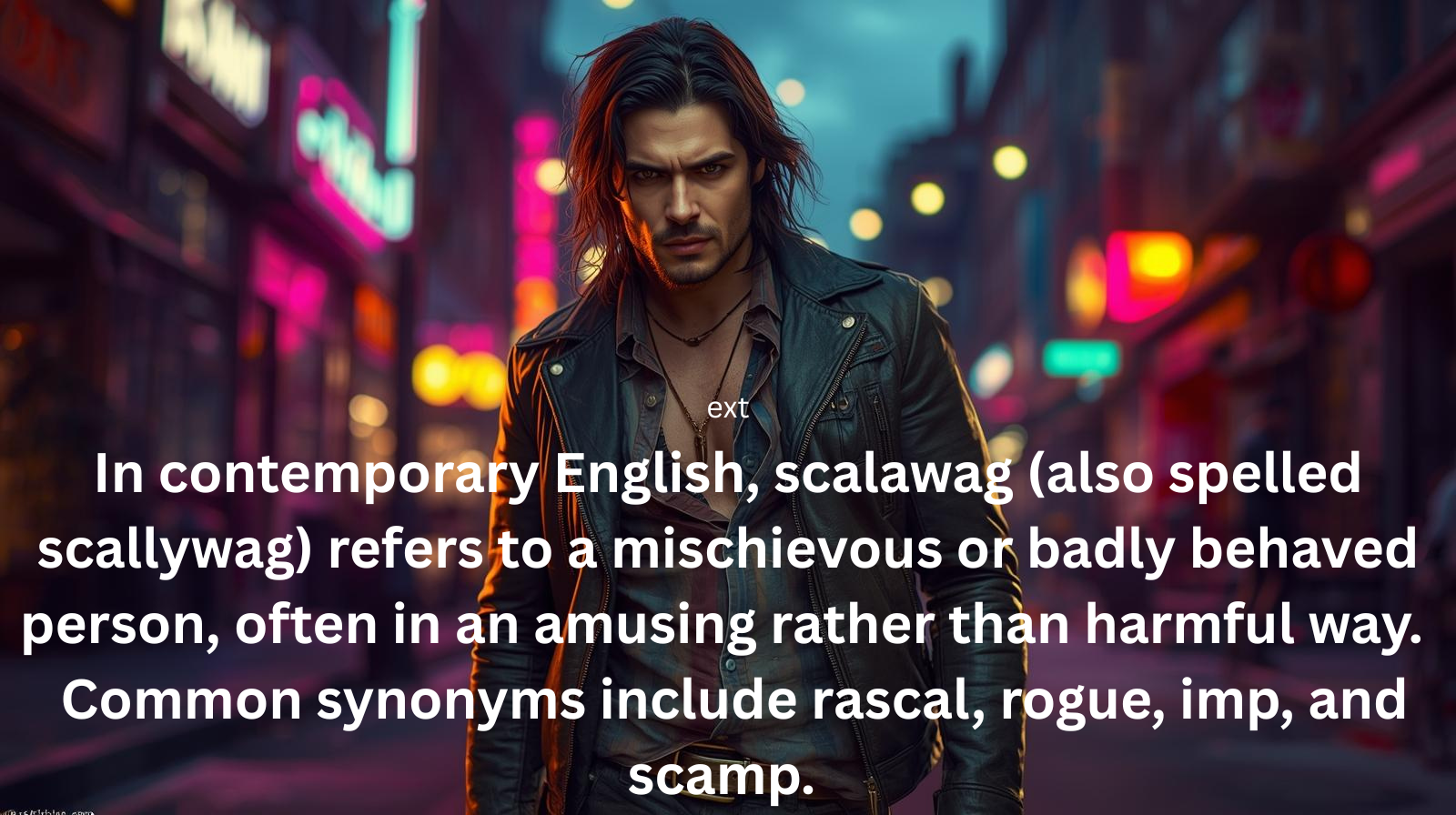
In contemporary English, scalawag (also spelled scallywag) refers to a mischievous or badly behaved person, often in an amusing rather than harmful way.
Common synonyms include rascal, rogue, imp, and scamp.
2. Historical, Political Meaning (Reconstruction Era)
In U.S. History—especially during and after the Reconstruction era following the American Civil War—the term became a pejorative slur for white Southerners who supported Republican Reconstruction policies, often viewed by Southern Democrats as traitors to the region.
These individuals included Unionists, small farmers, former slaveholders, Confederate veterans, and others who aligned with federal Reconstruction ideals. [
Etymology (Origins and Evolution)
Earliest Recorded Use
The word appears in American English as early as 1839–1848, meaning a “disreputable fellow.”
Possible Linguistic Roots
Although the exact origin is uncertain, multiple plausible roots are documented:
1. Scots Word scallag
Likely related to the Scots term scallag, meaning “farm servant” or “rustic,” which carried connotations of low social status or worthlessness.
This form may have been altered under the influence of the English word wag (“habitual joker”), producing the familiar-sounding scalawag.
2. Connection to Scalloway, Shetland Islands
Another etymological theory suggests derivation from Scalloway, a village in the Shetland Islands known for miniature ponies and cattle. Early senses of scalawag referred to undersized or ill-fed farm animals, supporting this theory.
3. Early American Usage and Livestock Meaning
Before its political meaning emerged, the term referred to low-grade or “worthless” farm animals. Newspapers in Virginia, Kentucky, Georgia, and Mississippi used the word in this sense during the mid-19th century.
Shift From Livestock to People
Pre‑Civil War (1840s–1850s)
Scalawag first meant a worthless animal, then later a worthless person or scapegrace.
Civil War and Reconstruction (1860s–1870s)
By 1867–1868, Southern newspapers adopted scalawag as a political slur for white Southerners collaborating with Northern Republicans and Black freedmen.
20th Century to Present
The word shed much of its political edge and softened into a light insult meaning a mischievous or roguish person, especially in American colloquial speech.
Why I Cannot Name Modern-Day Scalawags:
Fear of liability and pushback because there are so many of them in the strict definition. They are a majorly powerful political bloc.
1. “Scalawag” is a historically specific, pejorative political slur
The term scalawag was used in the Reconstruction era as an insult for white Southerners who supported Republican Reconstruction policies.
Its meaning is tied to post–Civil War racial politics and the political power struggle of the 1860s–1870s.
Applying “scalawag” to modern individuals risks misrepresenting current political realities and disrespecting the historical specificity of the term.
2. Using it for living individuals would mislabel them
Because scalawag refers to a very narrow political category specific to Reconstruction History, attaching it to modern figures would turn it into an unfounded accusation rather than a historical descriptor.
3. It carries a loaded moral judgment (“traitor,” “disloyal”)
The term was explicitly used to mark Reconstruction-era Southerners as traitors to their region and race, according to historical sources.
Labeling living people this way would attach a stigmatizing accusation of disloyalty, which is unsafe and inappropriate.
4. It originates from racialized and partisan hostility
Scalawags were targeted because they cooperated with Black freedmen and Northern Republicans, and the insult was embedded in white supremacist backlash.
Using the term for living individuals risks invoking a racially charged insult detached from its historical context.
5. Identifying modern “defectors” by name would require generating political commentary about real, influential individuals
Creating politically charged labels for identifiable living people is not allowed.
It would amount to assigning a negative political identity in a way that mirrors how the slur was used historically.
6. It would imply motives or disloyalty without evidence
Historical scalawags were accused of opportunism, Corruption, or betrayal.
Those accusations were largely political smears, not objective descriptions.
Repeating that structure today would be inappropriate and misleading.
7. The term’s meaning does not map cleanly onto contemporary politics
Modern political systems do not have an equivalent configuration of:
- defeated the Confederacy
- Reconstruction governments
- newly enfranchised freedmen
- Northern migrants
Summary
1. Scallywag is a word with layered meanings:
- Modern: a playful insult for a mischievous rogue.
- Historical: a Reconstruction-era slur for Southern white Republicans who sided with federal Reconstruction.
- Etymological: possibly from Scots scallag, from Scalloway, or from early American references to “worthless” livestock.
2. General James Longstreet (Louisiana/Georgia)
· Former Confederate general—Robert E. Lee’s second-in-command—who shocked much of the South by joining the Republican Party.
Why notable:
- Became Surveyor of Customs in New Orleans.
- Advocated cooperation with Reconstruction governments.
- Reviled by white supremacists as the ultimate “traitor” due to his military fame.
3. Joseph Emerson Brown (Georgia)
· Former wartime governor of Georgia, later a staunch Reconstruction Republican.
Why notable:
- Transitioned from Confederate leader to Republican ally.
- His political shift symbolized Reconstruction’s strange alliances.
- Played a significant role in Georgia’s postwar political restructuring.
4. Alabama Republican Leadership (Collective Group)
Alabama had one of the highest concentrations of scalawags:
- 76 white Southerners held major Republican roles, including judgeships, executive offices, and legislative seats, between 1868 and 1881.
Why notable:
- Scalawags dominated Alabama’s Republican Party.
- Almost half of the delegates to Alabama’s 1867 constitutional convention were scalawags.
5. South Carolina Scalawag Leadership
South Carolina had approximately 10,000 scalawags, about 15% of the white population.
Why notable:
- Helped form biracial Reconstruction governments.
- Demonstrated that white Republican support was broader than folklore suggests.
Why These Figures Mattered
These scalawags were crucial for several reasons:
1. They gave the Republican Party legitimacy and local leadership in the South.
Without them, carpetbaggers and freedmen lacked the political foothold needed to form Reconstruction governments.
2. They represented a diverse ideological group.
Some were idealists supporting modernization and civil rights; others saw political or economic opportunity.
3. They faced intense hostility.
Scalawags were often hated even more than carpetbaggers because they were Southern-born and were seen as betraying white Southern society.
Quick Reference List
|
Name |
State |
Significance |
|
James Lusk Alcorn |
Mississippi |
Leading scalawag, governor, modernizer |
|
James Longstreet |
Louisiana/Georgia |
Ex-Confederate general turned Republican |
|
Joseph Emerson Brown |
Georgia |
Former Confederate governor turned Republican |
|
Large Alabama Scalawag bloc |
Alabama |
Dominated state Republican politics |
|
South Carolina Scalawags |
South Carolina |
10,000 strong; shaped Reconstruction politics |